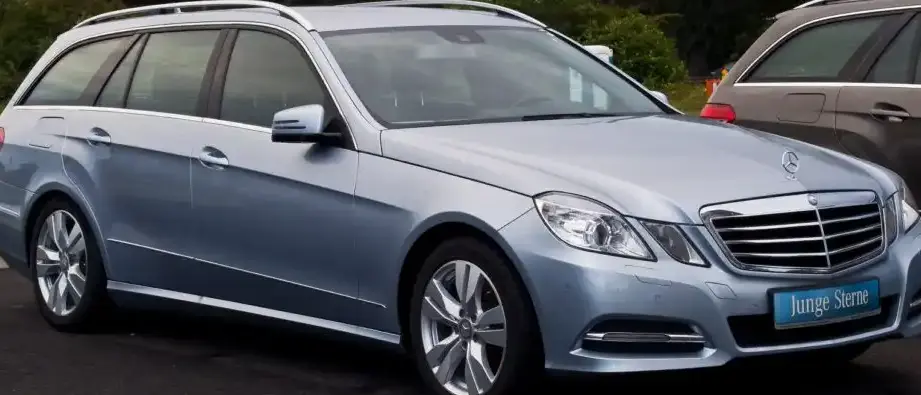
The Mercedes-Benz E 300 BlueTEC Hybrid (S212) was a short-lived but significant variant of the fifth-generation E-Class T-modell (station wagon), produced from July 2012 to January 2013. Representing Mercedes-Benz’s foray into diesel-electric hybrid technology within the executive wagon segment, this model aimed to combine the practicality of a spacious estate car with improved fuel efficiency and reduced emissions. It sat within the S212 series, utilizing the 1HX0 platform, and offered a unique powertrain option compared to the more common petrol and diesel-only E-Class models. This variant was primarily marketed in Europe, where demand for diesel engines and fuel-efficient vehicles was particularly strong.
Technical Specifications
| Brand | Mercedes-Benz |
| Model | E-class |
| Generation | E-class T-modell (S212) |
| Type | E 300 BlueTEC Hybrid (204 Hp) 7G-TRONIC PLUS |
| Start of production | July, 2012 |
| End of production | January, 2013 |
| Powertrain Architecture | FHEV (Full Hybrid Electric Vehicle) |
| Body type | Station wagon (estate) |
| Seats | 5 |
| Doors | 5 |
| Fuel consumption (urban) | 4.5 l/100 km (52.3 US mpg, 62.8 UK mpg, 22.2 km/l) |
| Fuel consumption (extra urban) | 4.4-4.6 l/100 km (53.5 – 51.1 US mpg, 64.2 – 61.4 UK mpg, 22.7 – 21.7 km/l) |
| Fuel consumption (combined) | 4.4-4.5 l/100 km (53.5 – 52.3 US mpg, 64.2 – 62.8 UK mpg, 22.7 – 22.2 km/l) |
| CO2 emissions | 116-119 g/km |
| Fuel Type | Diesel |
| Acceleration 0 – 100 km/h | 7.8 sec |
| Acceleration 0 – 62 mph | 7.8 sec |
| Acceleration 0 – 60 mph | 7.4 sec |
| Maximum speed | 232 km/h (144.16 mph) |
| Emission standard | Euro 5 |
| Weight-to-power ratio | 9.2 kg/Hp, 108.5 Hp/tonne |
| Weight-to-torque ratio | 3.8 kg/Nm, 266 Nm/tonne |
| Gross battery capacity | 0.8 kWh |
| Battery technology | Lithium-ion (Li-Ion) |
| Battery location | Under the front hood |
| Max speed (electric) | 35 km/h (21.75 mph) |
| Electric motor power | 27 Hp @ 1000 rpm |
| Electric motor Torque | 250 Nm (184.39 lb.-ft.) |
| Electric motor location | Between the combustion engine and the transmission |
| Engine Power | 204 Hp @ 4200 rpm |
| Power per litre | 95.2 Hp/l |
| Engine Torque | 500 Nm @ 1600-1800 rpm (368.78 lb.-ft. @ 1600-1800 rpm) |
| Engine layout | Front, Longitudinal |
| Engine Model/Code | OM 651.924 |
| Engine displacement | 2143 cm3 (130.77 cu. in.) |
| Number of cylinders | 4 |
| Engine configuration | Inline |
| Cylinder Bore | 83 mm (3.27 in.) |
| Piston Stroke | 99 mm (3.9 in.) |
| Compression ratio | 16.2:1 |
| Number of valves per cylinder | 4 |
| Fuel injection system | Diesel Commonrail |
| Engine aspiration | BiTurbo, Intercooler |
| Valvetrain | DOHC |
| Engine oil capacity | 6.5 l (6.87 US qt | 5.72 UK qt) |
| Coolant | 11.3 l (11.94 US qt | 9.94 UK qt) |
| Kerb Weight | 1880 kg (4144.69 lbs.) |
| Max. weight | 2555 kg (5632.81 lbs.) |
| Max load | 675 kg (1488.12 lbs.) |
| Trunk (boot) space – minimum | 695 l (24.54 cu. ft.) |
| Trunk (boot) space – maximum | 1950 l (68.86 cu. ft.) |
| Fuel tank capacity | 59 l (15.59 US gal | 12.98 UK gal) |
| Max. roof load | 100 kg (220.46 lbs.) |
| Permitted trailer load with brakes (12%) | 2100 kg (4629.71 lbs.) |
| Permitted trailer load without brakes | 750 kg (1653.47 lbs.) |
| Permitted towbar download | 84 kg (185.19 lbs.) |
| Length | 4895 mm (192.72 in.) |
| Width | 1854 mm (72.99 in.) |
| Width including mirrors | 2071 mm (81.54 in.) |
| Height | 1515 mm (59.65 in.) |
| Wheelbase | 2874 mm (113.15 in.) |
| Front track | 1583 mm (62.32 in.) |
| Rear track | 1604 mm (63.15 in.) |
| Front overhang | 841 mm (33.11 in.) |
| Rear overhang | 1180 mm (46.46 in.) |
| Drag coefficient (Cd) | 0.29 |
| Minimum turning circle | 11.25 m (36.91 ft.) |
| Drivetrain Architecture | Rear wheel drive. FHEV. ICE and electric motor drive rear wheels. |
| Drive wheel | Rear wheel drive |
| Number of gears | 7 |
| Gearbox type | Automatic transmission G-TRONIC PLUS |
| Front suspension | Coil spring, Independent multi-link, Transverse stabilizer, Air Suspension (Optional) |
| Rear suspension | Independent multi-link, Air suspension, Transverse stabilizer |
| Front brakes | Ventilated discs, 322 mm |
| Rear brakes | Ventilated discs, 300 mm |
| Assisting systems | ABS (Anti-lock braking system) |
| Steering type | Steering rack and pinion |
| Power steering | Electric |
| Tires size | 225/55 R16 |
| Wheel rims size | 7.5J x 16 |
Powertrain & Engine Architecture
The E 300 BlueTEC Hybrid employed a sophisticated full hybrid system. The core of the powertrain was the OM 651.924 2.1-liter inline-four cylinder diesel engine. This engine, a mainstay in many Mercedes-Benz models, featured common-rail direct injection and a bi-turbocharger setup, delivering 204 horsepower at 4200 rpm and a substantial 500 Nm (368.78 lb-ft) of torque between 1600-1800 rpm. The high compression ratio of 16.2:1 was typical for diesel engines, maximizing efficiency. Sandwiched between the engine and the 7G-TRONIC PLUS seven-speed automatic transmission was a 27 hp electric motor. This motor drew power from a 0.8 kWh lithium-ion battery pack located under the front hood. The hybrid system allowed for electric-only driving at low speeds (up to 35 km/h or 21.75 mph) and provided assistance during acceleration, reducing the load on the diesel engine and improving fuel economy. The 7G-TRONIC PLUS transmission was specifically tuned to work seamlessly with the electric motor, optimizing gear changes for both efficiency and performance.
Driving Characteristics
The E 300 BlueTEC Hybrid offered a unique driving experience. While not as overtly sporty as some of its petrol-powered siblings, it provided ample power for everyday driving and highway cruising. The electric motor filled in torque gaps at lower engine speeds, resulting in smooth and responsive acceleration. The 0-60 mph time of around 7.4 seconds was respectable for a large wagon. The 7G-TRONIC PLUS transmission shifted smoothly and efficiently, contributing to a relaxed driving experience. The hybrid system’s ability to operate in electric-only mode in urban environments significantly reduced noise and emissions. Compared to the E 350 models, the E 300 Hybrid offered less outright power but superior fuel economy. Against the E 300 CDI diesel, the hybrid offered similar torque but with the added benefit of electric drive and lower emissions.
Equipment & Trim Levels
The E 300 BlueTEC Hybrid generally came well-equipped, reflecting its position as a premium model. Standard features typically included leather upholstery, automatic climate control, a high-quality audio system, and a suite of safety features such as ABS, ESP, and multiple airbags. The S212 E-Class offered a wide range of optional extras, including a panoramic sunroof, advanced navigation system, adaptive cruise control, and premium sound systems. Interior trim options varied, allowing buyers to personalize the cabin to their preferences. The dashboard layout was consistent with other S212 models, featuring a clean and elegant design.
Chassis & Braking
The E 300 BlueTEC Hybrid utilized a sophisticated suspension system designed to balance comfort and handling. The front suspension featured coil springs and an independent multi-link setup, while the rear suspension employed an independent multi-link design with air suspension as an optional upgrade. Air suspension provided adjustable ride height and improved ride quality. Braking duties were handled by ventilated discs on all four wheels, measuring 322mm at the front and 300mm at the rear. The anti-lock braking system (ABS) and electronic stability program (ESP) were standard, ensuring safe and controlled braking performance.
Market Reception & Comparison
The E 300 BlueTEC Hybrid received generally positive reviews from automotive critics. It was praised for its fuel efficiency, smooth ride, and quiet operation. However, some reviewers noted that the hybrid system added weight to the vehicle, slightly impacting handling. Compared to the standard E 300 CDI diesel, the hybrid offered comparable performance but with lower emissions and improved fuel economy in urban driving conditions. The higher initial cost of the hybrid model was a potential drawback for some buyers. Fuel economy figures of 4.4-4.5 l/100 km (53.5-52.3 US mpg) were significantly better than those of the non-hybrid E-Class models.
Legacy
The Mercedes-Benz E 300 BlueTEC Hybrid (S212) represented an important step in Mercedes-Benz’s development of hybrid technology. While its production run was brief, it demonstrated the potential for combining diesel power with electric assistance to achieve significant fuel savings and reduced emissions. Today, these models are relatively rare on the used car market. The OM 651 diesel engine is known for its durability and reliability, and the hybrid components have generally proven to be robust. However, potential buyers should be aware of the added complexity of the hybrid system and ensure that all components are functioning correctly. The E 300 BlueTEC Hybrid remains a unique and interesting variant within the S212 E-Class range, appealing to those seeking a fuel-efficient and technologically advanced executive wagon.