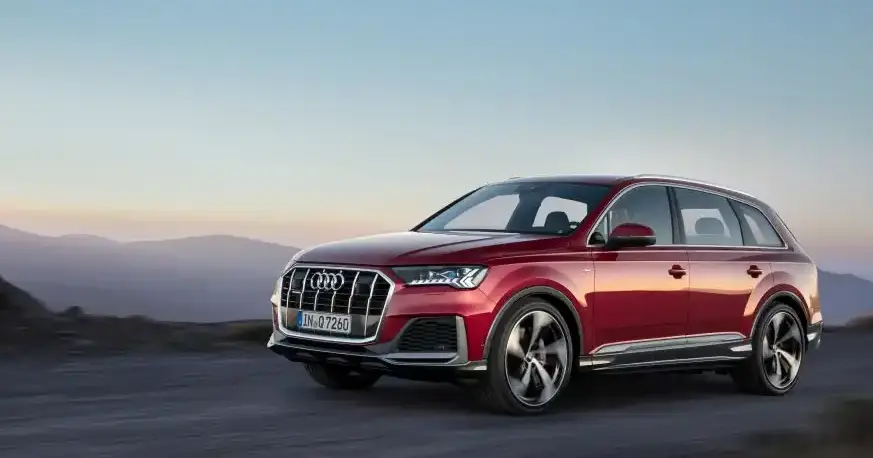
The Audi Q7 (Typ 4M, facelift 2019) 50 TDI V6 represents a significant iteration of Audi’s popular luxury SUV, produced from September 2019 through October 2020. This variant, equipped with a 3.0-liter turbocharged diesel V6 engine producing 286 horsepower and utilizing a 48-volt mild hybrid system, occupied a key position in the Q7 lineup, offering a balance of performance, efficiency, and technology. It was positioned as a premium offering, slotting above the base 45 TDI models and below the performance-oriented SQ7. The facelift brought updated styling, enhanced technology, and refined powertrain options, solidifying the Q7’s appeal in the competitive luxury SUV segment.
Technical Specifications
| Brand | Audi |
| Model | Q7 |
| Generation | Q7 (Typ 4M, facelift 2019) |
| Type (Engine) | 50 TDI V6 (286 Hp) Mild Hybrid quattro tiptronic 7 seats |
| Start of production | September, 2019 |
| End of production | October, 2020 |
| Powertrain Architecture | MHEV (Mild Hybrid Electric Vehicle) |
| Body type | SUV |
| Seats | 7 |
| Doors | 5 |
| Fuel consumption (urban) | 7.4-7.5 l/100 km (31.8 – 31.4 US mpg) |
| Fuel consumption (extra urban) | 6.4-6.6 l/100 km (36.8 – 35.6 US mpg) |
| Fuel consumption (combined) | 6.8-6.9 l/100 km (34.6 – 34.1 US mpg) |
| CO2 emissions | 178-181 g/km |
| Fuel Type | Diesel |
| Acceleration 0 – 100 km/h | 6.5 sec |
| Acceleration 0 – 62 mph | 6.5 sec |
| Acceleration 0 – 60 mph | 6.2 sec |
| Maximum speed | 241 km/h (149.75 mph) |
| Emission standard | Euro 6d-TEMP-EVAP-ISC |
| Weight-to-power ratio | 7.6 kg/Hp |
| Weight-to-torque ratio | 3.6 kg/Nm |
| Gross battery capacity | 0.5 kWh |
| Battery voltage | 48 V |
| Battery technology | Lithium-ion (Li-Ion) |
| Recuperation output | 8 kW |
| Power | 286 Hp @ 3500-4000 rpm |
| Torque | 600 Nm @ 2250-3250 rpm (442.54 lb.-ft.) |
| Engine layout | Front, Longitudinal |
| Engine Model/Code | EA897evo2 / DHXA |
| Engine displacement | 2967 cm3 (181.06 cu. in.) |
| Number of cylinders | 6 |
| Engine configuration | V-engine |
| Cylinder Bore | 83 mm (3.27 in.) |
| Piston Stroke | 91.4 mm (3.6 in.) |
| Compression ratio | 16:1 |
| Number of valves per cylinder | 4 |
| Fuel injection system | Diesel Commonrail |
| Engine aspiration | Turbocharger, Intercooler |
| Valvetrain | DOHC |
| Engine oil capacity | 6.1 l (6.45 US qt | 5.37 UK qt) |
| Coolant | 15 l (15.85 US qt | 13.2 UK qt) |
| Kerb Weight | 2165 kg (4773.01 lbs.) |
| Max. weight | 3015 kg (6646.94 lbs.) |
| Max load | 850 kg (1873.93 lbs.) |
| Trunk (boot) space – minimum | 787 l (27.79 cu. ft.) |
| Trunk (boot) space – maximum | 1925 l (67.98 cu. ft.) |
| Fuel tank capacity | 75 l (19.81 US gal | 16.5 UK gal) |
| AdBlue tank | 24 l (6.34 US gal | 5.28 UK gal) |
| Max. roof load | 100 kg (220.46 lbs.) |
| Permitted trailer load with brakes (8%) | 3500 kg (7716.18 lbs.) |
| Permitted trailer load without brakes | 750 kg (1653.47 lbs.) |
| Length | 5063 mm (199.33 in.) |
| Width | 1970 mm (77.56 in.) |
| Height | 1740 mm (68.5 in.) |
| Wheelbase | 2994 mm (117.87 in.) |
| Front track | 1679 mm (66.1 in.) |
| Rear track | 1691 mm (66.57 in.) |
| Drag coefficient (Cd) | 0.34 |
| Minimum turning circle | 12.5 m (41.01 ft.) |
| Front suspension | Independent multi-link suspension, Air suspension |
| Rear suspension | Independent multi-link suspension, Air suspension |
| Front brakes | Ventilated discs |
| Rear brakes | Ventilated discs |
| Number of gears | 8 |
| Gearbox type | Automatic transmission tiptronic |
INTRODUCTION
The Audi Q7 50 TDI V6 Mild Hybrid quattro tiptronic, introduced with the 2019 facelift of the Typ 4M generation, represented a sophisticated blend of performance and efficiency within Audi’s luxury SUV range. Built on the MLB Evo platform, shared with other Volkswagen Group vehicles like the Porsche Cayenne and Bentley Bentayga, the Q7 aimed to provide a comfortable and capable driving experience for families and discerning buyers. The 50 TDI variant specifically targeted customers seeking a powerful diesel engine with the added benefits of mild hybrid technology, offering improved fuel economy and reduced emissions compared to non-hybrid alternatives. This model year saw significant updates to the Q7’s exterior styling, interior technology, and powertrain options, enhancing its overall appeal.
Powertrain & Engine Architecture
At the heart of the Q7 50 TDI lies the EA897evo2 3.0-liter V6 diesel engine, designated with the code DHXA. This engine utilizes a sophisticated common rail direct injection system, delivering fuel at extremely high pressures for optimized combustion. The engine features a single turbocharger with an intercooler, boosting power and torque. The valvetrain employs a Dual Overhead Camshaft (DOHC) configuration with four valves per cylinder, maximizing airflow and engine efficiency. The mild hybrid system, a 48V setup, incorporates a belt starter generator (BSG) and a small lithium-ion battery. This system allows for extended start-stop functionality, regenerative braking, and a slight power boost during acceleration. The engine produces 286 horsepower at 3500-4000 rpm and a substantial 600 Nm (442.54 lb.-ft.) of torque between 2250-3250 rpm. The engine is paired with an 8-speed tiptronic automatic transmission, known for its smooth and responsive shifts. The quattro all-wheel-drive system distributes power between the front and rear axles as needed, providing excellent traction in various driving conditions.
Driving Characteristics
The Q7 50 TDI delivers a refined and confident driving experience. The 600 Nm of torque provides strong acceleration, allowing for effortless overtaking and comfortable highway cruising. The 8-speed tiptronic transmission is well-tuned, offering smooth gear changes and contributing to the overall sense of refinement. While not as overtly sporty as the SQ7, the 50 TDI offers ample power for most driving situations. The mild hybrid system is largely transparent to the driver, providing subtle assistance during acceleration and enabling a smoother start-stop experience. The quattro all-wheel-drive system inspires confidence in all weather conditions, providing excellent grip and stability. Compared to the lower-powered 45 TDI variants, the 50 TDI offers a noticeable performance upgrade, while remaining more fuel-efficient than the higher-performance SQ7.
Equipment & Trim Levels
The Q7 50 TDI typically came well-equipped with standard features including Audi’s Virtual Cockpit digital instrument cluster, a large infotainment touchscreen with navigation, leather upholstery, tri-zone automatic climate control, and a suite of advanced driver-assistance systems such as adaptive cruise control, lane departure warning, and automatic emergency braking. Optional extras included a panoramic sunroof, premium sound system, massaging front seats, and various cosmetic enhancements. Interior trim options ranged from wood veneers to brushed aluminum, allowing buyers to personalize the cabin to their preferences. The seven-seat configuration provided ample space for passengers and cargo, making it a practical choice for families.
Chassis & Braking
The Q7 50 TDI features an independent multi-link suspension on both the front and rear axles, often paired with Audi’s adaptive air suspension system. This air suspension allows for adjustable ride height and damping settings, providing a comfortable ride quality and improved off-road capability. The braking system consists of ventilated discs on all four wheels, providing ample stopping power. Anti-lock braking system (ABS) and electronic stability control (ESC) are standard features, enhancing safety and control. Steering is via a power-assisted rack and pinion system, offering precise and responsive handling.
Market Reception & Comparison
The Audi Q7 50 TDI V6 Mild Hybrid was generally well-received by automotive critics. It was praised for its powerful and efficient engine, comfortable ride, spacious interior, and advanced technology. Compared to its competitors, such as the BMW X5 and Mercedes-Benz GLE, the Q7 offered a compelling combination of luxury, practicality, and performance. Fuel economy was a strong point, with the mild hybrid system contributing to improved efficiency compared to traditional diesel engines. Reliability reports have been generally positive, although some owners have reported minor issues with the infotainment system and air suspension components.
Legacy
The Audi Q7 50 TDI V6 Mild Hybrid represents a significant step in Audi’s development of efficient and powerful luxury SUVs. The EA897evo2 engine proved to be a robust and reliable unit, and the mild hybrid technology paved the way for more advanced hybrid and electric powertrains in future Audi models. On the used car market, these Q7s hold their value relatively well, due to their desirable combination of features, performance, and reputation for quality. While maintenance costs can be higher than some competitors, the Q7 50 TDI remains a popular choice for buyers seeking a refined and capable luxury SUV.