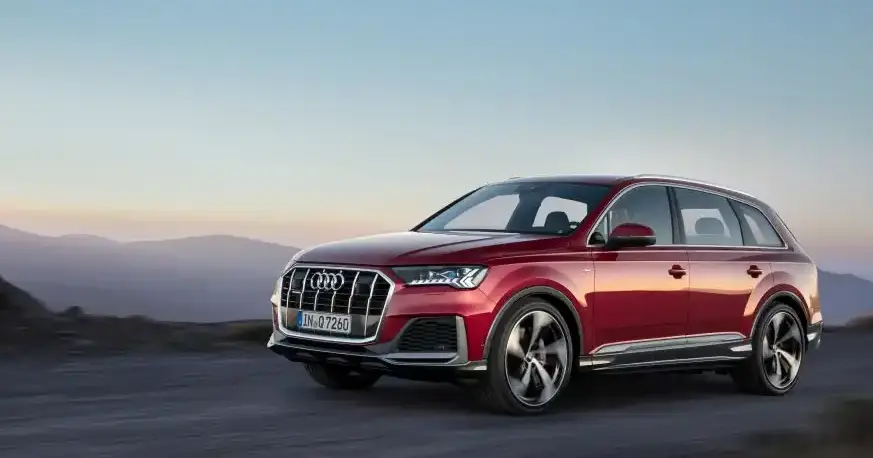
The Audi Q7 (Typ 4M, facelift 2019) 55 TFSI V6 represents a significant iteration of Audi’s popular luxury SUV, produced from September 2019 through 2024. This variant, equipped with a 3.0-liter turbocharged V6 engine producing 340 horsepower and a mild-hybrid system, occupies a mid-to-upper position within the Q7 lineup. It’s characterized by its blend of performance, efficiency, and spaciousness, catering to buyers seeking a premium seven-seat SUV. The facelift brought updated styling, enhanced technology, and refined powertrain options, solidifying the Q7’s position in the competitive luxury SUV segment. This specific configuration, paired with the eight-speed Tiptronic automatic transmission and quattro all-wheel drive, was a popular choice for North American and European markets.
Technical Specifications
| Brand | Audi |
| Model | Q7 |
| Generation | Q7 (Typ 4M, facelift 2019) |
| Type (Engine) | 55 TFSI V6 (340 Hp) Mild Hybrid quattro tiptronic 7 seat |
| Start of production | September, 2019 |
| End of production | 2024 |
| Powertrain Architecture | MHEV (Mild Hybrid Electric Vehicle) |
| Body type | SUV |
| Seats | 7 |
| Doors | 5 |
| Fuel consumption (urban) | 11.2 l/100 km (21 US mpg) |
| Fuel consumption (extra urban) | 7.6-7.9 l/100 km (30.9 – 29.8 US mpg) |
| Fuel consumption (combined) | 8.9-9.1 l/100 km (26.4 – 25.8 US mpg) |
| CO2 emissions | 203-208 g/km |
| Fuel Type | Petrol (Gasoline) |
| Acceleration 0 – 100 km/h | 5.9 sec |
| Acceleration 0 – 62 mph | 5.9 sec |
| Acceleration 0 – 60 mph | 5.6 sec |
| Maximum speed | 250 km/h (155.34 mph) |
| Emission standard | Euro 6d – TEMP – EVAP – ISC |
| Weight-to-power ratio | 6.3 kg/Hp |
| Weight-to-torque ratio | 4.3 kg/Nm |
| Power | 340 Hp @ 5000-6400 rpm |
| Torque | 500 Nm @ 1370-4500 rpm (368.78 lb.-ft.) |
| Engine layout | Front, Longitudinal |
| Engine Model/Code | DCBD |
| Engine displacement | 2995 cm3 (182.77 cu. in.) |
| Number of cylinders | 6 |
| Engine configuration | V-engine |
| Cylinder Bore | 84.5 mm (3.33 in.) |
| Piston Stroke | 89 mm (3.5 in.) |
| Compression ratio | 11.2:1 |
| Number of valves per cylinder | 4 |
| Fuel injection system | Direct injection |
| Engine aspiration | Turbocharger, Intercooler |
| Engine oil capacity | 7.6 l (8.03 US qt | 6.69 UK qt) |
| Coolant | 13.7 l (14.48 US qt | 12.05 UK qt) |
| Kerb Weight | 2140 kg (4717.89 lbs.) |
| Max. weight | 2950 kg (6503.64 lbs.) |
| Max load | 810 kg (1785.74 lbs.) |
| Trunk (boot) space – minimum | 740 l (26.13 cu. ft.) |
| Trunk (boot) space – maximum | 1925 l (67.98 cu. ft.) |
| Fuel tank capacity | 85 l (22.45 US gal | 18.7 UK gal) |
| Max. roof load | 100 kg (220.46 lbs.) |
| Permitted trailer load with brakes (8%) | 3500 kg (7716.18 lbs.) |
| Permitted trailer load without brakes | 750 kg (1653.47 lbs.) |
| Length | 5063 mm (199.33 in.) |
| Width | 1970 mm (77.56 in.) |
| Width including mirrors | 2212 mm (87.09 in.) |
| Height | 1741 mm (68.54 in.) |
| Wheelbase | 2994 mm (117.87 in.) |
| Front track | 1679 mm (66.1 in.) |
| Rear track | 1691 mm (66.57 in.) |
| Drag coefficient (Cd) | 0.34 |
| Minimum turning circle | 12.5 m (41.01 ft.) |
| Drive wheel | All wheel drive (4×4) |
| Number of gears | 8 |
| Gearbox type | Automatic transmission Tiptronic |
| Front suspension | Independent multi-link suspension |
| Rear suspension | Independent multi-link suspension |
| Front brakes | Ventilated discs |
| Rear brakes | Ventilated discs |
Powertrain & Engine Architecture
At the heart of the Q7 55 TFSI lies the DCBD engine, a 3.0-liter V6 gasoline engine. This engine utilizes a single twin-scroll turbocharger and direct fuel injection to deliver a potent 340 horsepower and 368 lb-ft of torque. The mild-hybrid system, employing a 48-volt electrical system, provides a boost during acceleration and enables coasting with the engine switched off to improve fuel efficiency. The engine’s architecture is longitudinally mounted, driving all four wheels through Audi’s renowned quattro all-wheel-drive system. The eight-speed Tiptronic automatic transmission offers smooth and responsive gear changes, with manual shift capability for driver control. This transmission is known for its durability and ability to handle the engine’s substantial torque output.
Driving Characteristics
The Q7 55 TFSI delivers a refined and capable driving experience. The 340 hp engine provides ample power for effortless highway cruising and confident overtaking. Acceleration from 0 to 60 mph takes approximately 5.6 seconds. The Tiptronic transmission is well-tuned, offering quick and seamless shifts. Compared to the base 2.0-liter four-cylinder Q7, the V6 offers significantly more power and a smoother driving experience. While not as sporty as some competitors, the Q7 prioritizes comfort and refinement. The quattro all-wheel-drive system provides excellent traction in all weather conditions, enhancing stability and control. The gear ratios are optimized for both fuel efficiency and performance, providing a balance between responsiveness and economy.
Equipment & Trim Levels
The Q7 55 TFSI typically came well-equipped as standard. Features included leather upholstery, a panoramic sunroof, a premium sound system, and a comprehensive suite of driver-assistance technologies such as adaptive cruise control, lane-keeping assist, and automatic emergency braking. The infotainment system featured a dual-screen setup with navigation, Apple CarPlay, and Android Auto compatibility. Optional extras included massaging front seats, a rear-seat entertainment system, and upgraded interior trim materials. The Prestige trim level, often available, added even more luxury features, such as a head-up display and a top-view camera system.
Chassis & Braking
The Q7’s chassis features an independent multi-link suspension at both the front and rear, providing a comfortable and controlled ride. The suspension is tuned to prioritize comfort, but still offers good body control in corners. The braking system consists of ventilated discs on all four wheels, providing ample stopping power. The electronic stability control (ESC) system works in conjunction with the quattro all-wheel drive to maintain stability and prevent skidding. The steering is precise and well-weighted, offering a confident feel on the road.
Market Reception & Comparison
The Audi Q7 55 TFSI was generally well-received by automotive critics. It was praised for its spacious interior, comfortable ride, and powerful engine. Fuel economy was considered reasonable for a vehicle of its size and performance, averaging around 26 mpg combined. Compared to other trims in the Q7 lineup, the 55 TFSI offered a significant performance upgrade over the base 2.0-liter model, while remaining more fuel-efficient than the supercharged 3.0-liter V6 found in earlier models. Competitors included the BMW X5, Mercedes-Benz GLE, and Volvo XC90.
Legacy
The DCBD engine, while complex, has proven to be relatively reliable when properly maintained. Common issues include oil consumption and occasional turbocharger problems, but these are not widespread. The eight-speed Tiptronic transmission is also known for its durability. On the used car market, the Q7 55 TFSI holds its value well due to its desirable combination of luxury, performance, and practicality. Regular maintenance, including oil changes and inspections of the turbocharger and cooling system, is crucial for ensuring long-term reliability. This variant remains a popular choice for buyers seeking a premium seven-seat SUV with a powerful and refined powertrain.