
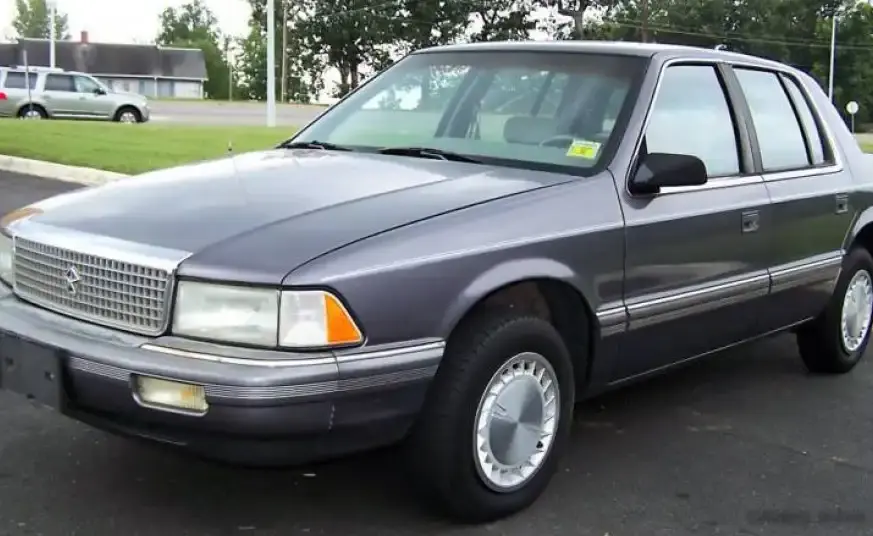
The Plymouth Acclaim 3.0i V6, produced between 1991 and 1994, represented Plymouth’s entry into the mid-size sedan market, aiming to offer a more upscale alternative to the Dodge Spirit and Chrysler LeBaron. Positioned as a comfortable and relatively well-equipped vehicle, the Acclaim was based on the Chrysler JA platform, sharing many components with its sister cars. The 3.0i V6 variant, equipped with a four-speed automatic transmission, was a popular choice, offering a balance of performance and convenience. It served as a step up from the base 2.5L engine, targeting buyers who desired more power for highway driving and passing maneuvers.
Technical Specifications
| Brand | Plymouth |
| Model | Acclaim |
| Generation | Acclaim |
| Type (Engine) | 3.0 i V6 (143 Hp) |
| Start of production | 1991 |
| End of production | 1994 |
| Powertrain Architecture | Internal Combustion engine |
| Body type | Sedan |
| Seats | 5 |
| Doors | 4 |
| Fuel consumption (urban) | 15 l/100 km (15.7 US mpg, 18.8 UK mpg, 6.7 km/l) |
| Fuel consumption (extra urban) | 9 l/100 km (26.1 US mpg, 31.4 UK mpg, 11.1 km/l) |
| Fuel Type | Petrol (Gasoline) |
| Maximum speed | 195 km/h (121.17 mph) |
| Weight-to-power ratio | 9.4 kg/Hp (105.9 Hp/tonne) |
| Weight-to-torque ratio | 5.8 kg/Nm (171.9 Nm/tonne) |
| Power | 143 Hp @ 5000 rpm |
| Power per litre | 48.1 Hp/l |
| Torque | 232 Nm @ 3600 rpm (171.11 lb.-ft. @ 3600 rpm) |
| Engine layout | Front, Transverse |
| Engine Model/Code | 6G72 |
| Engine displacement | 2972 cm3 (181.36 cu. in.) |
| Number of cylinders | 6 |
| Engine configuration | V-engine |
| Cylinder Bore | 91.1 mm (3.59 in.) |
| Piston Stroke | 76 mm (2.99 in.) |
| Compression ratio | 8.9:1 |
| Number of valves per cylinder | 2 |
| Fuel injection system | Multi-port manifold injection |
| Engine aspiration | Naturally aspirated engine |
| Valvetrain | OHC |
| Engine oil capacity | 4.3 l (4.54 US qt | 3.78 UK qt) |
| Coolant capacity | 9 l (9.51 US qt | 7.92 UK qt) |
| Kerb Weight | 1350 kg (2976.24 lbs.) |
| Trunk (boot) space (minimum) | 410 l (14.48 cu. ft.) |
| Fuel tank capacity | 61 l (16.11 US gal | 13.42 UK gal) |
| Length | 4600 mm (181.1 in.) |
| Width | 1730 mm (68.11 in.) |
| Height | 1360 mm (53.54 in.) |
| Wheelbase | 2630 mm (103.54 in.) |
| Front track | 1460 mm (57.48 in.) |
| Rear track | 1450 mm (57.09 in.) |
| Drivetrain Architecture | Front wheel drive, Internal Combustion Engine |
| Number of gears | 4 |
| Gearbox type | Automatic transmission |
| Front suspension | Coil spring |
| Rear suspension | Coil spring |
| Front brakes | Ventilated discs |
| Rear brakes | Drum |
| Assisting systems | ABS (Anti-lock braking system) |
| Steering type | Steering rack and pinion |
| Power steering | Hydraulic Steering |
| Tires size | 195/70 R14 |
Powertrain & Engine Architecture
The heart of the Acclaim 3.0i was the Mitsubishi-sourced 6G72 3.0-liter V6 engine. This engine featured a 60-degree V-angle, a cast iron block, and an aluminum cylinder head. It utilized a multi-port fuel injection system, delivering fuel directly to each intake port for improved efficiency and power delivery. The engine employed a single overhead camshaft (OHC) design, operating two valves per cylinder. The 6G72 was known for its relatively smooth operation and decent power output for its displacement. Paired with the engine was a four-speed automatic transmission, providing convenient shifting for everyday driving. This transmission, while not particularly sporty, was reliable and well-suited to the Acclaim’s intended purpose as a comfortable cruiser.
Driving Characteristics
The 143 horsepower and 171 lb-ft of torque produced by the 3.0L V6 and automatic transmission combination provided adequate, though not exhilarating, performance. Acceleration from 0 to 60 mph was estimated to be around 10-11 seconds. The automatic transmission featured relatively conservative gear ratios, prioritizing fuel economy and smooth shifts over aggressive acceleration. Compared to the manual transmission versions of the Acclaim, or the higher-output engines available in the Dodge Spirit and Chrysler LeBaron, the 3.0i automatic felt less responsive. However, it offered a more relaxed driving experience, particularly in city traffic. The power delivery was linear, making it easy to modulate the throttle and maintain control.
Equipment & Trim Levels
The Acclaim 3.0i V6 typically came standard with features such as air conditioning, power windows and locks, a tilt steering wheel, and an AM/FM stereo. Upholstery was generally cloth, though leather options were available. Higher trim levels could include features like cruise control, a power driver’s seat, and upgraded sound systems. The Acclaim aimed for a slightly more premium feel than its Dodge and Chrysler counterparts, with a focus on comfort and convenience features. Optional extras included a sunroof, alloy wheels, and a rear window defroster.
Chassis & Braking
The Acclaim utilized a front-wheel-drive layout with independent coil spring suspension in the front and a semi-independent coil spring suspension in the rear. The front suspension provided a comfortable ride, while the rear suspension was designed to maximize interior space. Braking duties were handled by ventilated discs in the front and drum brakes in the rear. An anti-lock braking system (ABS) was available, enhancing safety by preventing wheel lockup during hard braking. The suspension tuning was geared towards comfort rather than sporty handling, resulting in a relatively soft and forgiving ride.
Market Reception & Comparison
The Plymouth Acclaim 3.0i V6 was generally well-received by critics as a comfortable and practical mid-size sedan. However, it wasn’t considered a standout performer in its class. Compared to the 2.5L four-cylinder version, the 3.0i V6 offered a noticeable improvement in power and refinement. However, it came at a higher price point and with slightly lower fuel economy. Against competitors like the Honda Accord and Toyota Camry, the Acclaim was often seen as less refined and less reliable. Fuel economy figures were around 15 mpg city and 26 mpg highway, which were typical for a V6-powered sedan of that era.
Legacy
The Plymouth Acclaim, and particularly the 3.0i V6 variant, has become a relatively affordable classic car. The 6G72 engine is known for its durability, and with proper maintenance, can last for many years. However, like many vehicles of its age, the Acclaim is susceptible to rust and age-related wear and tear. Parts availability is generally good, as many components were shared with other Chrysler, Dodge, and Mitsubishi vehicles. Today, the Acclaim 3.0i V6 represents a piece of 1990s American automotive history, offering a glimpse into a time when comfort and convenience were prioritized over outright performance.
