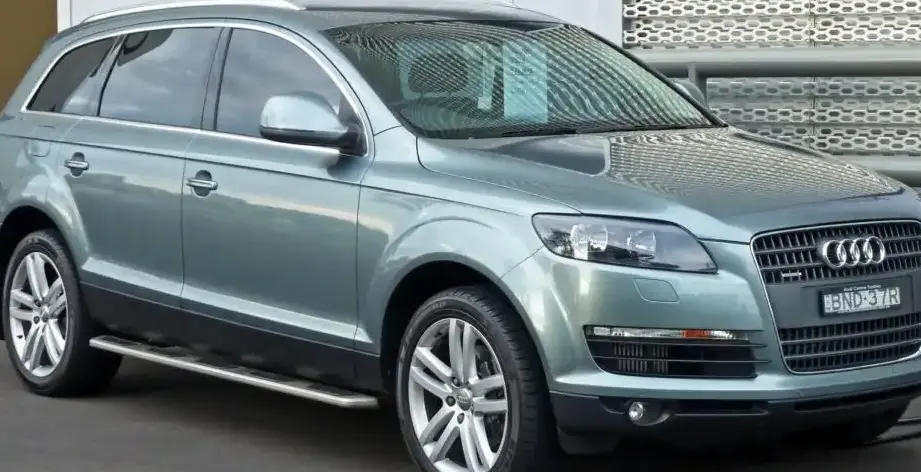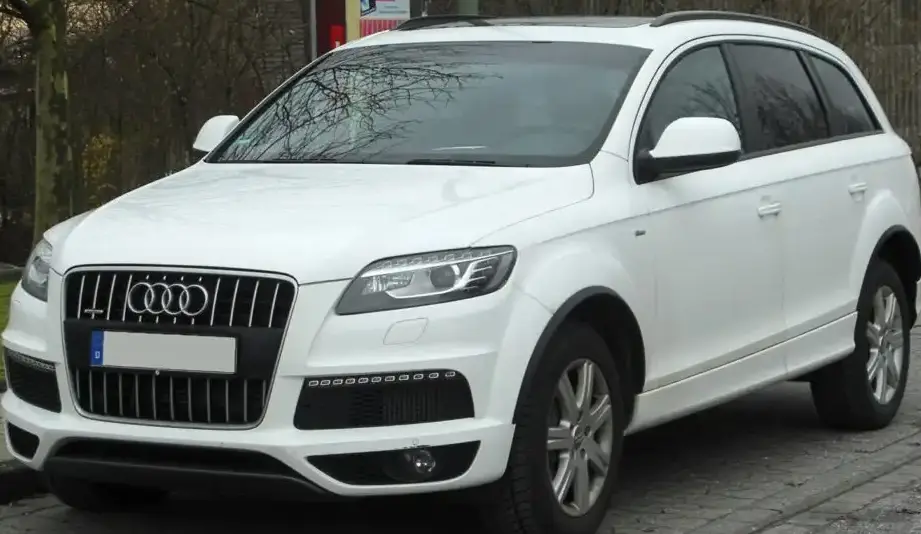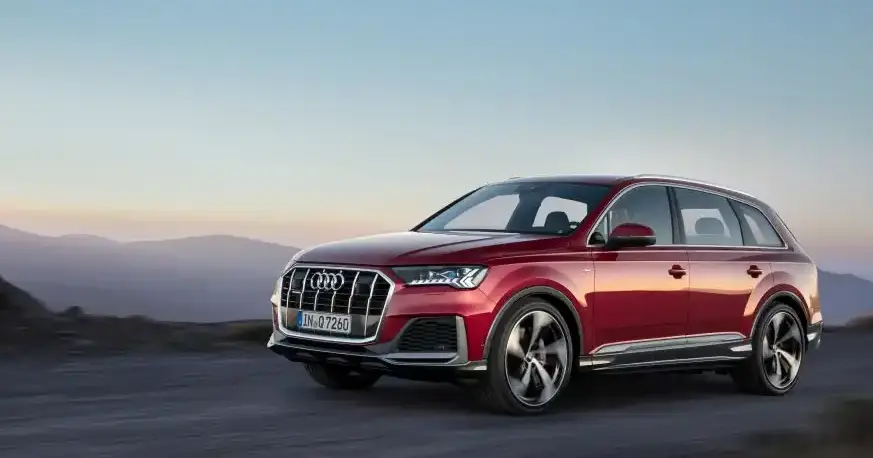
The Audi Q7 60 TFSI e, produced from December 2019 to September 2020, represents a significant step in Audi’s plug-in hybrid (PHEV) technology within the second-generation Q7 (Typ 4M) model range. This variant, introduced with the facelift of the 4M series, combined a 3.0-liter turbocharged V6 engine with an electric motor, delivering a combined system output of 456 horsepower. Positioned as a premium offering, the 60 TFSI e aimed to provide both performance and improved fuel efficiency, catering to buyers seeking a luxurious SUV with reduced emissions and the capability of all-electric driving.
Technical Specifications
| Brand | Audi |
| Model | Q7 |
| Generation | Q7 (Typ 4M, facelift 2019) |
| Type (Engine) | 60 TFSI e V6 (456 Hp) Plug-in Hybrid quattro tiptronic |
| Start of production | December, 2019 |
| End of production | September, 2020 |
| Powertrain Architecture | PHEV (Plug-in Hybrid Electric Vehicle) |
| Body type | SUV |
| Seats | 5 |
| Doors | 5 |
| Fuel consumption (combined) | 2.8-3 l/100 km (84 – 78.4 US mpg, 100.9 – 94.2 UK mpg, 35.7 – 33.3 km/l) |
| CO2 emissions | 64-69 g/km |
| Fuel Type | Petrol / electricity |
| Acceleration 0 – 100 km/h | 5.7 sec |
| Acceleration 0 – 62 mph | 5.7 sec |
| Acceleration 0 – 60 mph | 5.4 sec |
| Maximum speed | 240 km/h (149.13 mph) |
| Emission standard | Euro 6d-TEMP-EVAP-ISC |
| Weight-to-power ratio | 5.4 kg/Hp, 185.4 Hp/tonne |
| Weight-to-torque ratio | 3.5 kg/Nm, 284.6 Nm/tonne |
| Gross battery capacity | 17.3 kWh |
| Battery voltage | 308 V |
| Battery technology | Lithium-ion (Li-Ion) |
| Battery weight | 202 kg (445.33 lbs.) |
| Battery location | Under the trunk |
| Recuperation output | 80 kW |
| All-electric range (WLTP) | 41-42 km (25.48 – 26.1 mi) |
| Average Energy consumption (NEDC) | 22.2-22.9 kWh/100 km (35.73 – 36.85 kWh/100 mi, 94 – 91 MPGe, 4.5 – 4.4 km/kWh, 2.8 – 2.7 mi/kWh) |
| Max speed (electric) | 135 km/h (83.89 mph) |
| Electric motor power | 128 Hp |
| Electric motor Torque | 350 Nm (258.15 lb.-ft.) |
| Electric motor location | Between the combustion engine and the transmission |
| System power | 456 Hp |
| System torque | 700 Nm (516.29 lb.-ft.) |
| Power | 340 Hp @ 5200-6400 rpm |
| Torque | 450 Nm @ 1340-5300 rpm (331.9 lb.-ft. @ 1340-5300 rpm) |
| Engine layout | Front, Longitudinal |
| Engine Model/Code | DCBE |
| Engine displacement | 2995 cm3 (182.77 cu. in.) |
| Number of cylinders | 6 |
| Engine configuration | V-engine |
| Cylinder Bore | 84.5 mm (3.33 in.) |
| Piston Stroke | 89 mm (3.5 in.) |
| Compression ratio | 11.2:1 |
| Number of valves per cylinder | 4 |
| Fuel injection system | Direct injection |
| Engine aspiration | Turbocharger, Intercooler |
| Valvetrain | DOHC |
| Engine oil capacity | 7.2 l (7.61 US qt | 6.34 UK qt) |
| Coolant | 10 l (10.57 US qt | 8.8 UK qt) |
| Kerb Weight | 2460 kg (5423.37 lbs.) |
| Max. weight | 3145 kg (6933.54 lbs.) |
| Max load | 685 kg (1510.17 lbs.) |
| Trunk (boot) space – minimum | 650 l (22.95 cu. ft.) |
| Fuel tank capacity | 75 l (19.81 US gal | 16.5 UK gal) |
| Max. roof load | 100 kg (220.46 lbs.) |
| Permitted trailer load with brakes (12%) | 3500 kg (7716.18 lbs.) |
| Permitted trailer load without brakes | 750 kg (1653.47 lbs.) |
| Permitted towbar download | 140 kg (308.65 lbs.) |
| Length | 5063 mm (199.33 in.) |
| Width | 1970 mm (77.56 in.) |
| Width including mirrors | 2212 mm (87.09 in.) |
| Height | 1741 mm (68.54 in.) |
| Wheelbase | 2995 mm (117.91 in.) |
| Front track | 1679 mm (66.1 in.) |
| Rear (Back) track | 1690 mm (66.54 in.) |
| Front overhang | 977 mm (38.46 in.) |
| Rear overhang | 1091 mm (42.95 in.) |
| Minimum turning circle | 12.5 m (41.01 ft.) |
| Drive wheel | All wheel drive (4×4) |
| Number of gears | 8 |
| Gearbox type | automatic transmission tiptronic |
Powertrain & Engine Architecture
The heart of the Q7 60 TFSI e is the DCBE engine, a 3.0-liter V6 turbocharged gasoline engine. This engine utilizes direct fuel injection and a single turbocharger with an intercooler to produce 340 horsepower and 450 Nm (331.9 lb-ft) of torque. The engine’s design incorporates Audi’s Valvelift system, which allows for variable valve lift on the intake side, optimizing performance and efficiency. Coupled with this is a powerful electric motor, integrated between the engine and the eight-speed tiptronic automatic transmission, contributing an additional 128 horsepower and 350 Nm (258.15 lb-ft) of torque. The combined system output reaches 456 horsepower and 700 Nm (516.29 lb-ft). The 17.3 kWh lithium-ion battery pack is located under the trunk floor, providing an all-electric range of 41-42 km (25.48 – 26.1 mi) according to WLTP standards. The transmission itself is a well-refined eight-speed tiptronic, known for its smooth shifts and responsiveness.
Driving Characteristics
The 60 TFSI e offers a unique driving experience. In EV mode, the Q7 operates silently and smoothly, providing instant torque for quick acceleration. Switching to hybrid mode allows the vehicle to seamlessly blend power from both the engine and the electric motor. The combined output delivers brisk acceleration, with a 0-60 mph time of around 5.4 seconds. The tiptronic transmission is well-matched to the powertrain, providing smooth and timely gear changes. Compared to the standard Q7 variants, the 60 TFSI e feels more responsive at lower speeds due to the electric motor’s instant torque. While the added weight of the battery pack (202 kg / 445.33 lbs) slightly impacts handling, the quattro all-wheel-drive system maintains excellent stability and grip.
Equipment & Trim Levels
The 60 TFSI e typically came with a high level of standard equipment, reflecting its premium positioning. This included Audi’s virtual cockpit, a large infotainment touchscreen with navigation, leather upholstery, heated front seats, and a panoramic sunroof. Standard safety features included adaptive cruise control, lane departure warning, and automatic emergency braking. Optional extras included upgraded sound systems, massaging seats, and various driver-assistance packages. The interior trim was generally luxurious, with high-quality materials and a refined design.
Chassis & Braking
The Q7 60 TFSI e utilizes an independent multi-link suspension system at both the front and rear axles, providing a comfortable and controlled ride. Transverse stabilizers help to minimize body roll during cornering. The braking system consists of ventilated discs on all four wheels, providing ample stopping power. The electronic stability control (ESC) system is integrated with the quattro all-wheel-drive system to enhance stability and traction in various driving conditions.
Market Reception & Comparison
The Q7 60 TFSI e was generally well-received by critics, who praised its performance, fuel efficiency, and luxurious interior. However, some reviewers noted the reduced trunk space due to the battery pack. Compared to the Q7 45 TDI, the 60 TFSI e offered similar performance but with the added benefit of all-electric driving capability. Against the Q7 55 TFSI, the hybrid model provided better fuel economy, especially for shorter journeys. The higher initial cost of the 60 TFSI e was a consideration for some buyers, but the potential for reduced running costs and tax benefits made it an attractive option.
Legacy
The Audi Q7 60 TFSI e represents an important step in Audi’s transition towards electrification. The powertrain, while superseded by newer hybrid technologies, proved to be relatively reliable. The DCBE engine is known for its durability, and the hybrid system has demonstrated good long-term performance. On the used car market, these models hold their value reasonably well, appealing to buyers seeking a luxurious and efficient SUV with plug-in hybrid capability. The Q7 60 TFSI e paved the way for Audi’s broader range of plug-in hybrid models and helped to establish the brand as a leader in electric vehicle technology.