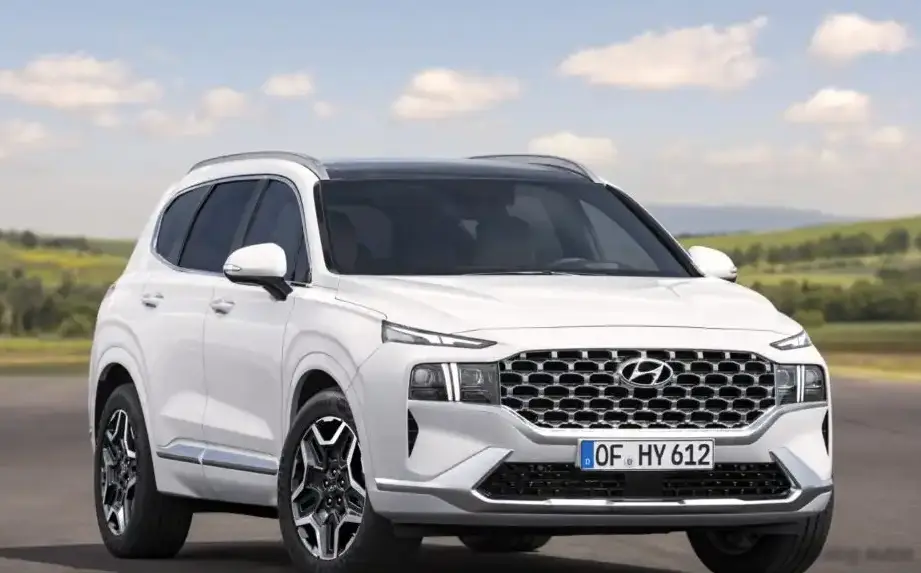
The Hyundai Santa Fe IV (TM) facelift, specifically the 2.5 Smartstream (191 Hp) HTRAC AWD Automatic variant, represents a significant evolution in Hyundai’s mid-size SUV offerings. Introduced in October 2020 and continuing through the 2023 model year, this version occupied a key position in the Santa Fe lineup, bridging the gap between more economical base models and the more powerful turbocharged options. It was designed to appeal to buyers seeking a balance of fuel efficiency, all-weather capability, and a comfortable driving experience. This facelift brought updated styling, enhanced technology, and refinements to the powertrain, solidifying the Santa Fe’s position in a highly competitive segment.
Technical Specifications
| Brand | Hyundai |
| Model | Santa Fe |
| Generation | Santa Fe IV (TM, facelift 2020) |
| Type (Engine) | 2.5 Smartstream (191 Hp) HTRAC AWD Automatic |
| Start of production | October, 2020 |
| End of production | August, 2023 |
| Powertrain Architecture | Internal Combustion engine |
| Body type | SUV |
| Seats | 5 |
| Doors | 5 |
| Fuel consumption (combined) | 9.8 l/100 km (24 US mpg, 28.8 UK mpg, 10.2 km/l) |
| Fuel Type | Petrol (Gasoline) |
| Emission standard | SULEV30 |
| Power | 191 Hp @ 6100 rpm |
| Power per litre | 76.5 Hp/l |
| Torque | 247 Nm @ 4000 rpm (182.18 lb.-ft. @ 4000 rpm) |
| Engine layout | Front, Transverse |
| Engine Model/Code | Smartstream / G4KN |
| Engine displacement | 2497 cm3 (152.38 cu. in.) |
| Number of cylinders | 4 |
| Engine configuration | Inline |
| Compression ratio | 13:1 |
| Number of valves per cylinder | 4 |
| Fuel injection system | Direct injection and Multi-port manifold injection |
| Engine aspiration | Naturally aspirated engine |
| Valvetrain | DOHC |
| Engine oil capacity | 5.8 l (6.13 US qt | 5.1 UK qt) |
| Coolant | 7.1 l (7.5 US qt | 6.25 UK qt) |
| Trunk (boot) space – minimum | 1031 l (36.41 cu. ft.) |
| Trunk (boot) space – maximum | 2042 l (72.11 cu. ft.) |
| Fuel tank capacity | 71 l (18.76 US gal | 15.62 UK gal) |
| Max. roof load | 100 kg (220.46 lbs.) |
| Permitted trailer load with brakes (12%) | 907 kg (1999.59 lbs.) |
| Permitted trailer load without brakes | 748 kg (1649.06 lbs.) |
| Length | 4785 mm (188.39 in.) |
| Width | 1900 mm (74.8 in.) |
| Height | 1709 mm (67.28 in.) |
| Wheelbase | 2766 mm (108.9 in.) |
| Front track | 1646 mm (64.8 in.) |
| Rear (Back) track | 1656 mm (65.2 in.) |
| Front overhang | 945 mm (37.2 in.) |
| Rear overhang | 1074 mm (42.28 in.) |
| Ride height (ground clearance) | 208 mm (8.19 in.) |
| Drag coefficient (Cd) | 0.34 |
| Minimum turning circle (turning diameter) | 11.4 m (37.4 ft.) |
| Drivetrain Architecture | The Internal combustion engine (ICE) drives the front wheels permanently, and the rear wheels are driven through an electrically or mechanically operated clutch if necessary. |
| Drive wheel | All wheel drive (4×4) |
| Number of gears and type of gearbox | 8 gears, automatic transmission |
| Front suspension | Independent, type McPherson with coil spring and anti-roll bar |
| Rear suspension | Independent multi-link spring suspension with stabilizer |
| Front brakes | Ventilated discs, 325.12 mm |
| Rear brakes | Disc, 304.8 mm |
| Assisting systems | ABS (Anti-lock braking system) |
| Steering type | Steering rack and pinion |
| Power steering | Electric Steering |
| Tires size | 235/60 R18 |
| Wheel rims size | 7.5J x 18 |
Powertrain & Engine Architecture
At the heart of this Santa Fe variant lies the Hyundai Smartstream 2.5-liter inline-four cylinder engine, designated as the G4KN. This engine represents a departure from older Hyundai designs, incorporating features like a split cooling system and optimized combustion chamber design for improved efficiency and reduced emissions. The engine utilizes both direct injection and multi-port fuel injection, a combination designed to balance power delivery with fuel economy. The direct injection system provides precise fuel metering during high-load conditions, while the multi-port injection assists during lower-load scenarios. The engine employs a dual continuously variable valve timing (CVVT) system, controlling both intake and exhaust valve timing for optimal performance across the rev range. Paired with this engine is an 8-speed automatic transmission, replacing the older 6-speed unit. This transmission offers smoother shifts and a wider gear ratio spread, contributing to both improved acceleration and reduced highway cruising RPMs. The HTRAC all-wheel-drive system is a key feature, employing an electronically controlled multi-plate clutch to distribute torque between the front and rear axles as needed, enhancing traction in various driving conditions.
Driving Characteristics
The 191 horsepower and 182 lb-ft of torque produced by the 2.5-liter engine, combined with the eight-speed automatic, deliver adequate, though not exhilarating, performance. Acceleration from 0 to 60 mph is typically in the 8.5-9.5 second range. The automatic transmission is tuned for comfort and efficiency, with gear changes generally smooth and unobtrusive. Compared to the available turbocharged engines in the Santa Fe lineup, this variant feels less responsive, particularly during overtaking maneuvers. However, the naturally aspirated engine provides a more linear power delivery, making it predictable and easy to modulate. The HTRAC all-wheel-drive system provides confident handling in inclement weather, offering enhanced stability and grip. The gear ratios are optimized for fuel efficiency, resulting in lower engine speeds at highway speeds, contributing to a quieter and more comfortable ride.
Equipment & Trim Levels
The 2.5-liter Smartstream engine was typically offered in the SEL Plus and Limited trim levels of the Santa Fe. Standard features on the SEL Plus included features like a larger touchscreen infotainment system (typically 10.25 inches), Apple CarPlay and Android Auto integration, a power driver’s seat, heated front seats, and Hyundai SmartSense safety features (including forward collision avoidance assist, lane keeping assist, and driver attention warning). The Limited trim added features such as leather upholstery, a panoramic sunroof, a premium audio system, and additional safety technologies like blind-spot monitoring and rear cross-traffic alert. Optional extras included premium paint colors, carpeted floor mats, and various accessory packages.
Chassis & Braking
The Santa Fe IV utilizes a front McPherson strut suspension and a rear multi-link suspension, providing a comfortable and controlled ride. The suspension is tuned to prioritize comfort over sporty handling. The front suspension incorporates a stabilizer bar to reduce body roll during cornering. Braking duties are handled by ventilated discs at the front and solid discs at the rear. The braking system is equipped with ABS (Anti-lock Braking System), Electronic Stability Control (ESC), and Brake Assist. The Santa Fe’s chassis is designed to provide a stable and secure driving experience, with a focus on minimizing noise, vibration, and harshness (NVH).
Market Reception & Comparison
Critics generally praised the Santa Fe 2.5L for its comfortable ride, spacious interior, and comprehensive suite of standard features. However, the engine’s performance was often cited as a drawback, with some reviewers noting its lack of outright acceleration compared to competitors and even other Santa Fe trims. Fuel economy was generally considered competitive for its class, achieving around 24 mpg combined. Compared to the turbocharged 2.0-liter engine option, the 2.5-liter offered a lower price point but sacrificed performance. Compared to the diesel options available in some markets, the 2.5-liter provided a simpler and potentially more reliable powertrain, albeit with lower torque figures.
Legacy
The Hyundai Smartstream 2.5-liter engine has proven to be a relatively reliable powertrain, with few widespread issues reported. The 8-speed automatic transmission has also demonstrated good durability. In the used car market, the 2020-2023 Santa Fe 2.5L HTRAC AWD Automatic represents a good value proposition for buyers seeking a well-equipped and comfortable mid-size SUV. Its lower price point compared to the turbocharged models makes it an attractive option for budget-conscious buyers who prioritize practicality and reliability over outright performance. Regular maintenance, including timely oil changes and fluid checks, is crucial to ensuring the long-term health of this powertrain.