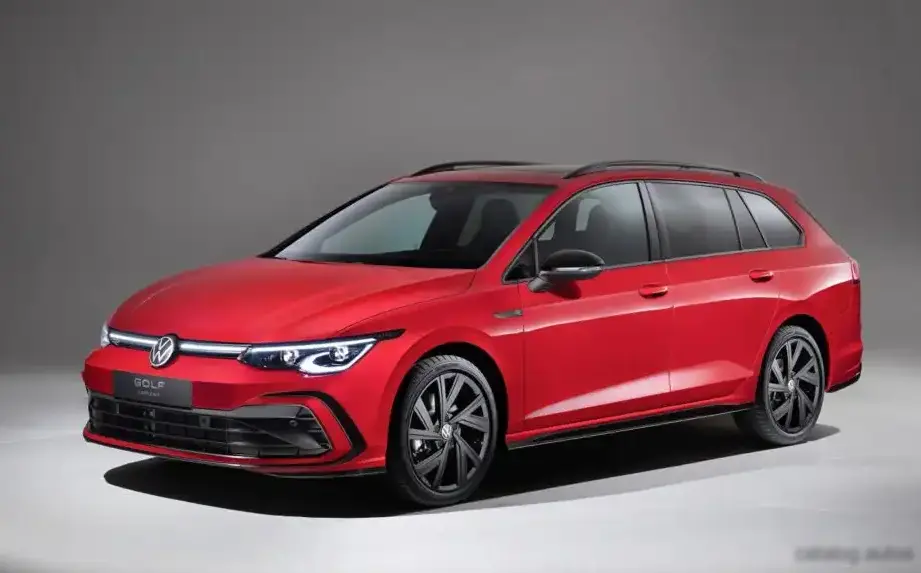
The Volkswagen Golf VIII Variant 1.0 TSI (110 hp) is a front-wheel-drive, five-door station wagon that was produced from 2020 to 2024. Positioned as an entry-level offering within the Golf VIII Variant lineup, it aimed to provide a balance of fuel efficiency, practicality, and affordability. This variant played a significant role in broadening the appeal of the Golf VIII Variant, particularly in European markets where station wagons remain popular. It represents Volkswagen’s continued commitment to downsizing and turbocharging to meet increasingly stringent emissions regulations while maintaining acceptable performance levels.
Technical Specifications
| Brand | Volkswagen |
| Model | Golf |
| Generation | Golf VIII Variant |
| Type (Engine) | 1.0 TSI (110 Hp) |
| Start of production | 2020 |
| End of production | 2024 |
| Powertrain Architecture | Internal Combustion engine |
| Body type | Station wagon (estate) |
| Seats | 5 |
| Doors | 5 |
| Fuel consumption at Low speed (WLTP) | 7.3 l/100 km (32.2 US mpg, 38.7 UK mpg, 13.7 km/l) |
| Fuel consumption at Medium speed (WLTP) | 5.5 l/100 km (42.8 US mpg, 51.4 UK mpg, 18.2 km/l) |
| Fuel consumption at high speed (WLTP) | 4.8 l/100 km (49 US mpg, 58.9 UK mpg, 20.8 km/l) |
| Fuel consumption at very high speed (WLTP) | 5.6 l/100 km (42 US mpg, 50.4 UK mpg, 17.9 km/l) |
| Combined fuel consumption (WLTP) | 5.5 l/100 km (42.8 US mpg, 51.4 UK mpg, 18.2 km/l) |
| CO2 emissions (WLTP) | 126 g/km |
| Fuel consumption (economy) – urban (NEDC) | 5.9 l/100 km (39.9 US mpg, 47.9 UK mpg, 16.9 km/l) |
| Fuel consumption (economy) – extra urban (NEDC) | 4.1 l/100 km (57.4 US mpg, 68.9 UK mpg, 24.4 km/l) |
| Fuel consumption (economy) – combined (NEDC) | 4.8 l/100 km (49 US mpg, 58.9 UK mpg, 20.8 km/l) |
| CO2 emissions (NEDC) | 110 g/km |
| Fuel Type | Petrol (Gasoline) |
| Acceleration 0 – 100 km/h | 10.5 sec |
| Acceleration 0 – 62 mph | 10.5 sec |
| Acceleration 0 – 60 mph | 10 sec (Calculated) |
| Maximum speed | 202 km/h (125.52 mph) |
| Emission standard | Euro 6d-ISC-FCM |
| Weight-to-power ratio | 11.3 kg/Hp, 88.6 Hp/tonne |
| Weight-to-torque ratio | 6.2 kg/Nm, 161 Nm/tonne |
| Power | 110 Hp @ 5000 rpm |
| Power per litre | 110.1 Hp/l |
| Torque | 200 Nm @ 2000-3000 rpm (147.51 lb.-ft.) |
| Engine layout | Front, Transverse |
| Engine Model/Code | DLAA |
| Engine displacement | 999 cm3 (60.96 cu. in.) |
| Number of cylinders | 3 |
| Engine configuration | Inline |
| Cylinder Bore | 74.5 mm (2.93 in.) |
| Piston Stroke | 76.4 mm (3.01 in.) |
| Compression ratio | 10.5:1 |
| Number of valves per cylinder | 4 |
| Fuel injection system | Direct injection |
| Engine aspiration | Turbocharger, Intercooler |
| Valvetrain | DOHC |
| Engine oil capacity | 4 l (4.23 US qt, 3.52 UK qt) |
| Kerb Weight | 1242 kg (2738.14 lbs.) |
| Max. weight | 1850 kg (4078.55 lbs.) |
| Max load | 608 kg (1340.41 lbs.) |
| Trunk (boot) space – minimum | 611 l (21.58 cu. ft.) |
| Trunk (boot) space – maximum | 1642 l (57.99 cu. ft.) |
| Fuel tank capacity | 45 l (11.89 US gal, 9.9 UK gal) |
| Max. roof load | 75 kg (165.35 lbs.) |
| Permitted trailer load with brakes (8%) | 1500 kg (3306.93 lbs.) |
| Permitted trailer load with brakes (12%) | 1300 kg (2866.01 lbs.) |
| Permitted trailer load without brakes | 650 kg (1433 lbs.) |
| Permitted towbar download | 80 kg (176.37 lbs.) |
| Length | 4633 mm (182.4 in.) |
| Width | 1789 mm (70.43 in.) |
| Width including mirrors | 2073 mm (81.61 in.) |
| Height | 1498 mm (58.98 in.) |
| Wheelbase | 2669 mm (105.08 in.) |
| Front track | 1533-1549 mm (60.35 – 60.98 in.) |
| Rear (Back) track | 1503-1519 mm (59.17 – 59.8 in.) |
| Minimum turning circle | 11.1 m (36.42 ft.) |
| Drivetrain Architecture | Front wheel drive, Internal Combustion engine |
| Number of gears and type of gearbox | 6 gears, manual transmission |
| Front suspension | Independent type McPherson |
| Rear suspension | Elastic beam |
| Front brakes | Ventilated discs |
| Rear brakes | Disc |
| Assisting systems | ABS (Anti-lock braking system) |
| Steering type | Steering rack and pinion |
| Power steering | Electric Steering |
| Tires size | 195/65 R 15 |
| Wheel rims size | 6 J x 15 |
INTRODUCTION
The Volkswagen Golf VIII Variant 1.0 TSI (110 hp) represents Volkswagen’s effort to offer a fuel-efficient and practical station wagon option within the eighth generation of the Golf. Introduced in 2020, this variant utilizes a three-cylinder turbocharged engine paired with a six-speed manual transmission. It’s positioned as the entry point to the Golf VIII Variant range, appealing to buyers prioritizing economy and everyday usability over outright performance. Built on the MQB Evo platform (shared with other VW Group vehicles like the Skoda Octavia and SEAT Leon Sportstourer), the Golf VIII Variant aimed to improve upon its predecessor in terms of space, technology, and driving dynamics.
Powertrain & Engine Architecture
At the heart of the Golf VIII Variant 1.0 TSI is the DLAA engine code, a 999cc three-cylinder turbocharged gasoline engine. This engine is part of Volkswagen’s EA211 family, known for its compact size and efficiency. It features direct fuel injection, a single scroll turbocharger, and a variable valve timing system on both the intake and exhaust sides (DOHC). The engine produces 110 horsepower at 5000 rpm and 200 Nm (147.51 lb-ft) of torque between 2000 and 3000 rpm. The six-speed manual transmission is designed to maximize fuel efficiency and provide adequate acceleration. The engine also incorporates a start-stop system to further reduce fuel consumption in urban driving conditions. A particulate filter is included to minimize emissions, meeting Euro 6d-ISC-FCM standards.
Driving Characteristics
The 1.0 TSI engine, while adequate for everyday driving, doesn’t offer the brisk acceleration of higher-powered Golf variants. The 0-62 mph (0-100 km/h) time of 10.5 seconds reflects this. The engine feels most comfortable in the mid-range, providing sufficient torque for overtaking maneuvers on the highway. The six-speed manual transmission is well-matched to the engine’s characteristics, allowing drivers to keep the engine in its optimal power band. Compared to the more powerful 1.5 eTSI or 2.0 TDI models, the 1.0 TSI feels less refined and requires more gear changes, especially when fully loaded or driving uphill. However, its lighter weight contributes to nimble handling and predictable cornering.
Equipment & Trim Levels
The Golf VIII Variant 1.0 TSI typically came equipped with a reasonable level of standard features. These generally included air conditioning, a touchscreen infotainment system with Apple CarPlay and Android Auto compatibility, LED headlights, and a suite of safety features such as automatic emergency braking and lane departure warning. Interior upholstery was typically cloth, with options for upgraded materials available. Higher trim levels offered additional features like adaptive cruise control, a larger touchscreen display, and a digital instrument cluster. Optional extras included a panoramic sunroof, upgraded sound system, and parking assist features.
Chassis & Braking
The Golf VIII Variant 1.0 TSI utilizes an independent McPherson strut suspension at the front and an elastic beam rear suspension. This setup provides a good balance between ride comfort and handling. The front brakes are ventilated discs, while the rear brakes are solid discs. ABS (Anti-lock Braking System) is standard. The suspension is tuned to prioritize comfort, but it still offers a reasonably controlled driving experience. Stabilizer bars are fitted to both the front and rear axles to reduce body roll during cornering.
Market Reception & Comparison
The Golf VIII Variant 1.0 TSI was generally well-received by automotive critics as a practical and economical option. Its fuel efficiency was a major selling point, with combined fuel consumption figures around 5.5 l/100 km (42.8 US mpg). However, some reviewers noted that the engine could feel strained when carrying a full load or driving on steep inclines. Compared to the 1.5 eTSI mild-hybrid variant, the 1.0 TSI offered lower initial cost but sacrificed some performance and refinement. The 2.0 TDI diesel models provided superior fuel economy and torque but came with a higher price tag and potential concerns about diesel emissions.
Legacy
The 1.0 TSI engine has proven to be relatively reliable, although some owners have reported issues with the timing chain. Regular maintenance, including oil changes and timing chain inspections, is crucial for ensuring long-term durability. On the used car market, the Golf VIII Variant 1.0 TSI represents a good value proposition for buyers seeking a practical and fuel-efficient station wagon. Its relatively low running costs and comfortable ride make it a popular choice for families and commuters. The engine’s compact size and efficiency continue to make it a relevant powertrain option in Volkswagen’s current lineup.