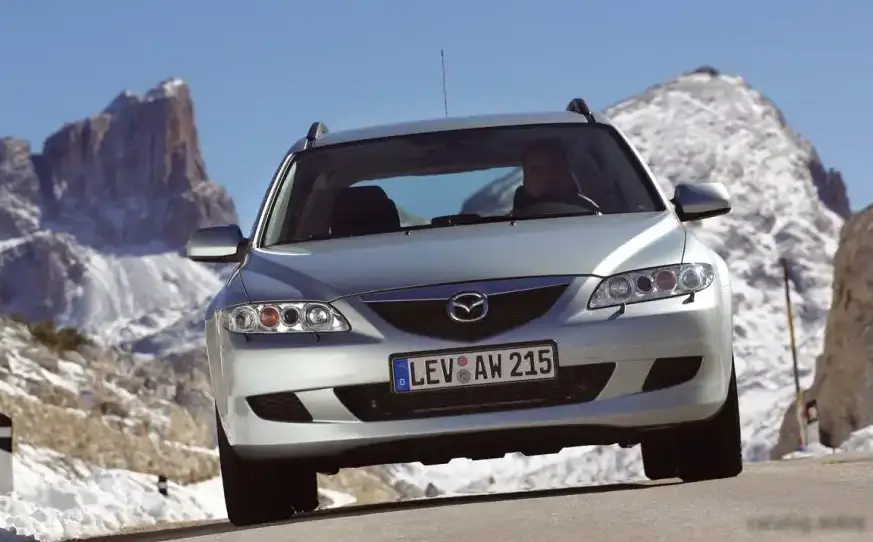
The Mazda 6 III Sport Combi (GJ series, post-facelift 2015) 2.2 SKYACTIV-D 150 hp 4×4 i-ELOOP represents a compelling blend of efficiency, practicality, and driving dynamics within the Mazda 6 lineup. Produced from 2015 to 2017, this variant occupied a mid-to-upper position in the range, offering all-wheel drive capability and Mazda’s fuel-saving i-ELOOP regenerative braking system. It was primarily marketed in Europe and other regions where diesel station wagons with all-wheel drive were popular, catering to buyers seeking a versatile and economical vehicle for both daily commuting and longer journeys.
Technical Specifications
| Brand | Mazda |
| Model | 6 |
| Generation | 6 III Sport Combi (GJ, facelift 2015) |
| Type (Engine) | 2.2 SKYACTIV-D (150 Hp) 4×4 i-ELOOP |
| Start of production | 2015 |
| End of production | 2017 |
| Powertrain Architecture | Internal Combustion engine |
| Body type | Station wagon (estate) |
| Seats | 5 |
| Doors | 5 |
| Fuel consumption (urban) | 6.1 l/100 km (38.6 US mpg, 46.3 UK mpg, 16.4 km/l) |
| Fuel consumption (extra urban) | 4.4 l/100 km (53.5 US mpg, 64.2 UK mpg, 22.7 km/l) |
| Fuel consumption (combined) | 5 l/100 km (47 US mpg, 56.5 UK mpg, 20 km/l) |
| CO2 emissions | 132 g/km |
| Fuel Type | Diesel |
| Acceleration 0 – 100 km/h | 9.5 sec |
| Acceleration 0 – 62 mph | 9.5 sec |
| Acceleration 0 – 60 mph | 9 sec (Calculated) |
| Maximum speed | 201 km/h (124.9 mph) |
| Emission standard | Euro 6 |
| Weight-to-power ratio | 9.8 kg/Hp, 102 Hp/tonne |
| Weight-to-torque ratio | 3.9 kg/Nm, 258.5 Nm/tonne |
| Power | 150 Hp @ 4500 rpm |
| Power per litre | 68.5 Hp/l |
| Torque | 380 Nm @ 1800-2600 rpm (280.27 lb.-ft. @ 1800-2600 rpm) |
| Engine layout | Front, Transverse |
| Engine Model/Code | SHY4 |
| Engine displacement | 2191 cm3 (133.7 cu. in.) |
| Number of cylinders | 4 |
| Engine configuration | Inline |
| Cylinder Bore | 86 mm (3.39 in.) |
| Piston Stroke | 94.3 mm (3.71 in.) |
| Compression ratio | 14:1 |
| Number of valves per cylinder | 4 |
| Fuel injection system | Diesel Commonrail |
| Engine aspiration | BiTurbo, Intercooler |
| Engine oil capacity | 5.1 l (5.39 US qt | 4.49 UK qt) |
| Coolant capacity | 8.5 l (8.98 US qt | 7.48 UK qt) |
| Kerb Weight | 1470-1569 kg (3240.8 – 3459.05 lbs.) |
| Max. weight | 2135 kg (4706.87 lbs.) |
| Max load | 566-665 kg (1247.82 – 1466.07 lbs.) |
| Trunk (boot) space – minimum | 522 l (18.43 cu. ft.) |
| Trunk (boot) space – maximum | 1664 l (58.76 cu. ft.) |
| Fuel tank capacity | 52 l (13.74 US gal | 11.44 UK gal) |
| Max. roof load | 100 kg (220.46 lbs.) |
| Permitted trailer load with brakes (8%) | 1800 kg (3968.32 lbs.) |
| Permitted trailer load with brakes (12%) | 1600 kg (3527.4 lbs.) |
| Permitted trailer load without brakes | 730 kg (1609.37 lbs.) |
| Permitted towbar download | 75 kg (165.35 lbs.) |
| Length | 4805 mm (189.17 in.) |
| Width | 1840 mm (72.44 in.) |
| Width including mirrors | 2113 mm (83.19 in.) |
| Height | 1480 mm (58.27 in.) |
| Wheelbase | 2750 mm (108.27 in.) |
| Front track | 1595 mm (62.8 in.) |
| Rear track | 1585 mm (62.4 in.) |
| Ride height (ground clearance) | 165 mm (6.5 in.) |
| Minimum turning circle | 11.0 m (36.09 ft.) |
| Drive wheel | All wheel drive (4×4) |
| Number of gears | 6 |
| Gearbox type | Manual transmission |
| Front brakes | Ventilated discs |
| Rear brakes | Disc |
INTRODUCTION
The Mazda 6 III Sport Combi, particularly the facelifted version introduced in 2015, represented a significant step forward in Mazda’s design and engineering philosophy. The “Kodo – Soul of Motion” design language was refined, and the vehicle benefited from improvements in interior quality and technology. The 2.2 SKYACTIV-D 150 hp 4×4 i-ELOOP variant was a key offering, designed to appeal to customers who needed the practicality of a station wagon, the security of all-wheel drive, and the fuel efficiency of a modern diesel engine. The i-ELOOP system, a capacitor-based regenerative braking system, further enhanced fuel economy by storing energy recovered during deceleration and using it to power electrical components.
Powertrain & Engine Architecture
At the heart of this variant lies the SHY4 2.2-liter SKYACTIV-D four-cylinder diesel engine. This engine is characterized by its high compression ratio (14:1) and sophisticated twin-turbocharger setup. The two-stage turbocharging system, featuring a small turbo for immediate response and a larger turbo for high-end power, contributes to the engine’s broad torque curve. The engine utilizes a common-rail direct injection system, delivering fuel at extremely high pressures for optimized combustion. The 6-speed manual transmission was standard, providing precise gear changes and contributing to the vehicle’s engaging driving experience. The all-wheel-drive system is a viscous coupling type, automatically distributing torque between the front and rear axles as needed to maintain traction.
Driving Characteristics
The 150 hp SKYACTIV-D engine, coupled with the manual transmission, delivers a balanced driving experience. While not overtly sporty, it provides ample torque (380 Nm / 280 lb-ft) for confident overtaking and effortless cruising. The 0-60 mph acceleration time of around 9 seconds is respectable for a diesel station wagon. The manual gearbox allows for greater driver control, and the gear ratios are well-matched to the engine’s torque curve. Compared to higher-output versions of the 2.2 SKYACTIV-D, this variant prioritizes fuel economy over outright performance. The all-wheel-drive system enhances stability and traction, particularly in adverse weather conditions, making it a capable and sure-footed vehicle.
Equipment & Trim Levels
The 2.2 SKYACTIV-D 150 hp 4×4 i-ELOOP typically came with a generous level of standard equipment. This included features such as air conditioning, power windows, power mirrors, a multi-function steering wheel, and a basic audio system. Higher trim levels offered upgrades such as leather upholstery, heated front seats, a touchscreen infotainment system with navigation, and advanced safety features like lane departure warning and automatic emergency braking. The i-ELOOP system was a standard feature on this variant, contributing to its fuel-saving credentials.
Chassis & Braking
The Mazda 6 Sport Combi features a MacPherson strut front suspension and a multi-link rear suspension, providing a comfortable and controlled ride. The all-wheel-drive models typically had slightly stiffer spring rates to compensate for the added weight of the drivetrain components. Braking duties are handled by ventilated discs at the front and solid discs at the rear. Anti-lock braking system (ABS) and electronic brakeforce distribution (EBD) are standard features, ensuring safe and effective braking performance.
Market Reception & Comparison
The Mazda 6 III Sport Combi 2.2 SKYACTIV-D 150 hp 4×4 i-ELOOP was generally well-received by automotive critics. It was praised for its stylish design, comfortable interior, and fuel-efficient engine. The all-wheel-drive system was seen as a valuable asset for drivers in regions with harsh winters or challenging road conditions. Compared to other diesel station wagons in its class, the Mazda 6 offered a more engaging driving experience and a more premium interior. However, some critics noted that the 150 hp engine could feel slightly underpowered when fully loaded or when tackling steep hills. Fuel economy figures consistently placed it among the best in its segment.
Legacy
The 2.2 SKYACTIV-D engine has proven to be a reliable and durable powertrain, although, like all modern diesel engines, it requires regular maintenance and the use of high-quality oil. The i-ELOOP system has also demonstrated good long-term reliability. On the used car market, these Mazda 6 variants hold their value reasonably well, particularly those with lower mileage and a full service history. They remain a popular choice for buyers seeking a practical, economical, and well-equipped station wagon with all-wheel drive capability.