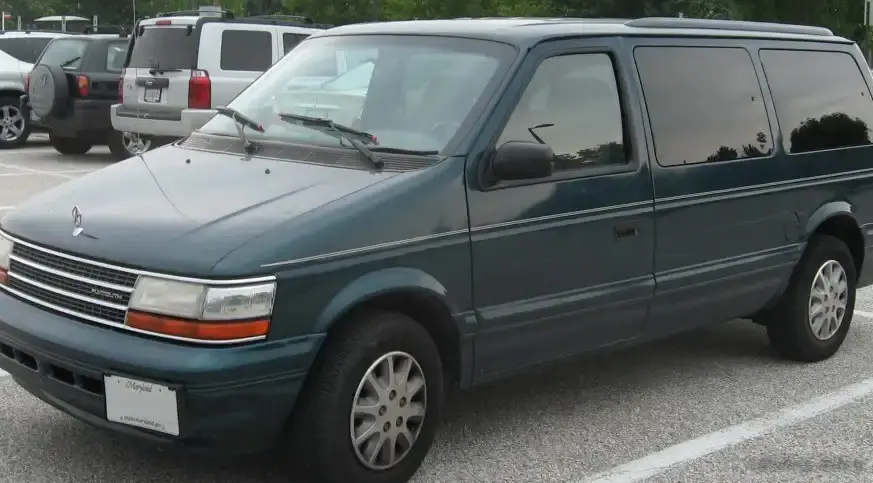
The Plymouth Grand Voyager 3.3i V6 LE, produced from 1990 to 1995, represented a significant offering in the burgeoning minivan segment. Part of the first generation of the Voyager (and its Dodge Caravan counterpart), this variant aimed to provide a balance of family practicality, comfort, and a more upscale experience than base models. It occupied a mid-range position within the Grand Voyager lineup, slotting above the base models and below the more fully-equipped Grand Voyager SE. The 3.3i V6 LE was primarily marketed towards American families seeking a spacious and versatile vehicle for both daily commuting and longer road trips.
Technical Specifications
| Brand | Plymouth |
| Model | Grand Voyager |
| Type | 3.3 i V6 LE (165 Hp) |
| Start of production | 1990 |
| End of production | 1995 |
| Powertrain Architecture | Internal Combustion engine |
| Body type | Minivan |
| Seats | 7 |
| Doors | 4 |
| Fuel consumption (combined) | 11.8 l/100 km (19.9 US mpg, 23.9 UK mpg, 8.5 km/l) |
| Fuel Type | Petrol (Gasoline) |
| Weight-to-power ratio | 10.4 kg/Hp, 96 Hp/tonne |
| Weight-to-torque ratio | 6.5 kg/Nm, 153.1 Nm/tonne |
| Power | 165 Hp @ 4800 rpm |
| Power per litre | 50 Hp/l |
| Torque | 263 Nm @ 3600 rpm (193.98 lb.-ft. @ 3600 rpm) |
| Engine layout | Front, Transverse |
| Engine Model/Code | EGA |
| Engine displacement | 3301 cm3 (201.44 cu. in.) |
| Number of cylinders | 6 |
| Engine configuration | V-engine |
| Cylinder Bore | 93 mm (3.66 in.) |
| Piston Stroke | 81 mm (3.19 in.) |
| Compression ratio | 8.9:1 |
| Number of valves per cylinder | 2 |
| Fuel injection system | Multi-port manifold injection |
| Engine aspiration | Naturally aspirated engine |
| Engine oil capacity | 4.3 l (4.54 US qt | 3.78 UK qt) |
| Coolant capacity | 9.5 l (10.04 US qt | 8.36 UK qt) |
| Kerb Weight | 1718 kg (3787.54 lbs.) |
| Trunk (boot) space – minimum | 1020 l (36.02 cu. ft.) |
| Fuel tank capacity | 75 l (19.81 US gal | 16.5 UK gal) |
| Length | 4898 mm (192.83 in.) |
| Width | 1830 mm (72.05 in.) |
| Height | 1646 mm (64.8 in.) |
| Wheelbase | 3030 mm (119.29 in.) |
| Front track | 1522 mm (59.92 in.) |
| Rear track | 1578 mm (62.13 in.) |
| Drivetrain Architecture | Front wheel drive |
| Number of gears and type of gearbox | 4 gears, automatic transmission |
| Front suspension | Coil spring |
| Rear suspension | Coil spring |
| Front brakes | Ventilated discs |
| Rear brakes | Drum |
| Assisting systems | ABS (Anti-lock braking system) |
| Steering type | Steering rack and pinion |
| Power steering | Hydraulic Steering |
| Tires size | 205/70 R15 S |
Powertrain & Engine Architecture
The heart of the Grand Voyager 3.3i V6 LE was the EGA engine, a 3.3-liter (3301 cc) naturally aspirated V6. This engine was a key component of Chrysler’s powertrain family at the time, and was known for its relatively smooth operation and adequate power delivery. The EGA featured a 90-degree V-angle, two valves per cylinder, and a multi-port fuel injection system. The 8.9:1 compression ratio was a compromise between performance and the fuel quality available in the US market. The engine produced 165 horsepower at 4800 rpm and 263 Nm (194 lb-ft) of torque at 3600 rpm. Paired with this engine was a four-speed automatic transmission, a Torqueflite A727 variant, which was a common and generally reliable unit. This transmission was selected for its ease of use and suitability for family transportation, prioritizing smooth shifts over outright performance.
Driving Characteristics
The 3.3L V6 and four-speed automatic combination in the Grand Voyager LE delivered adequate, but not exhilarating, performance. Acceleration was sufficient for merging onto highways and passing slower traffic, but it wasn’t a particularly quick vehicle. The automatic transmission’s gear ratios were tuned for fuel economy and smooth cruising, rather than aggressive acceleration. Compared to the available 3.0L V6 or the later 3.8L V6 options, the 3.3L offered a middle ground. The 3.8L provided noticeably more power, while the 3.0L was more fuel-efficient but felt underpowered when fully loaded. The front-wheel-drive configuration provided predictable handling, but the Grand Voyager wasn’t designed for sporty driving. The emphasis was on comfort and ease of operation.
Equipment & Trim Levels
The “LE” designation indicated a mid-level trim package. Standard features typically included air conditioning, power windows and locks, an upgraded sound system, and cloth upholstery. The interior featured a relatively simple dashboard layout with easy-to-use controls. Optional extras included a rear entertainment system (a significant selling point for minivans at the time), upgraded audio systems, and alloy wheels. The LE trim aimed to provide a comfortable and well-equipped interior without the higher price tag of the top-tier SE model.
Chassis & Braking
The Grand Voyager utilized a body-on-frame construction, which was common for minivans of that era. The suspension consisted of coil springs at all four corners. Front suspension utilized independent components, while the rear employed a solid axle. Braking duties were handled by ventilated discs at the front and drum brakes at the rear. ABS (Anti-lock Braking System) was included as a standard safety feature. Steering was rack-and-pinion with hydraulic power assist. The tires were typically 205/70R15 size, providing a balance of ride comfort and handling.
Market Reception & Comparison
The Plymouth Grand Voyager 3.3i V6 LE was generally well-received by critics and consumers. It was praised for its spacious interior, comfortable ride, and relatively affordable price. However, some reviewers noted that the 3.3L V6 engine could feel strained when the vehicle was fully loaded or climbing hills. Compared to competitors like the Ford Windstar and the Chevrolet Lumina APV, the Grand Voyager offered a more refined interior and a more modern design. Fuel economy was average for the class, around 19.9 US mpg combined. Reliability was generally good, although some owners reported minor issues with the automatic transmission and electrical components.
Legacy
The Plymouth Grand Voyager 3.3i V6 LE, while no longer in production, remains a relatively common sight on used car lots. The EGA 3.3L V6 engine is known for its durability, and with proper maintenance, can last for many years. The four-speed automatic transmission is also generally reliable. However, like any vehicle of this age, potential buyers should be aware of potential issues such as rust, worn suspension components, and aging rubber parts. Today, these Grand Voyagers are often sought after by families looking for an affordable and spacious vehicle, or by collectors interested in a piece of 1990s automotive history. The 3.3L V6/automatic combination represents a solid, if unspectacular, powertrain that provided reliable service for a generation of families.