
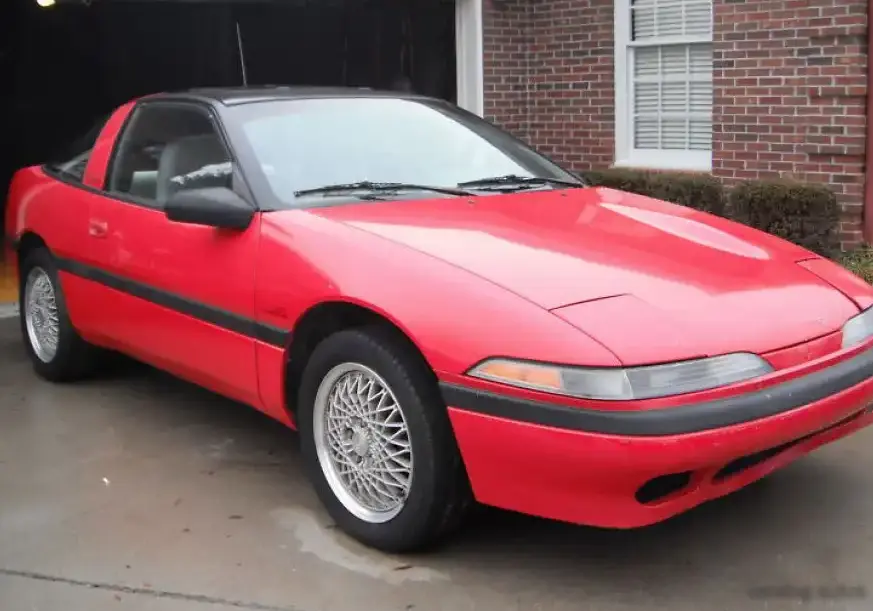
The Plymouth Laser 1.8i, producing 94 horsepower, was a front-wheel-drive coupe manufactured from 1989 to 1994. It represented Plymouth’s entry into the sporty compact car market, sharing its platform and many components with the Mitsubishi Eclipse and Eagle Talon – a result of the Diamond-Star Motors joint venture between Chrysler and Mitsubishi. Positioned as the base model within the Laser lineup, the 1.8i offered a more affordable and fuel-efficient alternative to the higher-performance Turbo and V6 variants. It was primarily aimed at buyers seeking a stylish, economical, and relatively practical coupe.
Technical Specifications
| Brand | Plymouth |
| Model | Laser |
| Generation | Laser |
| Type (Engine) | 1.8i (94 Hp) |
| Start of production | 1989 |
| End of production | 1994 |
| Powertrain Architecture | Internal Combustion engine |
| Body type | Coupe |
| Seats | 4 |
| Doors | 3 |
| Fuel consumption (urban) | 10 l/100 km (23.5 US mpg) |
| Fuel consumption (extra urban) | 6 l/100 km (39.2 US mpg) |
| Fuel Type | Petrol (Gasoline) |
| Maximum speed | 175 km/h (108.74 mph) |
| Weight-to-power ratio | 12.7 kg/Hp |
| Weight-to-torque ratio | 8.4 kg/Nm |
| Power | 94 Hp @ 5000 rpm |
| Power per litre | 53.6 Hp/l |
| Torque | 142 Nm @ 3500 rpm (104.73 lb.-ft. @ 3500 rpm) |
| Engine layout | Front, Transverse |
| Engine Model/Code | 4G37 |
| Engine displacement | 1755 cm3 (107.1 cu. in.) |
| Number of cylinders | 4 |
| Engine configuration | Inline |
| Cylinder Bore | 80.6 mm (3.17 in.) |
| Piston Stroke | 86 mm (3.39 in.) |
| Compression ratio | 9:1 |
| Number of valves per cylinder | 2 |
| Fuel injection system | Multi-port manifold injection |
| Engine aspiration | Naturally aspirated engine |
| Valvetrain | OHC |
| Engine oil capacity | 3.8 l (4.02 US qt | 3.34 UK qt) |
| Coolant capacity | 6 l (6.34 US qt | 5.28 UK qt) |
| Kerb Weight | 1190 kg (2623.5 lbs.) |
| Trunk (boot) space – minimum | 290 l (10.24 cu. ft.) |
| Trunk (boot) space – maximum | 730 l (25.78 cu. ft.) |
| Fuel tank capacity | 60 l (15.85 US gal | 13.2 UK gal) |
| Length | 4330 mm (170.47 in.) |
| Width | 1690 mm (66.54 in.) |
| Height | 1310 mm (51.57 in.) |
| Wheelbase | 2470 mm (97.24 in.) |
| Front track | 1465 mm (57.68 in.) |
| Rear track | 1450 mm (57.09 in.) |
| Drivetrain Architecture | Front wheel drive |
| Number of gears | 5 |
| Type of gearbox | Manual transmission |
| Front suspension | Coil spring |
| Rear suspension | Coil spring |
| Front brakes | Ventilated discs |
| Rear brakes | Disc |
| Assisting systems | ABS (Anti-lock braking system) |
| Steering type | Steering rack and pinion |
| Power steering | Hydraulic Steering |
| Tires size | 185/70 R14 |
Powertrain & Engine Architecture
The Plymouth Laser 1.8i was powered by Mitsubishi’s 4G37 inline-four cylinder engine. This 1.8-liter (1755 cc) engine featured a single overhead camshaft (SOHC) valvetrain with two valves per cylinder. It utilized a multi-port fuel injection system, which improved fuel atomization and efficiency compared to earlier carburetor designs. The engine produced 94 horsepower at 5000 rpm and 142 Nm (104.73 lb-ft) of torque at 3500 rpm. The 9:1 compression ratio was a compromise between performance and the ability to run on readily available gasoline grades. The engine was transversely mounted in the front of the vehicle, driving the front wheels. The standard transmission was a five-speed manual, although a four-speed automatic transmission was also available, albeit less common in this trim.
Driving Characteristics
The 1.8i Laser offered modest performance. Acceleration was adequate for everyday driving, but it wasn’t particularly quick. The 0-60 mph time was estimated to be around 10-11 seconds. The five-speed manual transmission allowed drivers to keep the engine in its optimal power band, providing a more engaging driving experience. The automatic transmission, while offering convenience, resulted in noticeable performance degradation due to its less efficient power delivery and wider gear ratios. Handling was generally considered competent, with the front-wheel-drive layout providing predictable cornering behavior. However, it lacked the sharpness and responsiveness of the Turbo or V6 models.
Equipment & Trim Levels
The 1.8i Laser was typically equipped with basic features. Standard equipment generally included cloth upholstery, a basic AM/FM stereo, manual windows and locks, and a tilt steering wheel. Air conditioning was often an optional extra. The interior design was functional but not luxurious. Higher trim levels, though rare on the 1.8i, could add features like power windows and locks, upgraded audio systems, and alloy wheels. The base model focused on affordability, so many features were kept to a minimum.
Chassis & Braking
The Laser 1.8i utilized a relatively simple chassis design. Both front and rear suspension systems employed coil springs and MacPherson struts. The front brakes were ventilated discs, providing adequate stopping power, while the rear brakes were solid discs. An anti-lock braking system (ABS) was available as an option, enhancing safety. The steering system was a rack-and-pinion setup with hydraulic power assistance, offering reasonable steering feel and maneuverability. The relatively light weight of the 1.8i model, at approximately 1190 kg (2623.5 lbs), contributed to its manageable handling characteristics.
Market Reception & Comparison
The Plymouth Laser 1.8i was generally well-received as an affordable and stylish coupe. Critics praised its fuel efficiency and practicality, but noted its lack of outright performance compared to the Turbo and V6 models. Compared to its siblings, the Mitsubishi Eclipse and Eagle Talon, the Laser often represented the most budget-friendly option. The 1.8i’s fuel economy was a strong point, achieving around 23.5 mpg in the city and 39.2 mpg on the highway. Reliability was generally good, although the 4G37 engine was known to be susceptible to oil leaks as it aged. The automatic transmission, while convenient, was sometimes criticized for its sluggishness and potential for long-term durability issues.
Legacy
The Plymouth Laser 1.8i, while not the most powerful or sought-after variant, remains a popular choice among enthusiasts seeking an affordable and reliable classic coupe. The 4G37 engine is known for its relative simplicity and ease of maintenance. Parts availability is generally good, thanks to the shared components with the Eclipse and Talon. Today, well-maintained examples of the 1.8i Laser can be found in the used car market at relatively low prices, making them an attractive option for those looking for a retro-styled coupe with reasonable running costs. The car represents a unique period in automotive history, showcasing the success of the Diamond-Star Motors joint venture and the growing popularity of sporty coupes in the early 1990s.
