
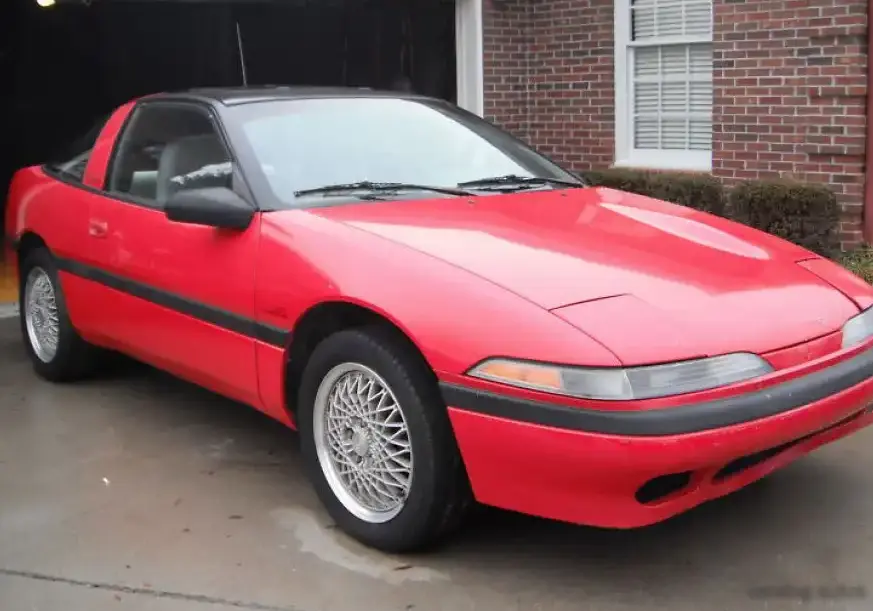
The Plymouth Laser 2.0i Turbo, produced between 1991 and 1994, represented a bold entry by Plymouth into the burgeoning sport-compact coupe market. Built in partnership with Mitsubishi – and mechanically identical to the Mitsubishi Eclipse and Eagle Talon – the Laser was part of the Diamond Star Motors (DSM) project, a joint venture aimed at producing competitive and technologically advanced vehicles. The 2.0i Turbo variant occupied the performance-oriented end of the Laser lineup, offering a significant power upgrade over the base models and appealing to drivers seeking a sporty and engaging driving experience. It was positioned as a direct competitor to vehicles like the Toyota Celica and Nissan NX.
Technical Specifications
| Brand | Plymouth |
| Model | Laser |
| Generation | Laser |
| Type (Engine) | 2.0i Turbo (195 Hp) |
| Start of production | 1991 |
| End of production | 1994 |
| Powertrain Architecture | Internal Combustion engine |
| Body type | Coupe |
| Seats | 4 |
| Doors | 3 |
| Fuel consumption (urban) | 18 l/100 km (13.1 US mpg) |
| Fuel consumption (extra urban) | 9 l/100 km (26.1 US mpg) |
| Fuel Type | Petrol (Gasoline) |
| Maximum speed | 230 km/h (142.92 mph) |
| Weight-to-power ratio | 6.4 kg/Hp |
| Weight-to-torque ratio | 4.5 kg/Nm |
| Power | 195 Hp @ 6000 rpm |
| Power per litre | 97.6 Hp/l |
| Torque | 276 Nm @ 3000 rpm (203.57 lb.-ft. @ 3000 rpm) |
| Engine layout | Front, Transverse |
| Engine Model/Code | 4G63T |
| Engine displacement | 1997 cm3 (121.86 cu. in.) |
| Number of cylinders | 4 |
| Engine configuration | Inline |
| Cylinder Bore | 85 mm (3.35 in.) |
| Piston Stroke | 88 mm (3.46 in.) |
| Compression ratio | 7.8:1 |
| Number of valves per cylinder | 4 |
| Fuel injection system | Multi-port manifold injection |
| Engine aspiration | Turbocharger |
| Valvetrain | DOHC |
| Engine oil capacity | 4.5 l (4.76 US qt | 3.96 UK qt) |
| Coolant capacity | 7 l (7.4 US qt | 6.16 UK qt) |
| Kerb Weight | 1245 kg (2744.76 lbs.) |
| Trunk (boot) space – minimum | 290 l (10.24 cu. ft.) |
| Trunk (boot) space – maximum | 730 l (25.78 cu. ft.) |
| Fuel tank capacity | 60 l (15.85 US gal | 13.2 UK gal) |
| Length | 4330 mm (170.47 in.) |
| Width | 1690 mm (66.54 in.) |
| Height | 1310 mm (51.57 in.) |
| Wheelbase | 2470 mm (97.24 in.) |
| Front track | 1465 mm (57.68 in.) |
| Rear track | 1450 mm (57.09 in.) |
| Drivetrain Architecture | Front wheel drive |
| Number of gears | 5 |
| Gearbox type | Manual transmission |
| Front suspension | Coil spring |
| Rear suspension | Coil spring |
| Front brakes | Ventilated discs |
| Rear brakes | Disc |
| Assisting systems | ABS (Anti-lock braking system) |
| Steering type | Steering rack and pinion |
| Power steering | Hydraulic |
| Tires size | 185/70 R14 |
Powertrain & Engine Architecture
The heart of the Laser 2.0i Turbo was the 4G63T engine, a 2.0-liter, inline-four cylinder powerplant. This engine was a product of Mitsubishi’s extensive experience in turbocharged engine technology. The 4G63T featured a cast iron block and an aluminum cylinder head, incorporating a double overhead camshaft (DOHC) valvetrain with four valves per cylinder. This configuration allowed for efficient airflow and contributed to the engine’s high output. Fuel delivery was handled by a multi-port fuel injection system, precisely metering fuel into the intake ports. The turbocharger, a Garrett unit, provided significant boost, increasing power output substantially. The engine’s 7.8:1 compression ratio was a compromise between performance and reliability when used with a turbocharger. The 2.0i Turbo was exclusively offered with a five-speed manual transmission, designed to handle the engine’s torque output and provide a more engaging driving experience.
Driving Characteristics
The 195 horsepower and 203 lb-ft of torque delivered by the 4G63T engine transformed the Laser into a genuinely quick coupe. Acceleration was brisk, and the turbocharger provided a noticeable surge of power in the mid-range. While not as refined as some of its competitors, the Laser offered a raw and visceral driving experience. The five-speed manual transmission was well-matched to the engine, allowing drivers to keep the engine in its optimal power band. Compared to the naturally aspirated Laser models, the 2.0i Turbo offered a significantly more responsive and exciting driving experience. The front-wheel-drive layout, while common for the time, could exhibit torque steer under hard acceleration.
Equipment & Trim Levels
The Laser 2.0i Turbo typically came equipped with a relatively comprehensive list of standard features for the early 1990s. These included power windows, power door locks, and an AM/FM stereo. Sport seats with bolstered support were standard, providing good lateral restraint during spirited driving. Optional extras included a sunroof, upgraded audio systems, and alloy wheels. The interior design was functional and driver-focused, with a straightforward dashboard layout and easy-to-read gauges. Upholstery was typically cloth, with leather options available as an upgrade.
Chassis & Braking
The Laser’s chassis utilized a MacPherson strut front suspension and a coil spring rear suspension. This setup provided a reasonable balance between ride comfort and handling. The front suspension incorporated a stabilizer bar to reduce body roll during cornering. Braking duties were handled by ventilated discs at the front and solid discs at the rear. An anti-lock braking system (ABS) was standard, enhancing safety and control during emergency braking situations. The Laser’s relatively lightweight construction – around 2745 pounds – contributed to its agile handling characteristics.
Market Reception & Comparison
The Plymouth Laser 2.0i Turbo was generally well-received by automotive critics, who praised its performance and value. It was often lauded as a compelling alternative to more established sport-compact coupes. However, some reviewers noted the Laser’s somewhat basic interior and the potential for torque steer. Compared to the base model Lasers, the 2.0i Turbo offered a substantial performance upgrade, but at a higher price point. The Mitsubishi Eclipse and Eagle Talon, being mechanically identical, offered similar performance and features. Fuel economy was reasonable for a turbocharged vehicle of its era, averaging around 18 mpg in the city and 26 mpg on the highway.
Legacy
The Plymouth Laser, and particularly the 2.0i Turbo variant, has gained a cult following among enthusiasts. The 4G63T engine is renowned for its durability and tunability, making it a popular choice for aftermarket modifications. Well-maintained examples of the Laser 2.0i Turbo are becoming increasingly collectible. While some issues, such as oil leaks and turbocharger wear, are common with age, the 4G63T engine is generally considered to be a robust and reliable powerplant. The Laser’s legacy lies in its contribution to the sport-compact car scene of the early 1990s and its demonstration of the potential of the DSM partnership.
