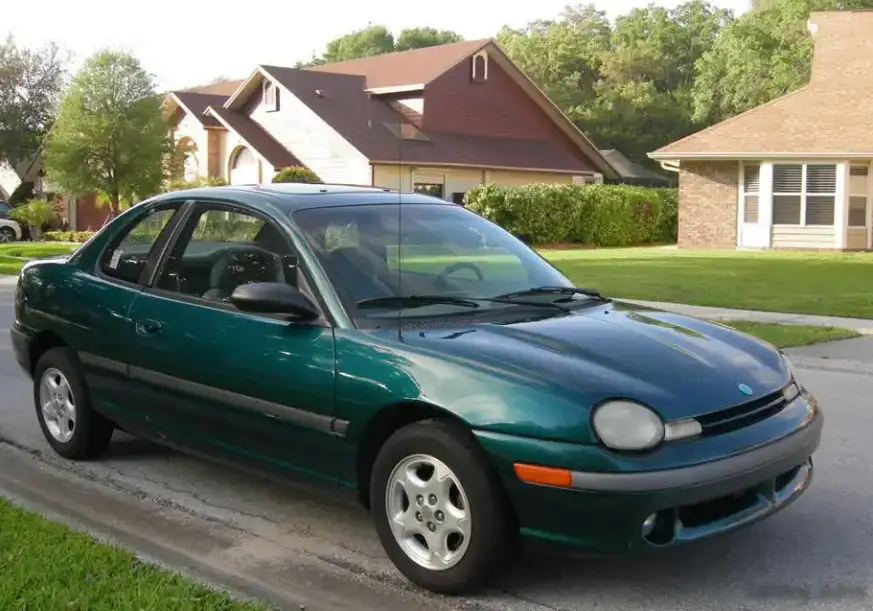
The Plymouth Neon Coupe 2.0 16V, produced from 1994 to 1999, represented Plymouth’s entry into the compact coupe market. Positioned as an affordable and relatively sporty option, the Neon Coupe aimed to attract buyers seeking a modern, fuel-efficient vehicle with a touch of style. It was part of the first generation of the Neon (1994-1999), built on the ‘A’ platform shared with the Dodge Neon and Chrysler Neon, primarily targeting the North American market. The 2.0-liter 16-valve engine, producing 147 horsepower, was a mid-range offering within the Neon lineup, slotting above the base 1.8-liter engine and below any potential performance-oriented trims that were not widely offered.
Technical Specifications
| Brand | Plymouth |
| Model | Neon |
| Generation | Neon Coupe |
| Type (Engine) | 2.0 16V (147 Hp) |
| Start of production | 1994 |
| End of production | 1999 |
| Powertrain Architecture | Internal Combustion engine |
| Body type | Coupe |
| Seats | 5 |
| Doors | 2 |
| Fuel consumption (combined) | 7.2 l/100 km |
| Fuel consumption (US mpg) | 32.7 |
| Fuel consumption (UK mpg) | 39.2 |
| Fuel Type | Petrol (Gasoline) |
| Weight-to-power ratio | 7.4 kg/Hp |
| Power | 147 Hp @ 6600 rpm |
| Power per litre | 73.6 Hp/l |
| Torque | 174 Nm @ 5500 rpm (128.34 lb.-ft. @ 5500 rpm) |
| Engine layout | Front, Transverse |
| Engine Model/Code | ECC |
| Engine displacement | 1996 cm3 (121.8 cu. in.) |
| Number of cylinders | 4 |
| Engine configuration | Inline |
| Cylinder Bore | 87.5 mm (3.44 in.) |
| Piston Stroke | 83 mm (3.27 in.) |
| Compression ratio | 9.8:1 |
| Number of valves per cylinder | 4 |
| Fuel injection system | Multi-port manifold injection |
| Engine aspiration | Naturally aspirated |
| Engine oil capacity | 4.25 l (4.49 US qt | 3.74 UK qt) |
| Coolant capacity | 6 l (6.34 US qt | 5.28 UK qt) |
| Kerb Weight | 1082 kg (2385.4 lbs.) |
| Trunk (boot) space – minimum | 216 l (7.63 cu. ft.) |
| Fuel tank capacity | 47 l (12.42 US gal | 10.34 UK gal) |
| Length | 4364 mm (171.81 in.) |
| Width | 1715 mm (67.52 in.) |
| Height | 1345 mm (52.95 in.) |
| Wheelbase | 2642 mm (104.02 in.) |
| Front track | 1458 mm (57.4 in.) |
| Rear track | 1458 mm (57.4 in.) |
| Drivetrain Architecture | Front wheel drive |
| Number of gears | 5 |
| Gearbox type | Manual transmission |
| Front suspension | Wishbone |
| Rear suspension | Coil spring |
| Front brakes | Ventilated discs |
| Rear brakes | Drum |
| Assisting systems | ABS (Anti-lock braking system) |
| Steering type | Steering rack and pinion |
| Tires size | 185/65 R14 S |
Powertrain & Engine Architecture
The heart of the Neon Coupe 2.0 16V was the 2.0-liter inline-four cylinder engine, designated the ECC code. This engine featured a multi-port fuel injection system, providing precise fuel delivery for improved efficiency and performance. The 16-valve dual overhead camshaft (DOHC) valvetrain allowed for optimized airflow into and out of the cylinders, contributing to the engine’s respectable power output for its displacement. The engine’s design prioritized reliability and affordability, utilizing common materials and a relatively simple layout. The five-speed manual transmission was the standard offering, providing drivers with direct control over the engine’s power. The transmission was chosen for its durability and relatively low cost, aligning with the Neon’s overall value proposition.
Driving Characteristics
The 2.0-liter Neon Coupe offered a noticeable step up in performance compared to the base 1.8-liter model. While not a sports car, the 147 horsepower engine provided adequate acceleration for everyday driving and even some spirited maneuvers. The five-speed manual transmission allowed drivers to keep the engine in its optimal power band, resulting in responsive performance. The gear ratios were tuned for a balance between acceleration and fuel economy. Compared to a hypothetical higher-output version, the 2.0-liter engine prioritized smooth power delivery over outright peak performance. The front-wheel-drive configuration provided predictable handling, although it could exhibit some torque steer under hard acceleration.
Equipment & Trim Levels
The Neon Coupe 2.0 16V typically came standard with features such as air conditioning, power steering, and an AM/FM radio. Interior upholstery was generally cloth, with a simple and functional dashboard layout. Optional extras included upgraded sound systems, power windows and locks, and alloy wheels. The trim level of the 2.0-liter model was generally considered mid-range, offering a good balance of features and affordability. It wasn’t a luxury trim, but it provided more comfort and convenience than the base models.
Chassis & Braking
The Neon Coupe utilized a front-wheel-drive chassis with an independent wishbone front suspension and a coil spring rear suspension. This setup provided a comfortable ride quality while maintaining reasonable handling characteristics. The front brakes were ventilated discs, offering good stopping power, while the rear brakes were drums, a cost-saving measure. Anti-lock braking system (ABS) was available, enhancing safety by preventing wheel lockup during hard braking. The steering system employed a rack and pinion setup, providing precise and responsive steering feel.
Market Reception & Comparison
The Plymouth Neon Coupe 2.0 16V was generally well-received by critics as an affordable and practical compact coupe. It was praised for its fuel efficiency, comfortable ride, and relatively spacious interior. However, some critics noted that the interior materials were somewhat basic and that the engine lacked the refinement of some competitors. Compared to other trims in the Neon lineup, the 2.0-liter model offered a significant performance advantage over the base 1.8-liter engine, making it a popular choice for drivers who wanted a bit more power. Fuel economy was comparable to other compact coupes of the era, and reliability was generally considered good.
Legacy
The Plymouth Neon Coupe 2.0 16V has become a relatively affordable and accessible classic car in the used car market. The ECC engine is known for its durability, although regular maintenance is essential to prevent issues. Common problems include oil leaks and sensor failures. Parts availability is generally good, as many components were shared with other Chrysler, Dodge, and Plymouth models. While not a highly sought-after collector’s item, the Neon Coupe 2.0 16V remains a popular choice for enthusiasts seeking an affordable and reliable compact coupe with a touch of 1990s styling. Its simple design and relatively easy maintenance make it a good candidate for restoration or modification projects.