
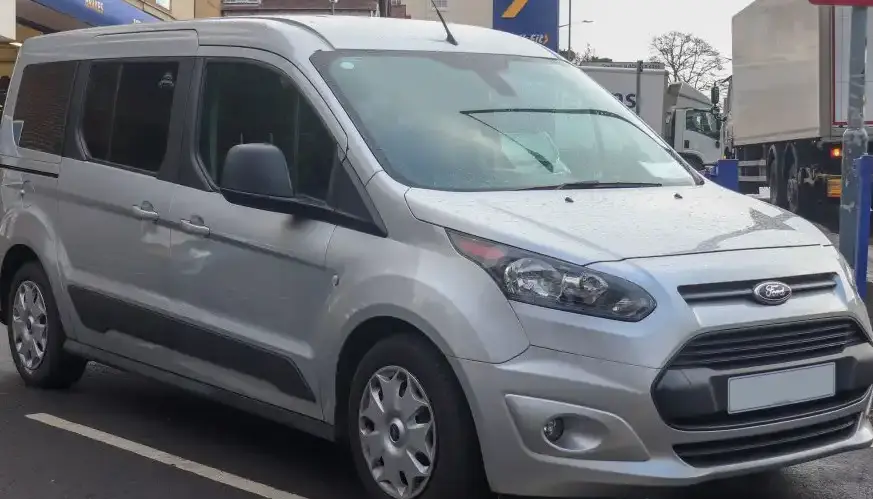
The Ford Grand Tourneo Connect II 1.6 Duratorq TDCi 75 hp, 7-seat variant was a popular choice in the European market from 2014 to 2015. Positioned as an entry-level offering within the second generation Tourneo Connect range, it catered to families and businesses needing a practical and affordable multi-passenger vehicle. Built on the Ford C-Max/Focus platform (Mk2), it offered a blend of space, efficiency, and functionality. This model represented Ford’s attempt to capture a segment seeking a compact minivan alternative to larger, more expensive options.
Technical Specifications
| Brand | Ford |
| Model | Tourneo Connect |
| Generation | Grand Tourneo Connect II |
| Type | 1.6 Duratorq TDCi (75 Hp) 7 Seat |
| Start of production | 2014 |
| End of production | 2015 |
| Powertrain Architecture | Internal Combustion engine |
| Body type | Minivan |
| Seats | 7 |
| Doors | 5 |
| Fuel consumption (urban) | 5.6 l/100 km (42 US mpg, 50.4 UK mpg, 17.9 km/l) |
| Fuel consumption (extra urban) | 4.6 l/100 km (51.1 US mpg, 61.4 UK mpg, 21.7 km/l) |
| Fuel consumption (combined) | 5 l/100 km (47 US mpg, 56.5 UK mpg, 20 km/l) |
| CO2 emissions | 130 g/km |
| Fuel Type | Diesel |
| Acceleration 0 – 100 km/h | 18.3 sec |
| Acceleration 0 – 62 mph | 18.3 sec |
| Acceleration 0 – 60 mph | 17.4 sec |
| Maximum speed | 145 km/h (90.1 mph) |
| Emission standard | Euro 5 |
| Weight-to-power ratio | 19.2 kg/Hp, 52.2 Hp/tonne |
| Weight-to-torque ratio | 6.5 kg/Nm, 153.1 Nm/tonne |
| Power | 75 Hp @ 3500 rpm |
| Power per litre | 48.1 Hp/l |
| Torque | 220 Nm @ 1500 rpm (162.26 lb.-ft. @ 1500 rpm) |
| Engine layout | Front, Transverse |
| Engine Model/Code | UBGA |
| Engine displacement | 1560 cm3 (95.2 cu. in.) |
| Number of cylinders | 4 |
| Engine configuration | Inline |
| Cylinder Bore | 75 mm (2.95 in.) |
| Piston Stroke | 88.3 mm (3.48 in.) |
| Compression ratio | 16:1 |
| Number of valves per cylinder | 2 |
| Fuel injection system | Diesel Commonrail |
| Engine aspiration | Turbocharger, Intercooler |
| Valvetrain | SOHC |
| Engine oil capacity | 6.2 l (6.55 US qt | 5.46 UK qt) |
| Coolant | 7.3 l (7.71 US qt | 6.42 UK qt) |
| Kerb Weight | 1437 kg (3168.04 lbs.) |
| Max. weight | 2300 kg (5070.63 lbs.) |
| Max load | 863 kg (1902.59 lbs.) |
| Trunk (boot) space – minimum | 322 l (11.37 cu. ft.) |
| Trunk (boot) space – maximum | 2620 l (92.52 cu. ft.) |
| Permitted trailer load with brakes (12%) | 800 kg (1763.7 lbs.) |
| Permitted trailer load without brakes | 750 kg (1653.47 lbs.) |
| Length | 4818 mm (189.69 in.) |
| Width | 1835 mm (72.24 in.) |
| Width with mirrors folded | 1966 mm (77.4 in.) |
| Width including mirrors | 2137 mm (84.13 in.) |
| Height | 1840 mm (72.44 in.) |
| Wheelbase | 2662 mm (104.8 in.) |
| Front track | 1568 mm (61.73 in.) |
| Rear (Back) track | 1584 mm (62.36 in.) |
| Minimum turning circle | 12.2 m (40.03 ft.) |
| Drivetrain Architecture | Front wheel drive |
| Number of gears and type of gearbox | 5 gears, manual transmission |
| Front suspension | Independent, type McPherson with coil spring and anti-roll bar |
| Rear suspension | Semi-dependent beam with stabilizer lateral stability |
| Front brakes | Ventilated discs, 320 mm |
| Rear brakes | Disc, 280 mm |
| Assisting systems | ABS (Anti-lock braking system) |
| Steering type | Steering rack and pinion |
| Tires size | 205/60 R16 |
| Wheel rims size | 6.5J x 16 |
Powertrain & Engine Architecture
The heart of this Tourneo Connect variant is the 1.6-liter Duratorq TDCi engine, specifically the UBGA code. This engine is a four-cylinder, inline diesel, utilizing a turbocharger with intercooling to boost power and efficiency. The engine employs a common rail direct injection system, delivering fuel directly into the cylinders at high pressure for optimized combustion. The SOHC (Single Overhead Camshaft) valvetrain operates two valves per cylinder. The 75 horsepower output is achieved at 3500 rpm, while peak torque of 220 Nm (162 lb-ft) is available from just 1500 rpm, providing reasonable low-end grunt for everyday driving. The engine is transversely mounted at the front of the vehicle. The 5-speed manual transmission was the only gearbox option for this specific configuration.
Driving Characteristics
The 1.6 Duratorq TDCi 75 hp engine, paired with the 5-speed manual transmission, delivers modest performance. Acceleration is slow, with a 0-60 mph time of around 17.4 seconds. The focus is on fuel economy rather than outright speed. The gear ratios are tuned for efficiency, meaning the engine needs to be revved to maintain speed on inclines or when fully loaded. Compared to higher-powered versions of the Tourneo Connect (like those with the 1.6 TDCi 95 hp or 1.0 EcoBoost petrol engines), this variant feels noticeably underpowered. However, the readily available torque at low RPMs makes it suitable for urban driving and carrying loads. The manual transmission provides more driver control than an automatic would, but requires more driver involvement.
Equipment & Trim Levels
The 75 hp Duratorq TDCi 7-seat model typically came with a basic level of equipment. Standard features generally included power steering, ABS, driver and passenger airbags, electric front windows, and a basic audio system. The interior upholstery was typically cloth. Optional extras included air conditioning, alloy wheels, parking sensors, and upgraded audio systems. Trim levels were relatively simple, with the focus being on providing a functional and affordable vehicle. The 7-seat configuration involved a folding third-row bench, providing flexibility for passengers or cargo.
Chassis & Braking
The Grand Tourneo Connect II utilizes a McPherson strut independent suspension setup at the front, providing a comfortable ride. The rear suspension employs a semi-independent beam with a stabilizer bar, balancing ride comfort with handling stability. The braking system consists of ventilated discs on the front wheels and solid discs on the rear. ABS (Anti-lock Braking System) is standard. The suspension tuning is geared towards comfort and practicality rather than sporty handling. The relatively light curb weight of around 1437 kg (3168 lbs) helps to mitigate the effects of the low horsepower output.
Market Reception & Comparison
The 1.6 Duratorq TDCi 75 hp variant was generally well-received as an affordable and economical option. Critics noted its practicality and spaciousness, but also pointed out its lack of power, especially when fully loaded. Compared to the 95 hp version of the same engine, the 75 hp model offered significantly less performance. However, it also delivered slightly better fuel economy. Against competitors like the Citroën Berlingo and Renault Kangoo, the Tourneo Connect offered a competitive package in terms of space, practicality, and price.
Legacy
The 1.6 Duratorq TDCi engine, in its various iterations, proved to be a relatively reliable unit. While not without its issues (such as potential EGR valve problems and turbocharger wear), it generally offered good longevity with regular maintenance. In the used car market, the 75 hp variant represents an affordable entry point into Tourneo Connect ownership. However, potential buyers should be aware of its limited power and consider whether it meets their needs. The simplicity of the engine and transmission makes it relatively easy and inexpensive to repair, contributing to its continued appeal as a budget-friendly family vehicle.
