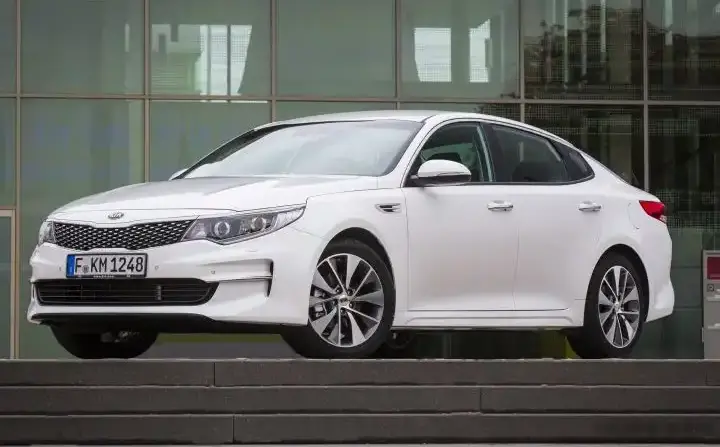
The Kia Optima IV GT 2.0 T-GDI Automatic, produced from 2016 to 2018, represents a significant step forward for Kia in the mid-size sedan segment. Positioned as the performance-oriented variant of the fourth-generation Optima (JF), this model aimed to deliver a more engaging driving experience while maintaining the practicality and comfort expected of a family sedan. It was primarily marketed in North America, Europe, and parts of Asia, offering a compelling alternative to established competitors like the Honda Accord, Toyota Camry, and Ford Fusion. The GT trim, specifically with the 2.0 T-GDI engine and automatic transmission, was the top-of-the-line offering, emphasizing sporty styling and enhanced performance.
Technical Specifications
| Brand | Kia |
| Model | Optima |
| Generation | Optima IV |
| Type (Engine) | GT 2.0 T-GDI (245 Hp) Automatic |
| Start of production | 2016 |
| End of production | 2018 |
| Powertrain Architecture | Internal Combustion engine |
| Body type | Sedan |
| Seats | 5 |
| Doors | 4 |
| Fuel consumption (urban) | 11.8 l/100 km (19.9 US mpg, 23.9 UK mpg, 8.5 km/l) |
| Fuel consumption (extra urban) | 6.1 l/100 km (38.6 US mpg, 46.3 UK mpg, 16.4 km/l) |
| Fuel consumption (combined) | 8.2 l/100 km (28.7 US mpg, 34.4 UK mpg, 12.2 km/l) |
| CO2 emissions | 191 g/km |
| Fuel Type | Petrol (Gasoline) |
| Acceleration 0 – 100 km/h | 7.4 sec |
| Acceleration 0 – 62 mph | 7.4 sec |
| Acceleration 0 – 60 mph | 7 sec |
| Maximum speed | 240 km/h (149.13 mph) |
| Emission standard | Euro 6 |
| Weight-to-power ratio | 6.4 kg/Hp, 155.1 Hp/tonne |
| Weight-to-torque ratio | 4.5 kg/Nm, 223.4 Nm/tonne |
| Power | 245 Hp @ 6000 rpm |
| Power per litre | 122.6 Hp/l |
| Torque | 353 Nm @ 1350-4000 rpm (260.36 lb.-ft. @ 1350-4000 rpm) |
| Engine layout | Front, Transverse |
| Engine Model/Code | G4KH |
| Engine displacement | 1998 cm3 (121.93 cu. in.) |
| Number of cylinders | 4 |
| Engine configuration | Inline |
| Cylinder Bore | 86 mm (3.39 in.) |
| Piston Stroke | 86 mm (3.39 in.) |
| Compression ratio | 10:1 |
| Number of valves per cylinder | 4 |
| Fuel injection system | Direct injection |
| Engine aspiration | Twin-Turbo, Intercooler |
| Engine oil capacity | 4.8 l (5.07 US qt | 4.22 UK qt) |
| Coolant | 7.3 l (7.71 US qt | 6.42 UK qt) |
| Kerb Weight | 1580-1680 kg (3483.3 – 3703.77 lbs.) |
| Max. weight | 2120 kg (4673.8 lbs.) |
| Max load | 440-540 kg (970.03 – 1190.5 lbs.) |
| Trunk (boot) space – minimum | 510 l (18.01 cu. ft.) |
| Fuel tank capacity | 70 l (18.49 US gal | 15.4 UK gal) |
| Max. roof load | 100 kg (220.46 lbs.) |
| Permitted trailer load with brakes (12%) | 1400 kg (3086.47 lbs.) |
| Permitted trailer load without brakes | 700 kg (1543.24 lbs.) |
| Permitted towbar download | 80 kg (176.37 lbs.) |
| Length | 4855 mm (191.14 in.) |
| Width | 1860 mm (73.23 in.) |
| Width including mirrors | 2120 mm (83.46 in.) |
| Height | 1465 mm (57.68 in.) |
| Wheelbase | 2805 mm (110.43 in.) |
| Front track | 1597 mm (62.87 in.) |
| Rear (Back) track | 1608 mm (63.31 in.) |
| Front overhang | 965 mm (37.99 in.) |
| Rear overhang | 1085 mm (42.72 in.) |
| Minimum turning circle (turning diameter) | 10.9 m (35.76 ft.) |
| Drivetrain Architecture | The Internal combustion engine (ICE) drives the front wheels of the vehicle. |
| Drive wheel | Front wheel drive |
| Number of gears and type of gearbox | 6 gears, automatic transmission |
| Front suspension | Independent, type McPherson with coil spring and anti-roll bar |
| Rear suspension | Independent multi-link suspension |
| Front brakes | Ventilated discs |
| Rear brakes | Disc |
| Assisting systems | ABS (Anti-lock braking system) |
| Steering type | Steering rack and pinion |
| Power steering | Electric Steering |
| Tires size | 215/60 R16; 215/55 R17; 235/45 R18 |
| Wheel rims size | 6.5J x 16; 7.5J x 17; 7.5J x18 |
Powertrain & Engine Architecture
The heart of the Optima GT is the 2.0-liter (1998 cc) turbocharged gasoline direct-injection (TGDI) engine, designated G4KH. This inline-four cylinder engine utilizes a twin-scroll turbocharger and intercooler to produce 245 horsepower at 6000 rpm and 260 lb-ft of torque between 1350 and 4000 rpm. The direct injection system optimizes fuel delivery for improved efficiency and performance. The engine features a 10:1 compression ratio and a four-valve-per-cylinder configuration. Paired with this engine is a six-speed automatic transmission, specifically tuned for quicker shifts and a more responsive feel compared to the standard Optima transmissions. This transmission features a torque converter and allows for manual shift control via paddle shifters, enhancing driver engagement.
Driving Characteristics
The 2.0 T-GDI automatic Optima GT delivers noticeably quicker acceleration than lower-trim models. The 7.4-second 0-60 mph time is a testament to the engine’s power and the transmission’s responsiveness. While not a dedicated sports sedan, the GT offers a more dynamic driving experience with improved throttle response and a more confident feel during cornering. The automatic transmission, while smooth, can sometimes feel slightly hesitant during quick downshifts. Compared to a manual transmission equipped Optima, the automatic sacrifices some driver control but provides greater convenience for everyday driving. The gear ratios are optimized for a balance of acceleration and fuel economy, with a relatively tall sixth gear for highway cruising.
Equipment & Trim Levels
The GT trim level came standard with a number of features designed to enhance both comfort and performance. These included leather upholstery, heated and ventilated front seats, a premium audio system, a touchscreen infotainment system with navigation, and a suite of advanced driver-assistance systems (ADAS) such as adaptive cruise control, lane departure warning, and automatic emergency braking. Exterior styling cues included a unique front grille, rear spoiler, and dual exhaust outlets. Optional extras included a panoramic sunroof, premium paint colors, and upgraded wheels. The interior featured a sporty design with metal accents and unique GT badging.
Chassis & Braking
The Optima GT features an independent suspension system at all four corners. The front suspension utilizes a McPherson strut design with coil springs and an anti-roll bar, while the rear suspension employs a multi-link setup. This configuration provides a good balance of ride comfort and handling precision. Braking duties are handled by ventilated disc brakes at the front and solid disc brakes at the rear. The GT trim also benefits from larger brake rotors and calipers compared to lower trims, providing improved stopping power. The electric power steering system offers a responsive and precise feel.
Market Reception & Comparison
The Kia Optima GT 2.0 T-GDI Automatic was generally well-received by automotive critics. Reviewers praised its stylish design, spacious interior, and strong performance. The fuel economy, averaging around 28.7 US mpg in combined driving, was considered competitive for its class. Compared to the base 1.6L turbo engine, the 2.0L GT offered a significant performance upgrade, but at a higher price point. Reliability reports have been generally positive, with few major issues reported with the powertrain. However, some owners have noted minor issues with the infotainment system and certain trim pieces.
Legacy
The Kia Optima GT 2.0 T-GDI Automatic played a crucial role in elevating Kia’s brand image and demonstrating its ability to produce genuinely competitive mid-size sedans. The G4KH engine proved to be a robust and reliable powerplant, and the six-speed automatic transmission provided smooth and efficient operation. On the used car market, these models hold their value relatively well, particularly those in excellent condition with low mileage. The Optima GT remains a popular choice for buyers seeking a stylish, well-equipped, and reasonably priced sedan with a sporty driving experience.