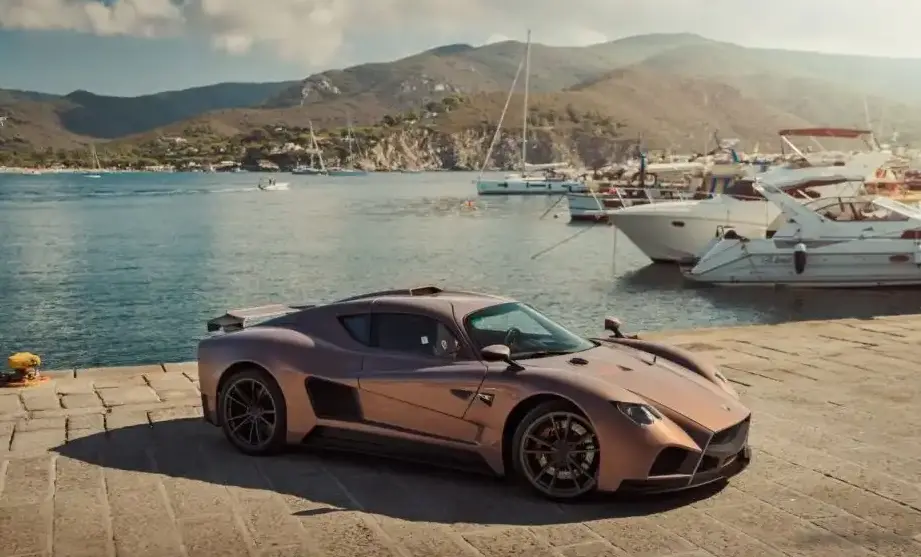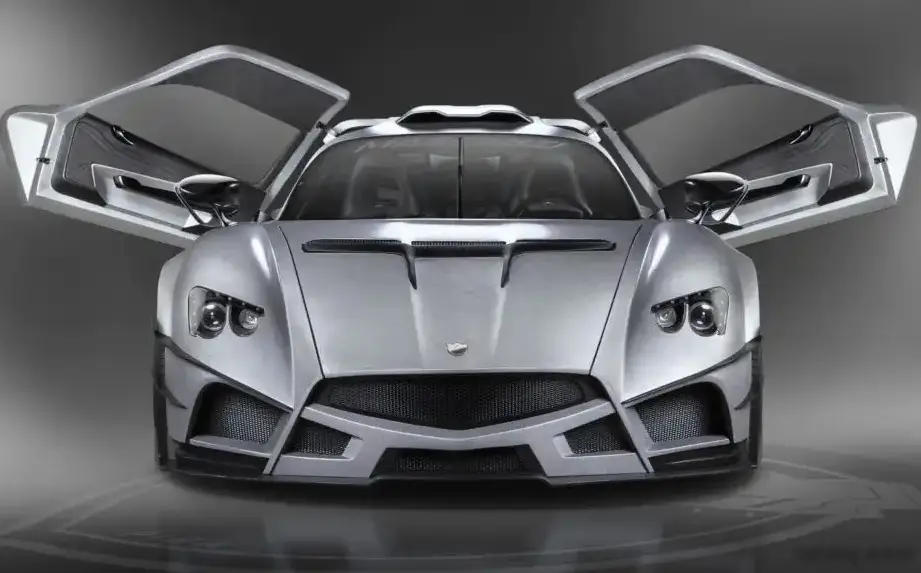
The Mazzanti Evantra Millecavalli, produced from 2016 to 2021, represents the highest-performance variant of the Italian automaker’s flagship model, the Evantra. Positioned as an ultra-exclusive, hand-built supercar, the Millecavalli (“thousand horsepower” in Italian) was designed to compete with established hypercar manufacturers. It’s built around a central carbon fiber monocoque chassis and features a heavily modified, twin-turbocharged V8 engine. The Evantra, in general, aimed to offer a bespoke, personalized experience for discerning customers, and the Millecavalli took that philosophy to its extreme.
Technical Specifications
| Brand | Mazzanti |
| Model | Evantra |
| Generation | Evantra Millecavalli |
| Type (Engine) | 7.2 V8 (1001 Hp) |
| Start of production | 2016 |
| End of production | 2021 |
| Powertrain Architecture | Internal Combustion engine |
| Body type | Coupe |
| Seats | 2 |
| Doors | 2 |
| Fuel Type | Petrol (Gasoline) |
| Acceleration 0 – 100 km/h | 2.7 sec |
| Acceleration 0 – 62 mph | 2.7 sec |
| Acceleration 0 – 60 mph | 2.6 sec |
| Maximum speed | 400 km/h (248.55 mph) |
| Weight-to-power ratio | 1.3 kg/Hp, 770 Hp/tonne |
| Weight-to-torque ratio | 1.1 kg/Nm, 930.8 Nm/tonne |
| Power | 1001 Hp @ 7500 rpm |
| Power per litre | 139 Hp/l |
| Torque | 1210 Nm @ 6500 rpm (892.45 lb.-ft. @ 6500 rpm) |
| Engine layout | Middle, Longitudinal |
| Engine displacement | 7200 cm3 (439.37 cu. in.) |
| Number of cylinders | 8 |
| Engine configuration | V-engine |
| Engine aspiration | BiTurbo, Intercooler |
| Kerb Weight | 1300 kg (2866.01 lbs.) |
| Length | 4425 mm (174.21 in.) |
| Width | 2008 mm (79.06 in.) |
| Height | 1225 mm (48.23 in.) |
| Wheelbase | 2550 mm (100.39 in.) |
| Drivetrain Architecture | Rear wheel drive, Internal Combustion engine |
| Number of gears and type of gearbox | 6 gears, manual transmission |
| Front suspension | Independent type McPherson |
| Rear suspension | McPherson |
| Front brakes | Ventilated discs, 390 mm |
| Rear brakes | Ventilated discs, 360 mm |
| Steering type | Steering rack and pinion |
| Front wheel tires | 265/35 R19 |
| Rear wheel tires | 335/30 R20 |
| Front wheel rims | 9.5J x 19 |
| Rear wheel rims | 12J x 20 |
Powertrain & Engine Architecture
The heart of the Millecavalli is its 7.2-liter V8 engine. This isn’t a newly designed engine from the ground up, but rather a heavily modified version of an American V8, reportedly based on a Chevrolet LS architecture. Mazzanti significantly upgraded the engine with twin turbochargers, an intercooler, and reinforced internal components to handle the immense power output. The engine utilizes a sophisticated engine management system to control fuel injection and ignition timing, optimizing performance and responsiveness. The 6-speed manual transmission was chosen to provide a direct connection between driver and machine, catering to the enthusiast market. The engine is mounted longitudinally in a mid-engine configuration, contributing to optimal weight distribution and handling balance.
Driving Characteristics
With 1001 horsepower and 892 lb-ft of torque, the Millecavalli delivers breathtaking acceleration. The 0-60 mph sprint is claimed to take just 2.6 seconds, and it can reach a top speed of 400 km/h (248.55 mph). The manual transmission, while rewarding for skilled drivers, demands precise gear changes to maximize the engine’s potential. The relatively lightweight construction (1300 kg / 2866 lbs) contributes to the car’s agility and responsiveness. However, the sheer power output means that the Millecavalli requires respect and careful control, particularly on public roads. The power delivery is described as aggressive, with significant turbo lag at lower RPMs, but a surge of power as the turbos spool up.
Equipment & Trim Levels
The Evantra Millecavalli was not offered with traditional trim levels. Instead, Mazzanti focused on providing a highly personalized experience for each customer. The interior is lavishly appointed with high-quality leather, carbon fiber trim, and bespoke detailing. Customers could choose from a wide range of colors and materials to create a unique interior tailored to their preferences. Standard features included air conditioning, power windows, and a premium audio system. Optional extras included a navigation system, upgraded seats, and custom paint finishes. The emphasis was on craftsmanship and exclusivity, with each car essentially being a one-off creation.
Chassis & Braking
The Millecavalli utilizes a central carbon fiber monocoque chassis, providing exceptional rigidity and lightweight construction. The suspension system features independent McPherson struts at both the front and rear, tuned for optimal handling and ride comfort. Large ventilated disc brakes (390mm front, 360mm rear) provide ample stopping power, necessary to control the car’s immense speed. The car rides on 19-inch wheels at the front and 20-inch wheels at the rear, fitted with high-performance tires (265/35 R19 front, 335/30 R20 rear) to maximize grip.
Market Reception & Comparison
The Mazzanti Evantra Millecavalli received limited critical attention due to its low production volume and exclusivity. Reviews generally praised its performance, handling, and bespoke craftsmanship. However, some critics noted that it lacked the brand recognition and established pedigree of more established supercar manufacturers. Compared to rivals like the Ferrari LaFerrari or McLaren P1, the Millecavalli offered a more raw and visceral driving experience, prioritizing driver engagement over electronic aids. Its price point, estimated to be around $1 million, placed it firmly in the hypercar segment.
Legacy
The Mazzanti Evantra Millecavalli represents a unique and ambitious attempt to create an ultra-exclusive Italian supercar. While production numbers were limited, the Millecavalli has garnered a following among collectors and enthusiasts who appreciate its rarity and performance. The long-term reliability of the powertrain remains to be fully assessed, given the limited number of cars produced. On the used car market, the Millecavalli commands a high price, reflecting its exclusivity and performance potential. It stands as a testament to the possibilities of low-volume, hand-built supercar manufacturing, and a bold statement from a relatively unknown Italian automaker.