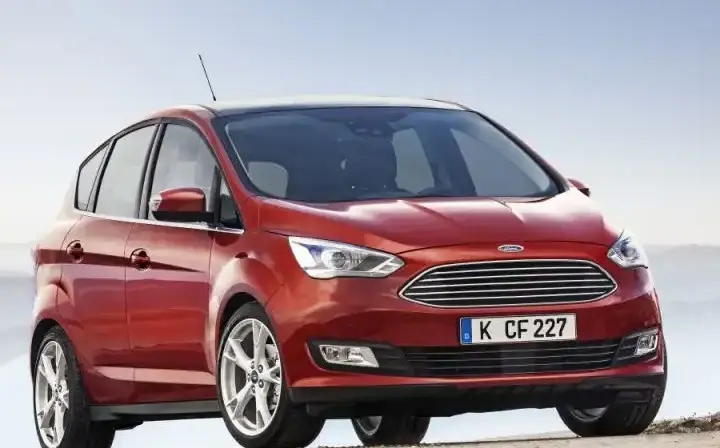
The Ford C-MAX II, particularly the 1.5 TDCi 120 horsepower variant produced from 2015 to 2019, represents a significant iteration of Ford’s compact multi-purpose vehicle (MPV) offering in the European market. This facelifted version of the second-generation C-MAX aimed to refine the original’s strengths – practicality, space efficiency, and driving dynamics – while addressing some criticisms regarding interior design and fuel economy. Positioned as a mid-range option within the C-MAX lineup, the 1.5 TDCi offered a balance between affordability, reasonable performance, and competitive fuel efficiency, making it a popular choice for families and individuals seeking a versatile vehicle.
Technical Specifications
| Brand | Ford |
| Model | C-MAX |
| Generation | C-MAX II (facelift 2015) |
| Type (Engine) | 1.5 TDCi (120 Hp) |
| Start of production | 2015 |
| End of production | June, 2019 |
| Powertrain Architecture | Internal Combustion engine |
| Body type | MPV |
| Seats | 5 |
| Doors | 5 |
| Fuel consumption (economy) – urban (NEDC) | 5.1 l/100 km (46.1 US mpg, 55.4 UK mpg, 19.6 km/l) |
| Fuel consumption (economy) – extra urban (NEDC) | 3.7 l/100 km (63.6 US mpg, 76.3 UK mpg, 27 km/l) |
| Fuel consumption (economy) – combined (NEDC) | 4.2 l/100 km (56 US mpg, 67.3 UK mpg, 23.8 km/l) |
| CO2 emissions (NEDC) | 110 g/km |
| Fuel Type | Diesel |
| Acceleration 0 – 100 km/h | 11.3 sec |
| Acceleration 0 – 62 mph | 11.3 sec |
| Acceleration 0 – 60 mph | 10.7 sec |
| Maximum speed | 184 km/h (114.33 mph) |
| Emission standard | Euro 6 |
| Weight-to-power ratio | 11.1 kg/Hp, 90.4 Hp/tonne |
| Weight-to-torque ratio | 4.9 kg/Nm, 203.3 Nm/tonne |
| Power | 120 Hp @ 3600 rpm |
| Power per litre | 80.1 Hp/l |
| Torque | 270 Nm @ 1750-2500 rpm (199.14 lb.-ft. @ 1750-2500 rpm) |
| Engine layout | Front, Transverse |
| Engine Model/Code | XWDA, XWDB, XWDC, XWDD, XWDE |
| Engine displacement | 1499 cm3 (91.47 cu. in.) |
| Number of cylinders | 4 |
| Engine configuration | Inline |
| Cylinder Bore | 73.5 mm (2.89 in.) |
| Piston Stroke | 88.3 mm (3.48 in.) |
| Compression ratio | 16:1 |
| Number of valves per cylinder | 2 |
| Fuel injection system | Diesel Commonrail |
| Engine aspiration | Turbocharger, Intercooler |
| Valvetrain | SOHC |
| Engine oil capacity | 3.85 l (4.07 US qt | 3.39 UK qt) |
| Coolant | 7.3 l (7.71 US qt | 6.42 UK qt) |
| Kerb Weight | 1328 kg (2927.74 lbs.) |
| Max. weight | 1915 kg (4221.85 lbs.) |
| Max load | 587 kg (1294.11 lbs.) |
| Trunk (boot) space – minimum | 432 l (15.26 cu. ft.) |
| Trunk (boot) space – maximum | 1684 l (59.47 cu. ft.) |
| Fuel tank capacity | 55 l (14.53 US gal | 12.1 UK gal) |
| Max. roof load | 75 kg (165.35 lbs.) |
| Permitted trailer load with brakes (12%) | 1200 kg (2645.55 lbs.) |
| Permitted trailer load without brakes | 700 kg (1543.24 lbs.) |
| Length | 4379 mm (172.4 in.) |
| Width | 1828 mm (71.97 in.) |
| Width with mirrors folded | 1858 mm (73.15 in.) |
| Width including mirrors | 2067 mm (81.38 in.) |
| Height | 1610 mm (63.39 in.) |
| Wheelbase | 2648 mm (104.25 in.) |
| Front track | 1543-1557 mm (60.75 – 61.3 in.) |
| Rear (Back) track | 1554-1569 mm (61.18 – 61.77 in.) |
| Minimum turning circle (turning diameter) | 11.1 m (36.42 ft.) |
| Drivetrain Architecture | The Internal combustion engine (ICE) drives the front wheels of the vehicle. |
| Drive wheel | Front wheel drive |
| Number of gears and type of gearbox | 6 gears, manual transmission |
| Front suspension | Independent, type McPherson with coil spring and anti-roll bar |
| Rear suspension | Independent multi-link spring suspension with stabilizer |
| Front brakes | Ventilated discs, 278×25 mm |
| Rear brakes | Disc, 280×11 mm |
| Assisting systems | ABS (Anti-lock braking system) |
| Steering type | Steering rack and pinion |
| Power steering | Electric Steering |
| Tires size | 205/55 R16; 215/55 R16; 215/50 R17; 235/40 R18 |
| Wheel rims size | 6.5J x 16; 7J x 16; 7J x 17; 8J x 18 |
INTRODUCTION
The Ford C-MAX II, launched in 2007 and receiving a significant facelift in 2015, is a compact MPV designed to offer a practical and versatile solution for families. The 1.5 TDCi 120 horsepower engine, introduced with the 2015 refresh, became a cornerstone of the C-MAX range in Europe. This engine, part of Ford’s EcoBoost engine family, was designed to deliver improved fuel efficiency and reduced emissions compared to its predecessors. The C-MAX II competed directly with vehicles like the Volkswagen Touran, Opel/Vauxhall Meriva, and Citroën C4 Picasso, offering a blend of space, comfort, and affordability. This particular variant aimed to provide a balance between running costs and usability, appealing to buyers who didn’t require the higher performance of more powerful engine options.
Powertrain & Engine Architecture
The heart of the C-MAX II 1.5 TDCi is the Ford EcoBoost 1.5-liter turbocharged diesel engine, specifically coded XWDA, XWDB, XWDC, XWDD, or XWDE depending on the specific calibration and market. This engine utilizes a common-rail direct fuel injection system, operating at a high pressure to ensure efficient combustion and reduced particulate emissions. The engine features a single overhead camshaft (SOHC) valvetrain, controlling two valves per cylinder. The turbocharger, coupled with an intercooler, provides increased air intake, boosting power and torque. The 1.5 TDCi produces 120 horsepower at 3600 rpm and 270 Nm (199 lb-ft) of torque between 1750 and 2500 rpm. This engine was paired with a six-speed manual transmission as standard, offering a good balance between fuel economy and drivability. While an automatic transmission was available in some markets, it wasn’t as commonly specified with this engine.
Driving Characteristics
The 1.5 TDCi 120 hp C-MAX offers a comfortable and composed driving experience, prioritizing fuel efficiency over outright performance. Acceleration from 0-60 mph takes around 10.7 seconds, and top speed is approximately 114 mph. The engine delivers adequate power for everyday driving, with the turbocharger providing a noticeable boost in mid-range acceleration. The six-speed manual transmission is well-matched to the engine’s characteristics, allowing drivers to keep the engine in its optimal torque band. Compared to the more powerful 1.6 EcoBoost petrol engine or the higher-output diesel variants, the 1.5 TDCi feels less eager to rev, but it compensates with significantly better fuel economy. The steering is light and precise, making the C-MAX easy to maneuver in urban environments. The suspension provides a comfortable ride, absorbing bumps and imperfections in the road surface effectively.
Equipment & Trim Levels
The C-MAX II 1.5 TDCi 120 hp typically came equipped with a reasonable level of standard features. These included air conditioning, power windows, power mirrors, a basic audio system with USB connectivity, and ABS brakes. Higher trim levels, such as Titanium or Zetec, added features like alloy wheels, a more advanced infotainment system with touchscreen display, automatic climate control, rear parking sensors, and cruise control. Optional extras included a panoramic sunroof, leather upholstery, and a navigation system. Interior upholstery was typically cloth, with higher trims offering partial leather options. The dashboard layout was generally functional and user-friendly, with a focus on practicality.
Chassis & Braking
The C-MAX II utilizes a front-wheel-drive platform with independent suspension on all four wheels. The front suspension employs a McPherson strut setup with a coil spring and anti-roll bar, while the rear features a multi-link suspension system, also with a stabilizer bar. This configuration provides a good balance between ride comfort and handling. Braking duties are handled by ventilated discs on the front wheels and solid discs on the rear. ABS (Anti-lock Braking System) is standard, enhancing safety and control during emergency braking situations. The C-MAX’s chassis is designed to provide a stable and predictable driving experience, with minimal body roll in corners.
Market Reception & Comparison
The Ford C-MAX II 1.5 TDCi 120 hp was generally well-received by automotive critics. It was praised for its fuel efficiency, spacious interior, and comfortable ride. However, some reviewers noted that the engine could feel a little underpowered when fully loaded or tackling steep hills. Compared to the 1.6 EcoBoost petrol variant, the 1.5 TDCi offered significantly better fuel economy, but at the expense of performance. The 1.5 TDCi also proved to be more economical to run than the higher-output diesel versions, making it an attractive option for budget-conscious buyers. Reliability reports suggest that the 1.5 TDCi engine is generally reliable, although regular servicing is essential to maintain optimal performance.
Legacy
The Ford C-MAX II 1.5 TDCi 120 hp remains a popular choice in the used car market, offering a practical and affordable MPV solution. The 1.5 TDCi engine has proven to be relatively durable, although potential buyers should be aware of the importance of regular maintenance, including oil changes and timing belt replacements. The C-MAX II’s spacious interior and versatile configuration continue to appeal to families and individuals seeking a flexible vehicle. While newer MPVs offer more advanced technology and features, the C-MAX II 1.5 TDCi remains a competitive option for those seeking a reliable and economical vehicle.