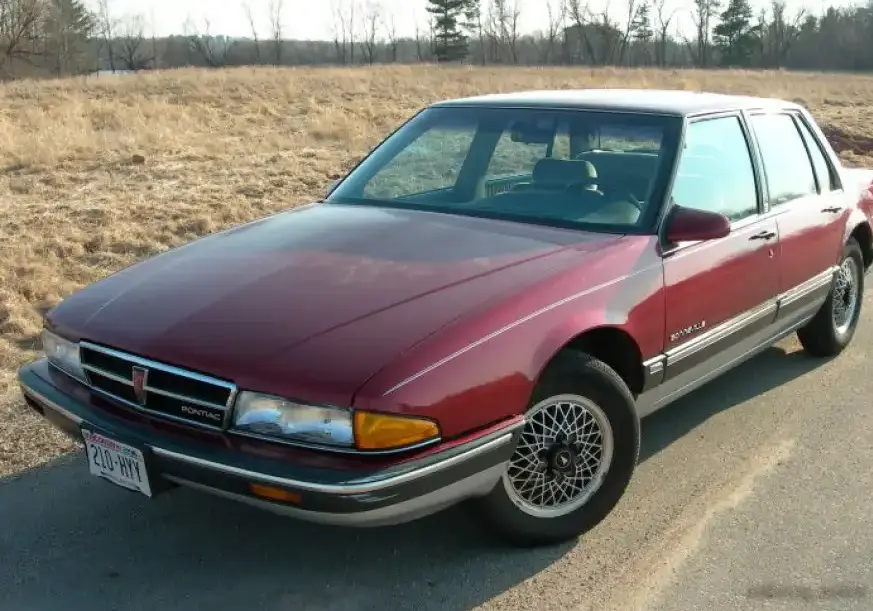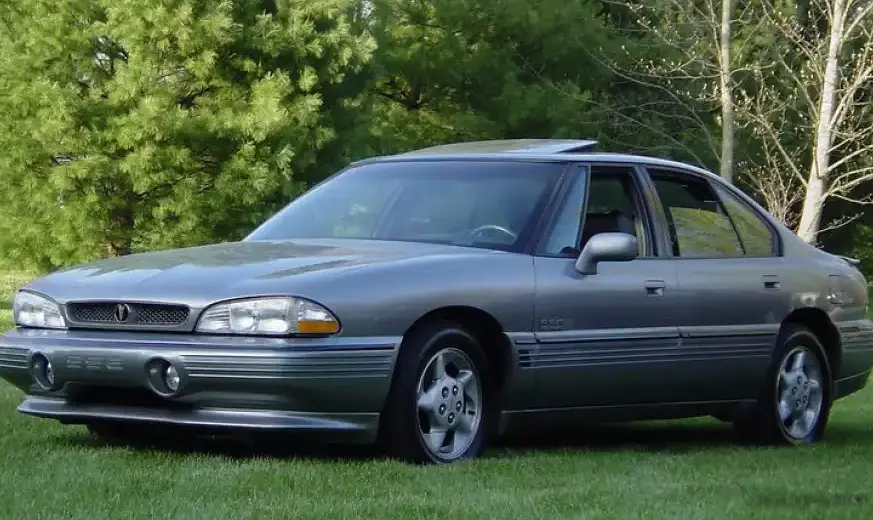
The Pontiac Bonneville II 3.8 i V6 SSEi, produced from 1991 to 1999, represented a significant iteration of Pontiac’s flagship full-size sedan. Positioned as a premium trim within the Bonneville II generation, the SSEi (Special Sport Edition injection) offered a blend of performance and luxury. It was built on the GM K-body platform, a front-wheel-drive architecture shared with other GM vehicles like the Buick Park Avenue and Oldsmobile 88. The Bonneville, throughout its history, aimed to provide American buyers with a spacious, comfortable, and relatively powerful family sedan, and the SSEi variant continued this tradition with a focus on enhanced features and a more spirited driving experience.
Technical Specifications
| Brand | Pontiac |
| Model | Bonneville |
| Generation | Bonneville II |
| Type (Engine) | 3.8 i V6 SSEi (228 Hp) |
| Start of production | 1991 year |
| End of production | 1999 year |
| Powertrain Architecture | Internal Combustion engine |
| Body type | Sedan |
| Seats | 5 |
| Doors | 4 |
| Fuel consumption (economy) – combined | 11.4 l/100 km |
| Fuel consumption (economy) – combined | 20.6 US mpg |
| Fuel consumption (economy) – combined | 24.8 UK mpg |
| Fuel consumption (economy) – combined | 8.8 km/l |
| Fuel Type | Petrol (Gasoline) |
| Weight-to-power ratio | 7.1 kg/Hp |
| Weight-to-power ratio | 140.1 Hp/tonne |
| Weight-to-torque ratio | 4.4 kg/Nm |
| Weight-to-torque ratio | 229.3 Nm/tonne |
| Power | 228 Hp @ 5000 rpm |
| Power per litre | 60.1 Hp/l |
| Torque | 373 Nm @ 3200 rpm |
| Torque | 275.11 lb.-ft. @ 3200 rpm |
| Engine layout | Front, Transverse |
| Engine Model/Code | L67 |
| Engine displacement | 3791 cm3 |
| Engine displacement | 231.34 cu. in. |
| Number of cylinders | 6 |
| Engine configuration | V-engine |
| Cylinder Bore | 96.5 mm |
| Cylinder Bore | 3.8 in. |
| Piston Stroke | 86.4 mm |
| Piston Stroke | 3.4 in. |
| Compression ratio | 8.5:1 |
| Number of valves per cylinder | 2 |
| Fuel injection system | Multi-port manifold injection |
| Engine aspiration | Supercharger |
| Engine oil capacity | 4.3 l |
| Engine oil capacity | 4.54 US qt |
| Engine oil capacity | 3.78 UK qt |
| Coolant | 12.3 l |
| Coolant | 13 US qt |
| Coolant | 10.82 UK qt |
| Kerb Weight | 1627 kg |
| Kerb Weight | 3586.92 lbs. |
| Trunk (boot) space – minimum | 506 l |
| Trunk (boot) space – minimum | 17.87 cu. ft. |
| Fuel tank capacity | 68 l |
| Fuel tank capacity | 17.96 US gal |
| Fuel tank capacity | 14.96 UK gal |
| Length | 5107 mm |
| Length | 201.06 in. |
| Width | 1892 mm |
| Width | 74.49 in. |
| Height | 1415 mm |
| Height | 55.71 in. |
| Wheelbase | 2815 mm |
| Wheelbase | 110.83 in. |
| Front track | 1545 mm |
| Front track | 60.83 in. |
| Rear (Back) track | 1547 mm |
| Rear (Back) track | 60.91 in. |
| Drivetrain Architecture | The Internal combustion engine (ICE) drives the front wheels of the vehicle. |
| Drive wheel | Front wheel drive |
| Number of gears and type of gearbox | 4 gears, automatic transmission |
| Front suspension | Spring Strut |
| Rear suspension | Coil spring |
| Front brakes | Ventilated discs |
| Rear brakes | Drum |
| Assisting systems | ABS (Anti-lock braking system) |
| Steering type | Steering rack and pinion |
| Power steering | Hydraulic Steering |
| Tires size | 225/60 R16 |
Powertrain & Engine Architecture
The heart of the Bonneville II SSEi was the 3.8L (3791 cc) L67 V6 engine. This engine was a significant upgrade over naturally aspirated 3.8L variants, featuring a Roots-type supercharger. The supercharger, coupled with multi-port fuel injection, boosted output to 228 horsepower at 5000 rpm and 275 lb-ft of torque at 3200 rpm. The L67 utilized a 90-degree V6 configuration with two valves per cylinder and a compression ratio of 8.5:1. The engine was transversely mounted in the front of the vehicle. The 4T60E four-speed automatic transmission was the sole transmission option for the SSEi, chosen for its smooth operation and suitability for the car’s intended cruising role. This transmission featured electronic control for optimized shift points and responsiveness.
Driving Characteristics
The 3.8L supercharged V6 in the Bonneville II SSEi delivered noticeably quicker acceleration than the base model. While not a sports car, the SSEi offered brisk performance for a full-size sedan, capable of 0-60 mph times in the low 7-second range. The automatic transmission, while smooth, wasn’t particularly aggressive in its shift programming, prioritizing comfort over outright performance. The front-wheel-drive layout provided predictable handling, but lacked the dynamic finesse of rear-wheel-drive competitors. The suspension was tuned for a comfortable ride, absorbing bumps and imperfections in the road effectively. The supercharger provided a broad torque curve, making the car feel responsive in everyday driving situations.
Equipment & Trim Levels
The SSEi trim level was well-equipped, offering a range of standard features designed to enhance comfort and convenience. These typically included leather upholstery, power-adjustable front seats, a premium sound system, automatic climate control, and alloy wheels. Optional extras included a sunroof, upgraded audio systems, and traction control. The interior featured a woodgrain trim and a generally upscale appearance. The SSEi aimed to provide a luxurious experience, competing with other premium sedans of the era.
Chassis & Braking
The Bonneville II utilized a front-wheel-drive chassis with an independent front suspension featuring coil springs and a strut design. The rear suspension employed a coil-spring independent setup. Braking duties were handled by ventilated discs at the front and drum brakes at the rear. Anti-lock braking system (ABS) was standard equipment, enhancing safety and control during hard braking. Steering was rack-and-pinion with hydraulic power assistance, providing light and easy steering feel. The tires were typically 225/60R16, offering a balance of ride comfort and grip.
Market Reception & Comparison
The Bonneville II SSEi was generally well-received by automotive critics. It was praised for its comfortable ride, spacious interior, and strong performance from the supercharged V6. However, some reviewers noted the car’s relatively bland styling and the lack of a manual transmission option. Compared to other trims, the SSEi offered a significant performance advantage over the base model, but at a higher price point. Fuel economy was reasonable for a full-size sedan, averaging around 20 mpg in combined driving. Reliability was generally good, although the supercharger did add a layer of complexity to the engine.
Legacy
The Pontiac Bonneville II 3.8 i V6 SSEi remains a popular choice among enthusiasts seeking a comfortable and reliable American sedan. The L67 supercharged engine is known for its durability and potential for modification. While parts availability can be a concern due to the car’s age, the engine itself is generally robust. Today, well-maintained examples of the SSEi can be found on the used car market, offering a nostalgic driving experience and a reminder of Pontiac’s commitment to building spacious and powerful family sedans. The 4T60E transmission, while generally reliable, can be prone to issues with age and mileage, requiring periodic maintenance or rebuilds.