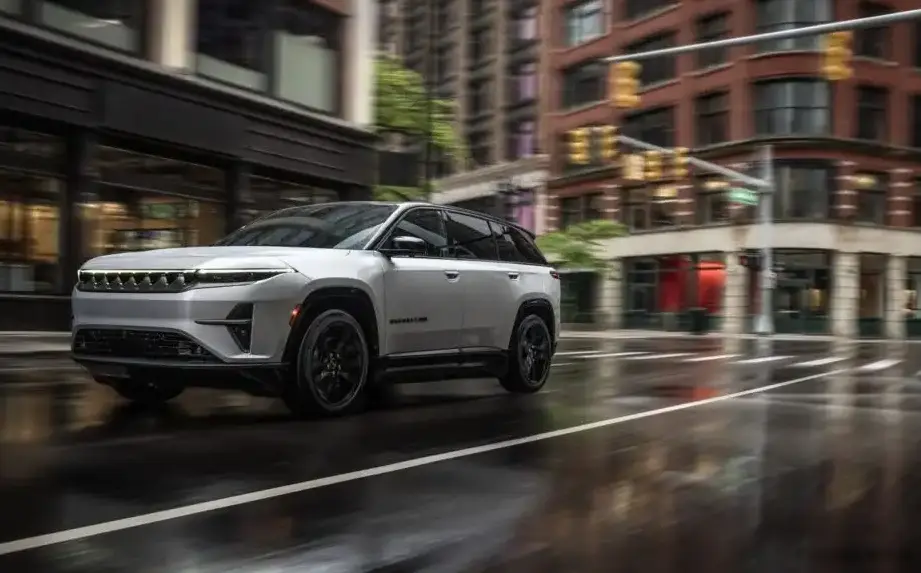
The Jeep Wagoneer S is an all-electric, mid-size luxury SUV introduced by Jeep for the 2025 model year, beginning production in February 2025. Representing Jeep’s foray into the premium electric SUV segment, the Wagoneer S is positioned below the larger Wagoneer and Grand Wagoneer, offering a more accessible entry point into the brand’s electrified future. It utilizes a dedicated electric vehicle architecture and aims to compete with vehicles like the Tesla Model Y, BMW iX, and Cadillac Lyriq. The Wagoneer S is designed to blend Jeep’s traditional off-road capability with the refinement and technology expected in the luxury SUV class.
Technical Specifications
| Brand | Jeep |
| Model | Wagoneer S |
| Generation | Wagoneer S |
| Type (Engine) | 100.5 kWh (500 Hp) 4WD Electric |
| Start of production | February, 2025 |
| Powertrain Architecture | BEV (Electric Vehicle) |
| Body type | SUV |
| Seats | 5 |
| Doors | 5 |
| Fuel Type | Electricity |
| Acceleration 0 – 60 mph | 4 sec |
| Maximum speed | 200 km/h (124.27 mph) |
| Weight-to-power ratio | 5.1 kg/Hp, 194.5 Hp/tonne |
| Weight-to-torque ratio | 3.6 kg/Nm, 276.2 Nm/tonne |
| Gross battery capacity | 100.5 kWh |
| Battery voltage | 400 V |
| Battery technology | Lithium nickel manganese cobalt oxides (Li-NMC) |
| Battery location | Below the floor |
| All-electric range | 473 km (293.91 mi) |
| Average Energy consumption | 22.5 kWh/100 km (36.21 kWh/100 mi, 93 MPGe, 4.4 km/kWh, 2.8 mi/kWh) |
| Electric motor 1 power | 204 Hp |
| Electric motor 1 location | Front axle, Transverse |
| Electric motor 1 type | Synchronous |
| Electric motor 2 power | 340 Hp |
| Electric motor 2 location | Rear axle, Transverse |
| Electric motor 2 type | Synchronous |
| System power | 500 Hp |
| System torque | 710 Nm (523.67 lb.-ft.) |
| Kerb Weight | 2571 kg (5668.08 lbs.) |
| Max. weight | 3039 kg (6699.85 lbs.) |
| Max load | 468 kg (1031.76 lbs.) |
| Trunk (boot) space – minimum | 866 l (30.58 cu. ft.) |
| Trunk (boot) space – maximum | 1727 l (60.99 cu. ft.) |
| Permitted trailer load with brakes (12%) | 1588 kg (3500.94 lbs.) |
| Length | 4886 mm (192.36 in.) |
| Width | 1900 mm (74.8 in.) |
| Width including mirrors | 2123 mm (83.58 in.) |
| Height | 1645 mm (64.76 in.) |
| Wheelbase | 2870 mm (112.99 in.) |
| Front track | 1636 mm (64.41 in.) |
| Rear (Back) track | 1639 mm (64.53 in.) |
| Ride height (ground clearance) | 162 mm (6.38 in.) |
| Drag coefficient (Cd) | 0.29 |
| Minimum turning circle (turning diameter) | 12.19 m (39.99 ft.) |
| Approach angle | 19.2° |
| Departure angle | 23.4° |
| Ramp-over (brakeover) angle | 14° |
| Drivetrain Architecture | One electric motor drives the front wheels, one electric motor drives the rear wheels. |
| Drive wheel | All wheel drive (4×4) |
| Number of gears and type of gearbox | 1 gears, automatic transmission |
| Front suspension | Independent type McPherson |
| Rear suspension | Independent multi-link suspension |
| Front brakes | Ventilated discs, 354×28 mm |
| Rear brakes | Ventilated discs, 350×22 mm |
| Assisting systems | ABS (Anti-lock braking system) |
| Steering type | Steering rack and pinion |
| Power steering | Electric Steering |
| Tires size | 235/50 R20 |
| Wheel rims size | 8.5J x 20 |
Powertrain & Engine Architecture
The Wagoneer S is built around a dedicated Battery Electric Vehicle (BEV) platform. It employs a dual-motor all-wheel-drive (AWD) system, with one synchronous electric motor powering the front axle and another powering the rear. The combined output of these motors is 500 horsepower and 710 Nm (523.67 lb.-ft.) of torque. The vehicle utilizes a 400V electrical architecture and a 100.5 kWh lithium-nickel-manganese-cobalt (Li-NMC) battery pack positioned low in the vehicle floor to optimize the center of gravity. The single-speed automatic transmission is inherent to the electric drivetrain, providing seamless power delivery. The regenerative braking system contributes to increased efficiency and range by capturing energy during deceleration.
Driving Characteristics
The dual-motor setup provides brisk acceleration, with a 0-60 mph time of approximately 4 seconds. The all-wheel-drive system ensures confident traction in various weather conditions. The low center of gravity, thanks to the battery pack placement, contributes to stable handling. While specific gear ratios aren’t publicly detailed, the single-speed transmission delivers instant torque, characteristic of electric vehicles. Compared to potential future higher-performance variants, this 500 hp version prioritizes a balance between performance and efficiency, offering a refined driving experience suitable for daily commutes and long-distance travel.
Equipment & Trim Levels
Details regarding specific trim levels and standard equipment for the Wagoneer S are still emerging. However, it is expected to offer a high level of standard features, including a large touchscreen infotainment system, advanced driver-assistance systems (ADAS), premium interior materials, and comfortable seating. Available options are likely to include a panoramic sunroof, upgraded audio system, ventilated and massaged seats, and advanced safety technologies. The interior design is expected to be modern and luxurious, with a focus on technology and connectivity.
Chassis & Braking
The Wagoneer S features an independent suspension system, with McPherson struts at the front and a multi-link setup at the rear. This configuration is designed to provide a comfortable ride and responsive handling. Ventilated disc brakes are used on all four wheels, providing ample stopping power. The inclusion of ABS (Anti-lock Braking System) enhances safety during emergency braking situations. The vehicle’s relatively low ride height (162 mm / 6.38 in.) suggests a focus on on-road performance, although Jeep’s off-road heritage may be reflected in some degree of ground clearance and traction management capabilities.
Market Reception & Comparison
As a newly introduced model, comprehensive market reception data for the Wagoneer S is currently limited. However, initial impressions suggest strong interest in the vehicle, particularly among consumers seeking a premium electric SUV with Jeep’s brand reputation. Compared to other trims within the Wagoneer lineup (once available), the S variant represents the entry point into the family, focusing on efficiency and technology rather than outright size or towing capacity. Its fuel economy, measured at 22.5 kWh/100 km (93 MPGe), is competitive within the electric SUV segment. Long-term reliability remains to be seen, but Jeep’s commitment to quality and the use of proven battery technology suggest a positive outlook.
Legacy
The Wagoneer S marks a significant step in Jeep’s transition towards electrification. Its success will be crucial in establishing Jeep as a major player in the rapidly growing electric vehicle market. The powertrain’s long-term reliability will be a key factor in its overall legacy. The vehicle’s innovative features and design are expected to influence future Jeep models, paving the way for a fully electrified lineup in the years to come. The Wagoneer S is poised to become a benchmark for electric SUVs, combining Jeep’s legendary capability with the benefits of zero-emission driving.