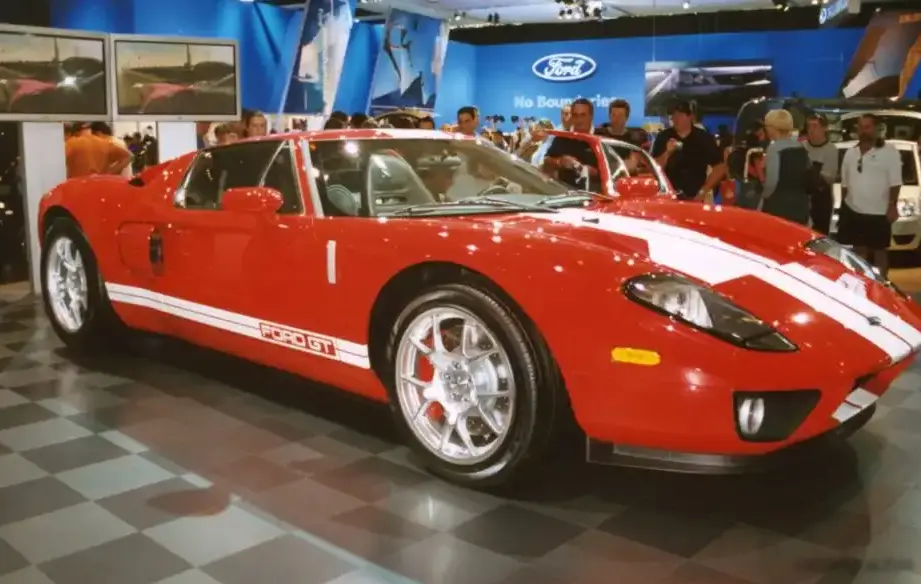
The Ford GT, specifically the 5.4 i V8 32V variant producing 557 horsepower, represents a modern interpretation of Ford’s legendary mid-engine sports car lineage. Produced for the 2005 and 2006 model years, this iteration of the GT was a limited-production vehicle designed to evoke the spirit of the original GT40 race cars that dominated the 24 Hours of Le Mans in the 1960s. It served as a halo car for the Ford brand, showcasing its engineering capabilities and design prowess. The GT was built on a dedicated platform, distinct from other Ford vehicles, and aimed to deliver a high-performance driving experience focused on track capability and driver engagement.
Technical Specifications
| Brand | Ford |
| Model | GT |
| Generation | GT |
| Type (Engine) | 5.4 i V8 32V (557 Hp) |
| Start of production | 2005 |
| End of production | 2006 |
| Powertrain Architecture | Internal Combustion engine |
| Body type | Coupe |
| Seats | 2 |
| Doors | 2 |
| Fuel consumption (economy) – urban | 18.1 l/100 km (13 US mpg, 15.6 UK mpg, 5.5 km/l) |
| Fuel consumption (economy) – extra urban | 11.2 l/100 km (21 US mpg, 25.2 UK mpg, 8.9 km/l) |
| Fuel Type | Petrol (Gasoline) |
| Acceleration 0 – 100 km/h | 3.6 sec |
| Acceleration 0 – 62 mph | 3.6 sec |
| Acceleration 0 – 60 mph | 3.4 sec |
| Maximum speed | 330 km/h (205.05 mph) |
| Weight-to-power ratio | 2.9 kg/Hp, 346 Hp/tonne |
| Weight-to-torque ratio | 2.4 kg/Nm, 421.1 Nm/tonne |
| Power | 557 Hp @ 6500 rpm |
| Power per litre | 103 Hp/l |
| Torque | 678 Nm @ 3750 rpm (500.07 lb.-ft. @ 3750 rpm) |
| Engine layout | Middle, Longitudinal |
| Engine Model/Code | C54SDSM |
| Engine displacement | 5409 cm3 (330.08 cu. in.) |
| Number of cylinders | 8 |
| Engine configuration | V-engine |
| Cylinder Bore | 90.2 mm (3.55 in.) |
| Piston Stroke | 105.8 mm (4.17 in.) |
| Compression ratio | 8.4:1 |
| Number of valves per cylinder | 4 |
| Fuel injection system | Multi-port manifold injection |
| Engine aspiration | Supercharger, Intercooler |
| Engine oil capacity | 9 l (9.51 US qt | 7.92 UK qt) |
| Coolant | 25 l (26.42 US qt | 22 UK qt) |
| Kerb Weight | 1610 kg (3549.44 lbs.) |
| Trunk (boot) space – minimum | 46 l (1.62 cu. ft.) |
| Fuel tank capacity | 66 l (17.44 US gal | 14.52 UK gal) |
| Length | 4645 mm (182.87 in.) |
| Width | 1955 mm (76.97 in.) |
| Height | 1125 mm (44.29 in.) |
| Wheelbase | 2710 mm (106.69 in.) |
| Front track | 1600 mm (62.99 in.) |
| Rear (Back) track | 1620 mm (63.78 in.) |
| Drivetrain Architecture | Rear wheel drive |
| Number of gears and type of gearbox | 6 gears, manual transmission |
| Front suspension | Wishbone |
| Rear suspension | Wishbone |
| Front brakes | Ventilated discs |
| Rear brakes | Ventilated discs |
| Assisting systems | ABS (Anti-lock braking system) |
| Steering type | Steering rack and pinion |
| Tires size | 235/45 ZR18; 315/40 ZR19 |
| Wheel rims size | 9J z 18; 11.5J x 19 |
Powertrain & Engine Architecture
The heart of the 2005-2006 Ford GT is its 5.4-liter Modular V8 engine, designated the C54SDSM. This engine is a heavily modified version of the Ford Triton engine family, but significantly upgraded for high performance. The key enhancement is the addition of a Lysholm twin-screw supercharger, providing forced induction and boosting power output. The engine features a cast-iron block with aluminum cylinder heads, four valves per cylinder, and a multi-port fuel injection system. The supercharger is integrated with an intercooler to reduce intake air temperature, further enhancing performance. The engine produces 557 horsepower at 6500 rpm and 500 lb-ft of torque at 3750 rpm. The engine is mounted mid-ship, contributing to the car’s balanced handling characteristics. The sole transmission option was a six-speed manual gearbox, designed for precise and engaging gear changes.
Driving Characteristics
The Ford GT delivers a raw and visceral driving experience. The supercharged V8 provides immediate and substantial acceleration, with the car reaching 60 mph in approximately 3.4 seconds. The mid-engine layout and relatively lightweight construction (around 3,549 pounds) contribute to exceptional handling and cornering ability. The manual transmission requires a skilled driver to extract the most performance, but offers a high degree of control. Compared to potential future variants with automatic transmissions, this manual setup prioritized driver involvement. The GT’s suspension is firm, reflecting its focus on track performance, and can be somewhat unforgiving on rough road surfaces. The steering is direct and responsive, providing excellent feedback to the driver.
Equipment & Trim Levels
The Ford GT was relatively sparsely equipped, focusing on performance rather than luxury. Standard features included air conditioning, a basic audio system, power windows and locks, and leather upholstery. The interior was functional and driver-focused, with aluminum trim and a minimalist design. Options were limited, but included racing stripes, forged aluminum wheels, and upgraded audio systems. The interior was designed to be lightweight and purposeful, reflecting the car’s racing heritage. The seats were supportive and designed to hold the driver securely during spirited driving.
Chassis & Braking
The Ford GT features a space frame chassis constructed from aluminum, providing a rigid and lightweight foundation. The suspension utilizes independent double wishbone setups at both the front and rear, with coil springs and adjustable dampers. The braking system consists of ventilated disc brakes at all four corners, providing ample stopping power. Anti-lock braking system (ABS) was standard. The car’s wide track and low center of gravity contribute to its exceptional stability and handling. The tires are high-performance ZR-rated tires, designed to provide maximum grip.
Market Reception & Comparison
The Ford GT was widely praised by automotive critics for its performance, handling, and styling. It was seen as a worthy successor to the original GT40 and a significant achievement for Ford. However, some critics noted the car’s firm ride and limited practicality. Compared to contemporary sports cars like the Porsche 911 Turbo or Chevrolet Corvette Z06, the GT offered a more raw and visceral driving experience, prioritizing performance over refinement. Fuel economy was predictably poor, reflecting the car’s high-performance nature. Reliability was generally good, although the supercharger and complex engine components required careful maintenance.
Legacy
The Ford GT remains a highly sought-after collector’s car. Its limited production run and iconic status have driven up values in the used car market. The powertrain, while requiring diligent maintenance, has proven to be relatively durable when properly cared for. The 2005-2006 Ford GT represents a significant moment in Ford’s history, demonstrating the company’s ability to create a world-class sports car. It paved the way for the second-generation GT, introduced in 2017, continuing the legacy of this iconic nameplate. The original GT’s influence can be seen in subsequent Ford performance vehicles, emphasizing the importance of lightweight construction, powerful engines, and engaging driving dynamics.