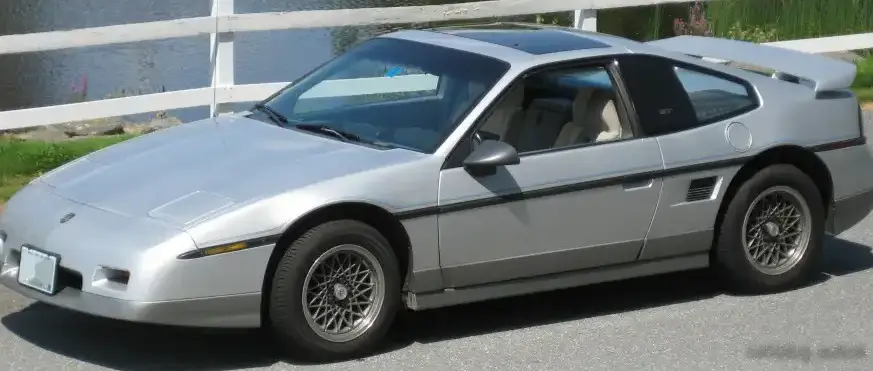
The Pontiac Fiero Sport 2.5, producing 93 horsepower, represents the entry-level variant of the innovative Fiero model line produced by Pontiac from 1983 to 1988. Introduced as a direct competitor to the Chevrolet Corvette and other mid-engine sports cars, the Fiero aimed to deliver European-style handling and performance at a more accessible price point. The 2.5-liter Sport model, equipped with a naturally aspirated four-cylinder engine and a five-speed manual transmission, served as the foundation of the Fiero range, offering a balance of affordability and sporty driving dynamics. It was the most popular version of the Fiero during its production run, appealing to buyers seeking a unique and relatively economical sports car.
Technical Specifications
| Brand | Pontiac |
| Model | Fiero |
| Generation | Fiero |
| Type (Engine) | Sport 2.5 (93 Hp) |
| Start of production | August, 1983 |
| End of production | August, 1988 |
| Powertrain Architecture | Internal Combustion engine |
| Body type | Coupe |
| Seats | 2 |
| Doors | 2 |
| Fuel Type | Petrol (Gasoline) |
| Acceleration 0 – 100 km/h | 12 sec |
| Acceleration 0 – 62 mph | 12 sec |
| Acceleration 0 – 60 mph | 11.4 sec |
| Maximum speed | 166 km/h (103.15 mph) |
| Weight-to-power ratio | 12 kg/Hp, 83.3 Hp/tonne |
| Weight-to-torque ratio | 6.1 kg/Nm, 162.9 Nm/tonne |
| Power | 93 Hp @ 4400 rpm |
| Power per litre | 37.6 Hp/l |
| Torque | 182 Nm @ 2800 rpm (134.24 lb.-ft. @ 2800 rpm) |
| Engine layout | Middle, Transverse |
| Engine Model/Code | LR8 |
| Engine displacement | 2471 cm3 (150.79 cu. in.) |
| Number of cylinders | 4 |
| Engine configuration | Inline |
| Cylinder Bore | 101.6 mm (4 in.) |
| Piston Stroke | 76.2 mm (3 in.) |
| Compression ratio | 8.2:1 |
| Number of valves per cylinder | 2 |
| Fuel injection system | Multi-port manifold injection |
| Engine aspiration | Naturally aspirated engine |
| Valvetrain | OHV |
| Engine oil capacity | 3.3 l (3.49 US qt | 2.9 UK qt) |
| Coolant | 13 l (13.74 US qt | 11.44 UK qt) |
| Kerb Weight | 1117 kg (2462.56 lbs.) |
| Fuel tank capacity | 38 l (10.04 US gal | 8.36 UK gal) |
| Length | 4072 mm (160.31 in.) |
| Width | 1750 mm (68.9 in.) |
| Height | 1194 mm (47.01 in.) |
| Wheelbase | 2372 mm (93.39 in.) |
| Front track | 1468 mm (57.8 in.) |
| Rear (Back) track | 1492 mm (58.74 in.) |
| Ride height (ground clearance) | 137 mm (5.39 in.) |
| Drag coefficient (Cd) | 0.37 |
| Minimum turning circle (turning diameter) | 12.1 m (39.7 ft.) |
| Drivetrain Architecture | The Internal combustion engine (ICE) drives the rear wheels of the vehicle. |
| Drive wheel | Rear wheel drive |
| Number of gears and type of gearbox | 5 gears, manual transmission |
| Front suspension | Independent coil spring |
| Rear suspension | McPherson |
| Front brakes | Disc |
| Rear brakes | Disc |
| Steering type | Steering rack and pinion |
| Tires size | 185/80 R13 |
| Wheel rims size | 5.5J x 13 |
Powertrain & Engine Architecture
The heart of the Fiero Sport 2.5 is the LR8 engine, a 2.5-liter (150.79 cubic inches) inline four-cylinder engine. This engine, derived from the Chevrolet Iron Duke family, featured a cast iron block and an aluminum cylinder head. It utilized a multi-port fuel injection system, a significant upgrade over the carburetor-equipped engines of earlier models, contributing to improved fuel efficiency and smoother operation. The engine employed an overhead valve (OHV) valvetrain with two valves per cylinder. The LR8 produced 93 horsepower at 4400 rpm and 134.24 lb-ft of torque at 2800 rpm. The engine was transversely mounted behind the driver and passenger, driving the rear wheels. The standard transmission was a five-speed manual, providing a direct and engaging driving experience. While an automatic transmission was offered, it was less common and generally considered to diminish the car’s sporty character.
Driving Characteristics
The Fiero Sport 2.5, with its 93 horsepower and five-speed manual transmission, offered a surprisingly nimble driving experience. Acceleration to 60 mph took approximately 11.4 seconds, and the top speed was around 103 mph. While not exceptionally quick, the car’s light weight (around 2463 lbs) and mid-engine layout contributed to balanced handling and responsive steering. The five-speed manual transmission allowed drivers to keep the engine in its optimal power band, maximizing performance. Compared to the more powerful V6-equipped Fieros, the 2.5-liter model felt less urgent in acceleration, but it provided a more economical and accessible entry point into the Fiero ownership experience. The gear ratios were tuned for a balance of acceleration and fuel economy, making it suitable for both city and highway driving.
Equipment & Trim Levels
The Fiero Sport 2.5 was positioned as the base model, offering a relatively sparse but functional equipment list. Standard features typically included cloth upholstery, a basic AM/FM radio, and manual windows and locks. The interior design was simple and functional, prioritizing driver engagement over luxury. Optional extras included air conditioning, upgraded sound systems, and power windows and locks. The exterior styling was characterized by its sleek, aerodynamic shape and distinctive fastback roofline. The Sport model featured standard steel wheels with wheel covers, while optional alloy wheels were available for a more premium appearance.
Chassis & Braking
The Fiero utilized a space frame chassis constructed from steel, providing a rigid and lightweight platform. The suspension consisted of independent coil springs at the front and a McPherson strut setup at the rear. This suspension design contributed to the car’s balanced handling and comfortable ride quality. The braking system featured disc brakes on all four wheels, providing adequate stopping power for the car’s weight and performance. The steering was a rack-and-pinion system, offering precise and responsive control.
Market Reception & Comparison
The Fiero Sport 2.5 received mixed reviews from automotive critics. While praised for its innovative mid-engine layout and sporty handling, it was often criticized for its relatively low power output and perceived lack of refinement. Compared to the V6-powered Fieros, the 2.5-liter model was seen as less exciting, but it offered a more affordable and fuel-efficient alternative. Fuel economy was a strong point, with the 2.5-liter engine achieving around 22 mpg city and 31 mpg highway. Reliability was generally good, although some owners reported issues with the engine’s cooling system and oil leaks.
Legacy
The Pontiac Fiero, despite its relatively short production run, has gained a devoted following among automotive enthusiasts. The 2.5-liter Sport model, as the most common variant, remains relatively affordable and accessible in the used car market. While the LR8 engine is known for its durability, regular maintenance is essential to prevent issues such as oil leaks and cooling system failures. Today, the Fiero is celebrated for its unique design, innovative engineering, and engaging driving experience. It represents a bold attempt by Pontiac to create an American sports car that could compete with the best from Europe and Japan, and it continues to inspire enthusiasts with its distinctive character.