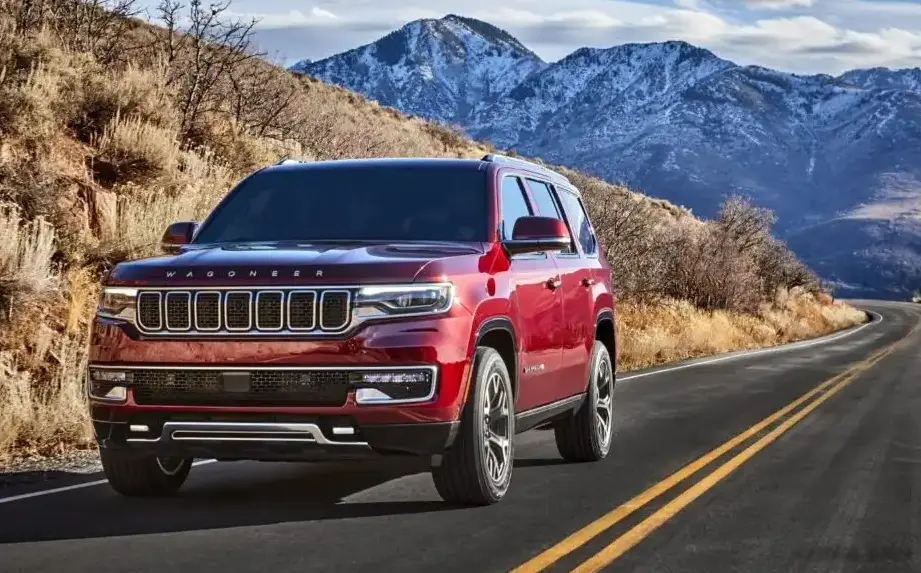
The Jeep Wagoneer (WS) 5.7L V8 HEMI eTorque 4WD, produced from March 2021 to November 2023, represents a significant return to form for the Wagoneer nameplate. This full-size SUV marked the revival of a historically important model, aiming to compete with domestic rivals like Chevrolet Tahoe and Ford Expedition, as well as international offerings like the Cadillac Escalade. Positioned as a premium offering within the Jeep lineup, the WS Wagoneer sought to blend traditional Jeep capability with luxury and modern technology. The 5.7L HEMI eTorque configuration was a key engine option, offering a balance of power and efficiency through its mild-hybrid system. It served as the standard engine for most trim levels, bridging the gap between the base model and potential higher-output variants.
Technical Specifications
| Brand | Jeep |
| Model | Wagoneer |
| Generation | Wagoneer (WS) |
| Type (Engine) | 5.7 V8 HEMI (397 Hp) eTorque 4WD TorqueFlite |
| Start of production | March, 2021 |
| End of production | November, 2023 |
| Powertrain Architecture | MHEV (Mild Hybrid Electric Vehicle) |
| Body type | SUV |
| Seats | 7-8 |
| Doors | 5 |
| Fuel consumption (urban) | 15.7 l/100 km (15 US mpg, 18 UK mpg, 6.4 km/l) |
| Fuel consumption (extra urban) | 11.8 l/100 km (19.9 US mpg, 23.9 UK mpg, 8.5 km/l) |
| Fuel consumption (combined) | 13.8 l/100 km (17 US mpg, 20.5 UK mpg, 7.2 km/l) |
| Fuel Type | Petrol (Gasoline) |
| Emission standard | LEV II |
| Weight-to-power ratio | 7.1 kg/Hp, 141.4 Hp/tonne |
| Weight-to-torque ratio | 5.1 kg/Nm, 195.2 Nm/tonne |
| Electric motor power | 16 Hp |
| Electric motor Torque | 176 Nm (129.81 lb.-ft.) |
| Electric motor location | Front, Transverse |
| Power | 397 Hp @ 5600 rpm |
| Torque | 548 Nm @ 3950 rpm (404.18 lb.-ft. @ 3950 rpm) |
| Maximum engine speed | 5800 rpm |
| Engine layout | Front, Longitudinal |
| Engine Model/Code | EZL |
| Engine displacement | 5654 cm3 (345.03 cu. in.) |
| Number of cylinders | 8 |
| Engine configuration | V-engine |
| Cylinder Bore | 99.5 mm (3.92 in.) |
| Piston Stroke | 90.9 mm (3.58 in.) |
| Compression ratio | 10.5:1 |
| Number of valves per cylinder | 2 |
| Fuel injection system | Multi-port manifold injection |
| Valvetrain | VCT |
| Engine oil capacity | 6.6 l (6.97 US qt | 5.81 UK qt) |
| Coolant capacity | 16 l (16.91 US qt | 14.08 UK qt) |
| Kerb Weight | 2808-2826 kg (6190.58 – 6230.26 lbs.) |
| Max. weight | 3493 kg (7700.75 lbs.) |
| Max load | 667-685 kg (1470.48 – 1510.17 lbs.) |
| Trunk (boot) space – minimum | 776 l (27.4 cu. ft.) |
| Trunk (boot) space – maximum | 3305 l (116.71 cu. ft.) |
| Fuel tank capacity | 100 l (26.42 US gal | 22 UK gal) |
| Permitted trailer load with brakes (12%) | 4536 kg (10000.17 lbs.) |
| Length | 5453 mm (214.69 in.) |
| Width | 2124 mm (83.62 in.) |
| Width including mirrors | 2388 mm (94.02 in.) |
| Height | 1921 mm (75.63 in.) |
| Wheelbase | 3124 mm (122.99 in.) |
| Front track | 1740 mm (68.5 in.) |
| Rear (Back) track | 1734 mm (68.27 in.) |
| Ride height (ground clearance) | 211-254 mm (8.31 – 10 in.) |
| Drag coefficient (Cd) | 0.352 |
| Minimum turning circle (turning diameter) | 11.6 m (38.06 ft.) |
| Approach angle | 21.5-25° |
| Departure angle | 21.1-24° |
| Ramp-over (brakeover) angle | 18.5-22° |
| Drivetrain Architecture | ICE and electric motor permanently drive all four wheels. |
| Drive wheel | All wheel drive (4×4) |
| Number of gears and type of gearbox | 8 gears, automatic transmission TorqueFlite |
| Front suspension | Independent coil spring, Transverse stabilizer |
| Rear suspension | Independent multi-link spring suspension with stabilizer |
| Front brakes | Ventilated discs, 378×30 mm |
| Rear brakes | Disc, 375×22 mm |
| Assisting systems | ABS (Anti-lock braking system) |
| Steering type | Steering rack and pinion |
| Power steering | Electric Steering |
| Tires size | 275/55 R20 |
| Wheel rims size | 9J x 20 |
Powertrain & Engine Architecture
The heart of this Wagoneer variant is the 5.7-liter HEMI V8 engine, designated with the EZL code. This engine utilizes multi-port fuel injection and Variable Cam Timing (VCT) to optimize performance and efficiency. The HEMI architecture is characterized by its hemispherical combustion chambers, contributing to increased airflow and power output. Crucially, this engine incorporates the eTorque mild-hybrid system. This system employs a 48-volt motor generator unit (MGU) integrated with the engine, providing assistance during acceleration and enabling a more seamless start-stop function. The MGU adds 16 horsepower and 176 Nm (129.81 lb-ft) of torque. The engine is longitudinally mounted in the chassis and paired with the TorqueFlite 8-speed automatic transmission. This transmission is known for its smooth shifting and responsiveness, contributing to a refined driving experience.
Driving Characteristics
The 5.7L HEMI eTorque powertrain delivers a robust driving experience, well-suited for a full-size SUV. While not as overtly sporty as some competitors, the Wagoneer offers ample power for towing, hauling passengers, and navigating various terrains. The eTorque system provides a noticeable boost during initial acceleration, mitigating some of the turbo lag often associated with larger engines. The 8-speed automatic transmission is well-tuned, providing smooth gear changes and keeping the engine within its optimal power band. Compared to potential higher-output HEMI variants, this configuration prioritizes usability and efficiency over outright performance. The gear ratios are optimized for towing and everyday driving, rather than aggressive acceleration.
Equipment & Trim Levels
The 5.7L HEMI eTorque engine was typically found on mid-range Wagoneer trims. Standard equipment generally included three-zone automatic climate control, an 8.4-inch touchscreen infotainment system with Apple CarPlay and Android Auto compatibility, and a suite of advanced driver-assistance systems (ADAS) such as adaptive cruise control, lane departure warning, and automatic emergency braking. Interior upholstery typically consisted of cloth or leatherette, with optional upgrades to premium leather available. Optional extras included a panoramic sunroof, premium audio system, and rear-seat entertainment system.
Chassis & Braking
The Wagoneer WS utilizes an independent coil spring suspension in the front and an independent multi-link spring suspension in the rear, both incorporating a transverse stabilizer bar. This setup provides a comfortable ride quality while maintaining reasonable handling characteristics. Braking duties are handled by ventilated discs at the front (378×30 mm) and solid discs at the rear (375×22 mm). An Anti-lock Braking System (ABS) is standard. The chassis is designed to accommodate the vehicle’s substantial weight and provide a stable platform for towing and off-road driving.
Market Reception & Comparison
The Jeep Wagoneer (WS) 5.7L HEMI eTorque 4WD received generally positive reviews, with critics praising its spacious interior, comfortable ride, and capable powertrain. Fuel economy, however, was a common point of criticism, typical for a vehicle of this size and class. Compared to the base V6 engine (when available), the 5.7L HEMI offered a significant performance upgrade, making it the preferred choice for buyers who frequently tow or require more power. Compared to competitors like the Chevrolet Tahoe and Ford Expedition, the Wagoneer offered a more luxurious interior and a more refined driving experience, but often at a higher price point.
Legacy
The 5.7L HEMI eTorque powertrain in the Wagoneer (WS) represents a transitional step in Jeep’s electrification strategy. While a mild-hybrid system, it demonstrated the brand’s commitment to improving fuel efficiency and reducing emissions. In the used car market, these Wagoneers are generally well-regarded for their reliability and capability. The HEMI engine is known for its durability, and the eTorque system has proven to be relatively trouble-free. However, potential buyers should be aware of the higher maintenance costs associated with a full-size SUV and the potential for expensive repairs.