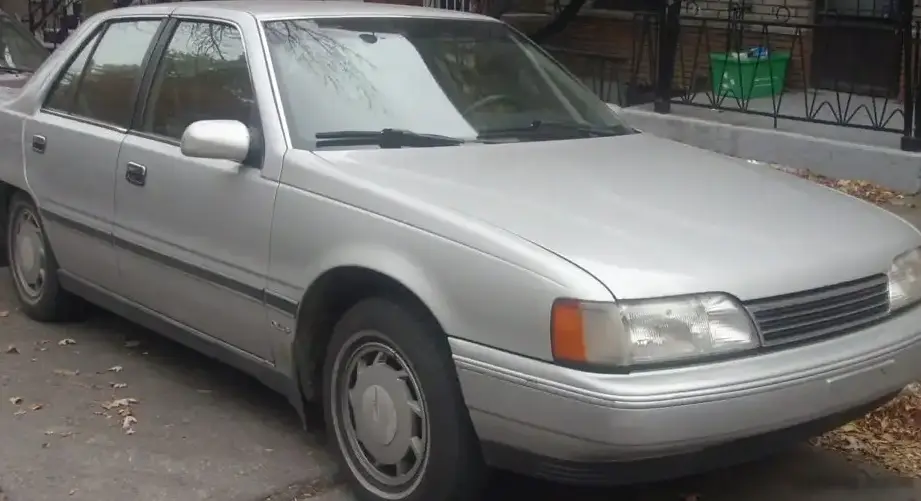
The Hyundai Sonata II (Y2), produced between 1988 and 1992, represented a significant step forward for the South Korean automaker in establishing a presence in the mid-size sedan market. This second generation of the Sonata, designated internally as the Y2, aimed to offer a more refined and technologically advanced vehicle compared to its predecessor. The 2.0 i 16V variant, equipped with a 131 horsepower engine and an automatic transmission, was positioned as a comfortable and practical option for families and commuters. It was a key model in Hyundai’s strategy to gain acceptance in international markets, particularly as a value-oriented alternative to established Japanese and American brands.
Technical Specifications
| Brand | Hyundai |
| Model | Sonata |
| Generation | Sonata II (Y2) |
| Type (Engine) | 2.0 i 16V (131 Hp) Automatic |
| Start of production | 1988 |
| End of production | 1992 |
| Powertrain Architecture | Internal Combustion engine |
| Body type | Sedan |
| Seats | 5 |
| Doors | 4 |
| Fuel consumption (urban) | 11.7 l/100 km (20.1 US mpg) |
| Fuel consumption (extra urban) | 7 l/100 km (33.6 US mpg) |
| Fuel consumption (combined) | 8.8 l/100 km (26.7 US mpg) |
| Fuel Type | Petrol (Gasoline) |
| Acceleration 0 – 100 km/h | 13.4 sec |
| Acceleration 0 – 62 mph | 13.4 sec |
| Acceleration 0 – 60 mph | 12.7 sec |
| Maximum speed | 186 km/h (115.58 mph) |
| Weight-to-power ratio | 9.1 kg/Hp |
| Weight-to-torque ratio | 6.7 kg/Nm |
| Power | 131 Hp @ 6000 rpm |
| Torque | 178 Nm @ 4500 rpm (131.29 lb.-ft. @ 4500 rpm) |
| Engine layout | Front, Transverse |
| Engine displacement | 1997 cm3 (121.86 cu. in.) |
| Number of cylinders | 4 |
| Engine configuration | Inline |
| Cylinder Bore | 85 mm (3.35 in.) |
| Piston Stroke | 88 mm (3.46 in.) |
| Compression ratio | 10:1 |
| Number of valves per cylinder | 4 |
| Fuel injection system | Multi-port manifold injection |
| Engine aspiration | Naturally aspirated engine |
| Valvetrain | DOHC |
| Kerb Weight | 1195 kg (2634.52 lbs.) |
| Trunk (boot) space | 500 l (17.66 cu. ft.) |
| Fuel tank capacity | 60 l (15.85 US gal | 13.2 UK gal) |
| Length | 4680 mm (184.25 in.) |
| Width | 1750 mm (68.9 in.) |
| Height | 1410 mm (55.51 in.) |
| Wheelbase | 2650 mm (104.33 in.) |
| Front track | 1455 mm (57.28 in.) |
| Rear track | 1444 mm (56.85 in.) |
| Drivetrain Architecture | Front wheel drive |
| Number of gears | 4 |
| Gearbox type | Automatic transmission |
| Front suspension | Coil spring |
| Rear suspension | Coil spring |
| Front brakes | Ventilated discs |
| Rear brakes | Disc |
| Assisting systems | ABS (Anti-lock braking system) |
| Steering type | Steering rack and pinion |
| Power steering | Hydraulic Steering |
| Tires size | 185/70 HR14 |
| Wheel rims size | 5.5J x 14 |
Powertrain & Engine Architecture
The heart of the Sonata II 2.0 i Automatic was the Mitsubishi-sourced 4G63 inline-four cylinder engine. This 1,997 cc (121.86 cubic inches) engine featured a dual overhead camshaft (DOHC) valvetrain with four valves per cylinder, contributing to its relatively high output for the time. The engine utilized multi-port fuel injection, a significant upgrade from the carburetor systems found in earlier Hyundai models. This system improved fuel efficiency and throttle response. The 4G63 engine produced 131 horsepower at 6000 rpm and 178 Nm (131.29 lb-ft) of torque at 4500 rpm. The engine’s design emphasized reliability and ease of maintenance, characteristics valued by consumers. The four-speed automatic transmission, while providing convenience, was not known for its sporty performance. It was geared towards smooth operation and fuel economy rather than rapid acceleration.
Driving Characteristics
The 2.0L automatic Sonata offered a comfortable, if not particularly exhilarating, driving experience. Acceleration from a standstill to 60 mph took approximately 12.7 seconds, and it reached a top speed of around 115.58 mph. The automatic transmission, while smooth, resulted in some power loss compared to the available five-speed manual transmission. Gear ratios were optimized for fuel efficiency and cruising comfort, meaning the engine often felt strained during aggressive acceleration. The suspension, tuned for ride quality, provided a reasonably comfortable ride on most road surfaces, but handling was not as sharp as some of its competitors. The steering, while hydraulic assisted, lacked significant feedback.
Equipment & Trim Levels
The 2.0 i Automatic trim level typically included features such as power steering, air conditioning, and a basic audio system. Interior upholstery was usually cloth, with a relatively simple dashboard layout. Optional extras included power windows, central locking, and a more advanced audio system. The Sonata II aimed to provide a good level of standard equipment for its price point, making it an attractive option for budget-conscious buyers. The interior design, while functional, was not particularly luxurious, reflecting the car’s positioning as a practical family sedan.
Chassis & Braking
The Sonata II utilized a front-engine, front-wheel-drive layout. The suspension consisted of coil springs all around, providing a comfortable ride. The front brakes were ventilated discs, offering adequate stopping power, while the rear brakes were solid discs. An anti-lock braking system (ABS) was available, enhancing safety. The chassis was designed for durability and crashworthiness, meeting the safety standards of the time. The relatively modest weight of the vehicle (approximately 2634.52 lbs) helped to offset the limitations of the engine’s power output.
Market Reception & Comparison
The Sonata II 2.0 i Automatic was generally well-received as a value-for-money proposition. Critics praised its comfortable ride, spacious interior, and relatively generous standard equipment. However, the automatic transmission was often criticized for its lack of responsiveness and its impact on fuel economy. Compared to the manual transmission version, the automatic offered less engaging driving experience. Compared to competitors like the Toyota Camry and Honda Accord, the Sonata II offered a lower price point but lacked the same level of refinement and brand recognition. The 1.6L engine option was more fuel efficient but significantly slower, while higher trim levels with more features came at a higher cost.
Legacy
The Hyundai Sonata II 2.0 i Automatic, while not a performance icon, played a crucial role in establishing Hyundai as a credible automaker in international markets. The 4G63 engine proved to be remarkably durable and reliable, and many examples remain on the road today. The automatic transmission, while not the most sophisticated, generally held up well over time. In the used car market, these Sonatas are often sought after for their affordability and simplicity. They represent a turning point for Hyundai, demonstrating the company’s commitment to building quality vehicles that could compete with established brands. The Y2 generation laid the groundwork for the Sonata’s continued success and evolution into the modern mid-size sedan it is today.