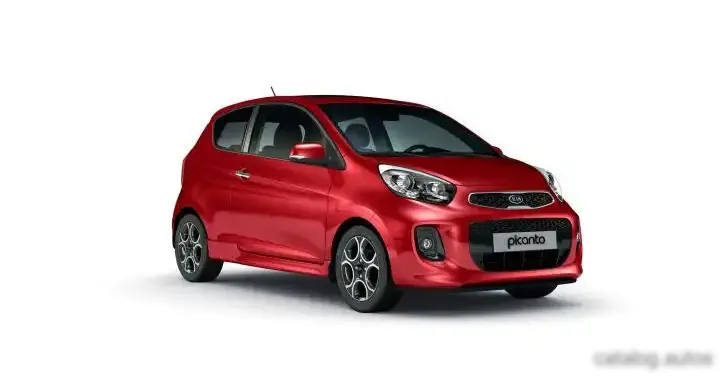
The Kia Picanto II, specifically the 3-door hatchback variant produced from 2015 to 2017 with the 1.0-liter engine producing 66 horsepower, represents an entry-level offering within the broader Picanto (TA) generation. Introduced as a facelift to the original Picanto II, this model aimed to provide an affordable and fuel-efficient city car for the European and Asian markets. Positioned as the base trim level, it catered to buyers prioritizing economy and practicality over outright performance. This variant was a key component of Kia’s strategy to establish a stronger foothold in the competitive microcar segment.
Technical Specifications
| Brand | Kia |
| Model | Picanto |
| Generation | Picanto II 3D (facelift 2015) |
| Type (Engine) | 1.0 (66 Hp) |
| Start of production | 2015 |
| End of production | 2017 |
| Powertrain Architecture | Internal Combustion engine |
| Body type | Hatchback |
| Seats | 5 |
| Doors | 3 |
| Fuel consumption (urban) | 5.5-5.8 l/100 km (42.8 – 40.6 US mpg) |
| Fuel consumption (extra urban) | 3.8 l/100 km (61.9 US mpg) |
| Fuel consumption (combined) | 4.4-4.5 l/100 km (53.5 – 52.3 US mpg) |
| CO2 emissions | 105-102 g/km |
| Fuel Type | Petrol (Gasoline) |
| Acceleration 0 – 100 km/h | 14.6 sec |
| Acceleration 0 – 62 mph | 14.6 sec |
| Acceleration 0 – 60 mph | 13.9 sec |
| Maximum speed | 158 km/h (98.18 mph) |
| Emission standard | Euro 6 |
| Weight-to-power ratio | 12.9 kg/Hp |
| Weight-to-torque ratio | 8.9 kg/Nm |
| Power | 66 Hp @ 5500 rpm |
| Torque | 95 Nm @ 3500 rpm (70.07 lb.-ft. @ 3500 rpm) |
| Engine layout | Front, Transverse |
| Engine Model/Code | B3LA |
| Engine displacement | 998 cm3 (60.9 cu. in.) |
| Number of cylinders | 3 |
| Engine configuration | Inline |
| Cylinder Bore | 71 mm (2.8 in.) |
| Piston Stroke | 84 mm (3.31 in.) |
| Compression ratio | 10.5:1 |
| Number of valves per cylinder | 4 |
| Fuel injection system | Multi-port manifold injection |
| Engine aspiration | Naturally aspirated engine |
| Engine oil capacity | 2.9 l (3.06 US qt | 2.55 UK qt) |
| Coolant capacity | 5.1 l (5.39 US qt | 4.49 UK qt) |
| Kerb Weight | 850-959 kg (1873.93 – 2114.23 lbs.) |
| Max. weight | 1400 kg (3086.47 lbs.) |
| Max load | 441-550 kg (972.24 – 1212.54 lbs.) |
| Trunk (boot) space – minimum | 200 l (7.06 cu. ft.) |
| Trunk (boot) space – maximum | 870 l (30.72 cu. ft.) |
| Fuel tank capacity | 35 l (9.25 US gal | 7.7 UK gal) |
| Length | 3595 mm (141.54 in.) |
| Width | 1595 mm (62.8 in.) |
| Width including mirrors | 1880 mm (74.02 in.) |
| Height | 1480 mm (58.27 in.) |
| Wheelbase | 2385 mm (93.9 in.) |
| Front track | 1409-1421 mm (55.47 – 55.94 in.) |
| Rear (Back) track | 1412-1424 mm (55.59 – 56.06 in.) |
| Minimum turning circle | 9.6 m (31.5 ft.) |
| Drivetrain Architecture | Front wheel drive |
| Number of gears and type of gearbox | 5 gears, manual transmission |
| Front suspension | Independent, type McPherson with coil spring and anti-roll bar |
| Rear suspension | Semi-independent, coil spring |
| Front brakes | Ventilated discs |
| Rear brakes | Disc |
| Assisting systems | ABS (Anti-lock braking system) |
| Steering type | Steering rack and pinion |
| Power steering | Electric Steering |
| Tires size | 155/70 R13 75T; 165/60 R14 75H; 175/50 R15 75H |
| Wheel rims size | 4.5J x 13 ET 46; 5.0J x 14 ET 49; 5.5J x 15 |
INTRODUCTION
The 2015-2017 Kia Picanto II 1.0 (66 Hp) 3-door hatchback is a subcompact car designed primarily for urban environments. As part of the TA generation Picanto, this facelifted model offered a refreshed exterior and minor interior updates compared to the original Picanto II. Built on the Kia’s 1HX0/A3 platform, it was marketed as an affordable, economical, and practical vehicle, particularly appealing to first-time car buyers and those seeking a nimble city runabout. The three-door configuration further emphasized its youthful appeal and compact footprint.
Powertrain & Engine Architecture
At the heart of this Picanto variant lies the Kia B3LA 1.0-liter inline-three cylinder gasoline engine. This engine, a mainstay in Kia’s smaller models, utilizes a multi-point fuel injection system to deliver fuel to the cylinders. The engine features a single overhead camshaft (SOHC) valvetrain with four valves per cylinder, contributing to reasonable efficiency and responsiveness for its size. The 66 horsepower output is achieved at 5,500 rpm, while peak torque of 95 Nm (70.07 lb-ft) arrives at 3,500 rpm. The engine is transversely mounted, driving the front wheels. The standard transmission for this model was a five-speed manual gearbox, optimized for fuel economy rather than sporty performance. The engine’s relatively simple design contributes to its reliability and ease of maintenance.
Driving Characteristics
The 1.0-liter engine and five-speed manual transmission combination in the Picanto II delivers modest performance. Acceleration from 0 to 60 mph takes approximately 13.9 seconds, and the top speed is around 98 mph. The gear ratios are tuned for maximizing fuel efficiency, meaning the engine needs to be revved to achieve brisk acceleration. Compared to potential higher-output variants (which weren’t widely available in the US market), this version feels noticeably slower, particularly when fully loaded or tackling inclines. However, its light weight and compact size make it surprisingly nimble in city traffic. The steering is light and easy, making maneuvering in tight spaces effortless. The suspension, while basic, provides a reasonably comfortable ride on smooth roads.
Equipment & Trim Levels
The 1.0-liter Picanto II typically came with a basic but functional equipment list. Standard features generally included power steering, central locking, electric front windows, and an ABS anti-lock braking system. Interior upholstery was typically cloth, with a simple dashboard layout. Optional extras, depending on the market, could include air conditioning, alloy wheels, and a basic audio system. This trim level was designed to be the most affordable, so many comfort and convenience features were offered as optional upgrades. The interior plastics were durable but not particularly luxurious, reflecting the car’s budget-oriented positioning.
Chassis & Braking
The Picanto II utilizes a McPherson strut front suspension with a coil spring and anti-roll bar, providing adequate handling and stability. The rear suspension is a semi-independent coil spring setup, which is cost-effective but less sophisticated than a fully independent system. Braking duties are handled by ventilated discs at the front and solid discs at the rear. The ABS system enhances braking performance and safety, particularly on slippery surfaces. The relatively light weight of the vehicle contributes to its braking efficiency. The steering system employs a rack and pinion setup with electric power assistance, offering a light and responsive feel.
Market Reception & Comparison
The Kia Picanto II 1.0 (66 Hp) was generally well-received as an affordable and economical city car. Critics praised its fuel efficiency, compact size, and ease of driving. However, the engine’s lack of power was a common criticism, particularly when compared to competitors offering larger engines or turbocharging. Compared to other trims in the Picanto lineup, this variant offered the lowest price point but also the least amount of performance and features. Its fuel economy, ranging from 4.4 to 4.5 l/100 km, was a key selling point, making it an attractive option for budget-conscious buyers.
Legacy
The Kia Picanto II 1.0 (66 Hp) has proven to be a relatively reliable vehicle, with the B3LA engine known for its durability. In the used car market, these models are often sought after for their low running costs and practicality. While not a performance car, its simplicity and affordability have made it a popular choice for urban commuters and first-time car owners. Maintenance is generally straightforward and inexpensive, thanks to the engine’s uncomplicated design. However, potential buyers should be aware of the engine’s limited power output and the basic nature of the interior trim. Overall, the Picanto II 1.0 remains a viable option for those seeking a dependable and economical city car.