
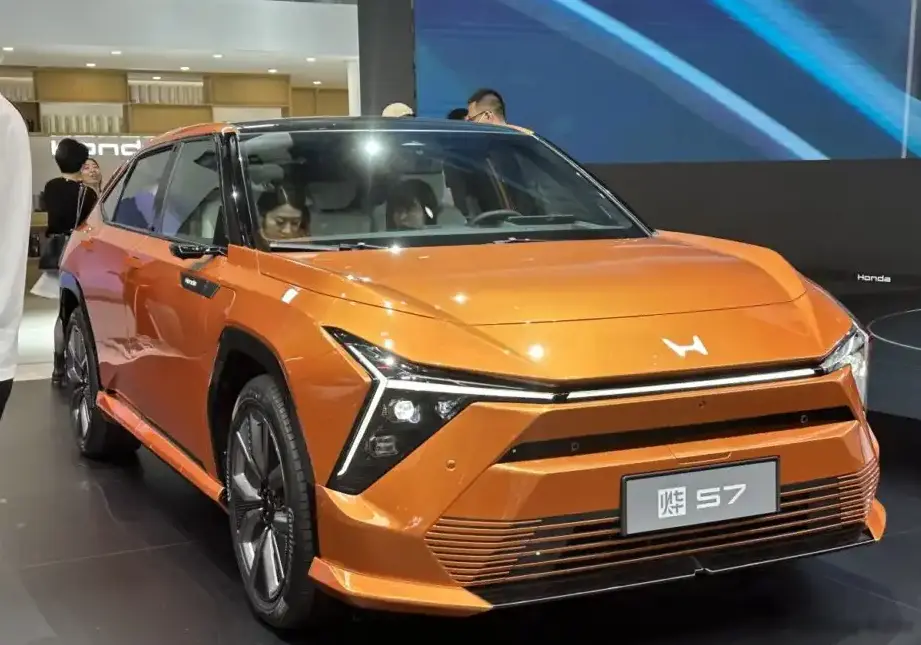
The Honda S7, launched in March 2025, represents Honda’s entry into the increasingly competitive all-electric SUV/Crossover market. Positioned as a mid-range offering within Honda’s anticipated EV lineup, the S7 aims to balance practicality, range, and performance with a focus on efficient electric propulsion. Built on a dedicated EV platform, the S7 is designed to appeal to families and individuals seeking a spacious and technologically advanced electric vehicle. This specific configuration features an 89.8 kWh battery pack paired with a single rear-mounted electric motor producing 272 horsepower.
Technical Specifications
| Brand | Honda |
| Model | S7 |
| Generation | S7 |
| Type (Engine) | 89.8 kWh (272 Hp) |
| Start of production | March, 2025 |
| Powertrain Architecture | BEV (Electric Vehicle) |
| Body type | SUV, Crossover |
| Seats | 5 |
| Doors | 5 |
| Fuel Type | Electricity |
| Maximum speed | 180 km/h (111.85 mph) |
| Weight-to-power ratio | 8 kg/Hp, 125.1 Hp/tonne |
| Weight-to-torque ratio | 5.2 kg/Nm, 193.1 Nm/tonne |
| Gross battery capacity | 89.8 kWh |
| Battery technology | Lithium nickel manganese cobalt oxides (Li-NMC) |
| Battery location | Below the floor |
| All-electric range (CLTC) | 650 km (403.89 mi) |
| Average Energy consumption (CLTC) | 14.6 kWh/100 km (23.5 kWh/100 mi, 143 MPGe, 6.8 km/kWh, 4.3 mi/kWh) |
| Electric motor power | 272 Hp |
| Electric motor Torque | 420 Nm (309.78 lb.-ft.) |
| Electric motor model/code | TZ220XSAMCF81 |
| Electric motor location | Rear axle, Transverse |
| Electric motor type | Synchronous |
| System power | 272 Hp |
| System torque | 420 Nm (309.78 lb.-ft.) |
| Kerb Weight | 2175-2191 kg (4795.05 – 4830.33 lbs.) |
| Max. weight | 2775 kg (6117.83 lbs.) |
| Max load | 584-600 kg (1287.5 – 1322.77 lbs.) |
| Trunk (boot) space – minimum | 471 l (16.63 cu. ft.) |
| Trunk (boot) space – maximum | 1485 l (52.44 cu. ft.) |
| Length | 4750 mm (187.01 in.) |
| Width | 1930 mm (75.98 in.) |
| Height | 1625 mm (63.98 in.) |
| Wheelbase | 2930 mm (115.35 in.) |
| Front track | 1641 mm (64.61 in.) |
| Rear (Back) track | 1654 mm (65.12 in.) |
| Minimum turning circle (turning diameter) | 11.5 m (37.73 ft.) |
| Approach angle | 17° |
| Departure angle | 24° |
| Climb angle | 21.8° |
| Drivetrain Architecture | One electric motor drives the rear wheels. |
| Drive wheel | Rear wheel drive |
| Number of gears and type of gearbox | 1 gears, automatic transmission |
| Front suspension | Coil spring, Double wishbone, Transverse stabilizer |
| Rear suspension | Independent multi-link spring suspension with stabilizer |
| Front brakes | Ventilated discs |
| Rear brakes | Ventilated discs |
| Assisting systems | ABS (Anti-lock braking system) |
| Steering type | Steering rack and pinion |
| Power steering | Electric Steering |
| Tires size | 265/55 R19 |
| Wheel rims size | 8.5J x 19 |
Powertrain & Engine Architecture
The Honda S7 utilizes a fully electric powertrain, centered around a permanent magnet synchronous motor driving the rear wheels. The 89.8 kWh lithium-nickel-manganese-cobalt oxide (Li-NMC) battery pack is positioned under the vehicle floor, contributing to a low center of gravity and maximizing interior space. The motor, designated TZ220XSAMCF81, delivers 272 horsepower and 420 Nm (309.78 lb.-ft.) of torque. The single-speed automatic transmission is a standard component of most modern EVs, providing seamless acceleration without the need for gear changes. The vehicle’s electrical architecture is designed for fast charging capabilities, though specific charging times vary depending on the charging infrastructure used.
Driving Characteristics
The rear-wheel-drive configuration of the S7 provides a balanced driving experience. With 272 hp and instant torque delivery characteristic of electric motors, the S7 offers brisk acceleration. While not positioned as a performance model, the S7 achieves a 0-60 mph time in the low-to-mid 7-second range. The single-speed transmission ensures smooth and linear power delivery. Compared to potential future higher-performance variants, this configuration prioritizes efficiency and a more relaxed driving experience. The relatively low curb weight (2175-2191 kg) contributes to agile handling, though the weight distribution is noticeably rear-biased.
Equipment & Trim Levels
The S7 89.8 kWh variant comes standard with a comprehensive suite of features, including a 12.3-inch touchscreen infotainment system, Honda Sensing suite of advanced driver-assistance systems (ADAS), automatic climate control, and a premium audio system. Interior upholstery consists of a combination of synthetic leather and cloth. Optional extras include a panoramic sunroof, heated and ventilated front seats, a head-up display, and advanced parking assist features. Trim levels above the base S7 offer upgraded interior materials, additional exterior styling elements, and potentially larger wheel sizes.
Chassis & Braking
The S7 features a coil spring, double wishbone suspension setup at the front, and an independent multi-link suspension at the rear, both incorporating a transverse stabilizer bar. This configuration is tuned for a comfortable ride while maintaining reasonable handling characteristics. Ventilated disc brakes are employed on all four wheels, providing ample stopping power. The inclusion of ABS (Anti-lock Braking System) is standard. The steering system utilizes an electric power steering (EPS) setup, offering precise and responsive steering feel.
Market Reception & Comparison
Initial reviews of the Honda S7 have been generally positive, with critics praising its spacious interior, comfortable ride, and competitive range. The 650 km (403.89 mi) CLTC range is comparable to other mid-range electric SUVs. Fuel economy, expressed as 14.6 kWh/100 km (143 MPGe), is competitive within its segment. Compared to potential higher-output variants, the 89.8 kWh model offers a more affordable entry point into the S7 lineup, appealing to buyers prioritizing efficiency and value. Reliability is expected to be strong, building on Honda’s reputation for durable vehicles, though long-term data is still emerging.
Legacy
The Honda S7 89.8 kWh represents a significant step for Honda in the electric vehicle market. Its powertrain, while not the most powerful in the S7 range, is expected to be highly reliable and efficient. As the EV market matures, this configuration is likely to remain a popular choice for buyers seeking a practical and affordable electric SUV. The S7’s success will contribute to Honda’s broader electrification strategy and help establish the brand as a key player in the future of automotive technology. The long-term value of this powertrain will depend on battery degradation and the availability of replacement parts, but Honda’s commitment to EV technology suggests continued support for the S7 platform for years to come.
