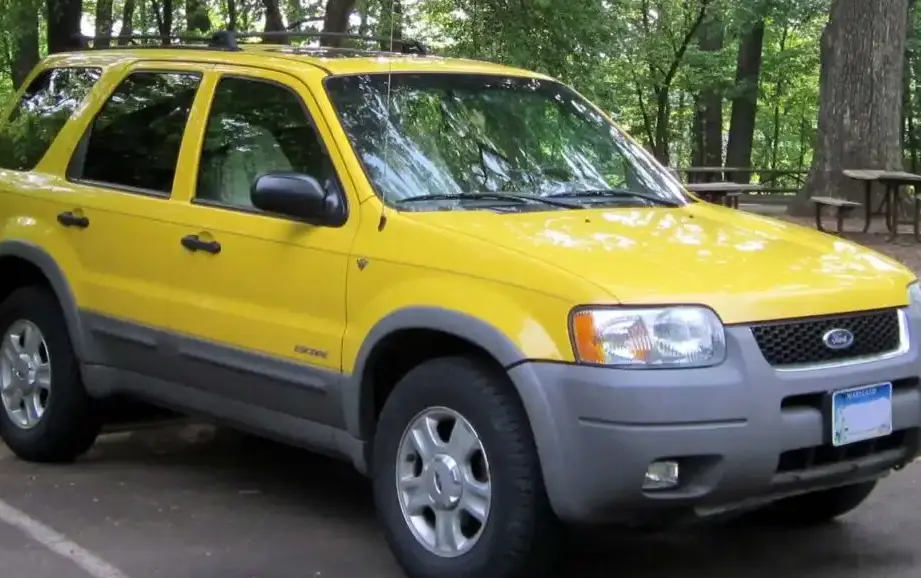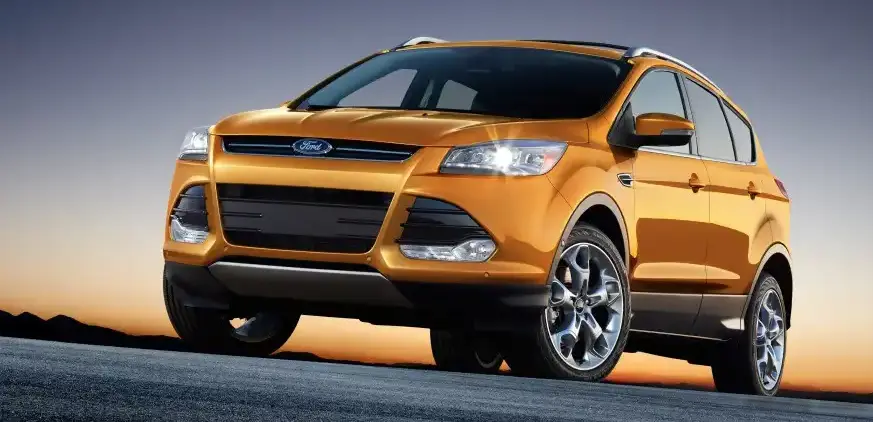
The Ford Escape III, produced from 2013 to 2016, represented a significant step forward for Ford’s compact SUV offering in the North American market. This generation, built on the global Ford C-platform (also known as the 1HX0 platform shared with the Ford Focus and Kuga), aimed to deliver a more refined and fuel-efficient experience than its predecessor. Among the various powertrain options available, the 1.6L EcoBoost engine paired with a six-speed automatic transmission and four-wheel drive (4WD) occupied a middle ground in the lineup, offering a balance between performance, economy, and capability. This configuration was positioned as a step up from the base 2.5L naturally aspirated engine, appealing to buyers seeking a more responsive driving experience without the higher price tag of the 2.0L EcoBoost.
Technical Specifications
| Brand | Ford |
| Model | Escape |
| Generation | Escape III |
| Type (Engine) | 1.6 EcoBoost (178 Hp) 4WD Automatic |
| Start of production | 2013 |
| End of production | 2016 |
| Powertrain Architecture | Internal Combustion engine |
| Body type | SUV |
| Seats | 5 |
| Doors | 5 |
| Fuel consumption (urban) | 10.7 l/100 km (22 US mpg) |
| Fuel consumption (extra urban) | 7.8 l/100 km (30.2 US mpg) |
| Fuel consumption (combined) | 9.4 l/100 km (25 US mpg) |
| Fuel Type | Petrol (Gasoline) |
| Weight-to-power ratio | 9.3 kg/Hp |
| Weight-to-torque ratio | 6.6 kg/Nm |
| Power | 178 Hp @ 5700 rpm |
| Power per litre | 111.5 Hp/l |
| Torque | 249 Nm @ 2500 rpm (183.65 lb.-ft. @ 2500 rpm) |
| Engine layout | Front, Transverse |
| Engine displacement | 1596 cm3 (97.39 cu. in.) |
| Number of cylinders | 4 |
| Engine configuration | Inline |
| Cylinder Bore | 79 mm (3.11 in.) |
| Piston Stroke | 81.2 mm (3.2 in.) |
| Compression ratio | 10:1 |
| Number of valves per cylinder | 4 |
| Fuel injection system | Direct injection |
| Engine aspiration | Turbocharger, Intercooler |
| Valvetrain | DOHC, Ti-VCT |
| Engine oil capacity | 4.1 l (4.33 US qt | 3.61 UK qt) |
| Coolant | 8 l (8.45 US qt | 7.04 UK qt) |
| Kerb Weight | 1653 kg (3644.24 lbs.) |
| Trunk (boot) space – minimum | 971 l (34.29 cu. ft.) |
| Trunk (boot) space – maximum | 1920 l (67.8 cu. ft.) |
| Fuel tank capacity | 58 l (15.32 US gal | 12.76 UK gal) |
| Permitted trailer load with brakes (12%) | 907 kg (1999.59 lbs.) |
| Length | 4524 mm (178.11 in.) |
| Width | 1839 mm (72.4 in.) |
| Width with mirrors folded | 1905 mm (75 in.) |
| Width including mirrors | 2078 mm (81.81 in.) |
| Height | 1684 mm (66.3 in.) |
| Wheelbase | 2690 mm (105.91 in.) |
| Front track | 1562 mm (61.5 in.) |
| Rear (Back) track | 1565 mm (61.61 in.) |
| Ride height (ground clearance) | 201 mm (7.91 in.) |
| Minimum turning circle (turning diameter) | 11.6 m (38.06 ft.) |
| Drive wheel | All wheel drive (4×4) |
| Number of gears and type of gearbox | 6 gears, automatic transmission |
| Front suspension | Independent, type McPherson with coil spring and anti-roll bar |
| Rear suspension | Independent coil spring |
| Front brakes | Ventilated discs |
| Rear brakes | Disc |
| Assisting systems | ABS (Anti-lock braking system) |
| Steering type | Steering rack and pinion |
| Power steering | Electric Steering |
| Tires size | 235/55 R17; 235/45 R19 |
| Wheel rims size | 17; 19 |
INTRODUCTION
The Ford Escape III 1.6 EcoBoost 4WD Automatic, produced between 2013 and 2016, was a key variant within the redesigned third-generation Escape lineup. This model aimed to provide a compelling option for buyers seeking a compact SUV with improved fuel efficiency and a more modern driving experience. The 1.6L EcoBoost engine, a member of Ford’s EcoBoost family of turbocharged, direct-injection engines, was introduced to offer a balance between power and economy. The inclusion of a six-speed automatic transmission and a four-wheel-drive system further broadened its appeal, making it suitable for a wider range of driving conditions and customer preferences. It sat in the middle of the range, offering more performance than the base 2.5L engine but at a lower price point than the more powerful 2.0L EcoBoost.
Powertrain & Engine Architecture
At the heart of this Escape variant lies the 1.6L EcoBoost engine, designated with engine codes like JQDA. This engine is a four-cylinder, inline configuration featuring direct fuel injection and a single turbocharger with an intercooler. The direct injection system allows for precise fuel delivery, optimizing combustion efficiency and contributing to improved power output and reduced emissions. The engine utilizes a double overhead camshaft (DOHC) valvetrain with Twin Independent Variable Camshaft Timing (Ti-VCT), further enhancing performance and responsiveness. The six-speed automatic transmission, a crucial component of this powertrain, was designed to provide smooth and efficient gear changes. It features a torque converter and electronically controlled shifting, adapting to driving conditions and driver input. The 4WD system is an intelligent system that automatically engages when wheel slip is detected, providing enhanced traction in adverse weather or on slippery surfaces.
Driving Characteristics
The 1.6L EcoBoost engine, producing 178 horsepower and 184 lb-ft of torque, provided a noticeable improvement in acceleration and responsiveness compared to the base 2.5L engine. While not as quick as the 2.0L EcoBoost, the 1.6L offered a more than adequate driving experience for everyday use. The six-speed automatic transmission generally shifted smoothly, although some drivers noted occasional hesitation during downshifts. The 4WD system provided confident handling in various conditions, enhancing stability and control. The gear ratios were tuned for a balance between fuel economy and performance, with a focus on providing sufficient torque for everyday driving situations. Compared to the manual transmission options available on other Escape trims, the automatic offered greater convenience, particularly in urban driving, but at the expense of some driver engagement and control.
Equipment & Trim Levels
The 1.6L EcoBoost 4WD Automatic Escape typically came standard with features such as air conditioning, power windows and locks, a basic audio system with a CD player and auxiliary input, and cloth upholstery. Higher trim levels, such as the SEL and Limited, added features like leather upholstery, a more advanced audio system with a touchscreen display, a rearview camera, and parking sensors. Optional extras included a panoramic sunroof, navigation system, and a premium sound system. Interior materials were generally of good quality for the price point, with a focus on durability and practicality. The dashboard layout was straightforward and user-friendly, with logically placed controls.
Chassis & Braking
The Escape III utilized a McPherson strut front suspension and an independent coil spring rear suspension. This setup provided a comfortable ride quality while maintaining reasonable handling characteristics. The front suspension incorporated a stabilizer bar to reduce body roll during cornering. Braking duties were handled by ventilated discs at the front and solid discs at the rear. The braking system was equipped with an Anti-lock Braking System (ABS) to prevent wheel lockup during hard braking, enhancing safety and control. The steering system was an electric power-assisted rack and pinion system, providing precise and responsive steering feel.
Market Reception & Comparison
The 1.6L EcoBoost 4WD Automatic Escape received generally positive reviews from automotive critics. It was praised for its fuel efficiency, comfortable ride, and well-equipped interior. However, some reviewers noted that the engine could feel strained when fully loaded or during aggressive acceleration. Compared to the 2.5L engine, the 1.6L EcoBoost offered a significant improvement in performance and fuel economy. Compared to the 2.0L EcoBoost, it provided a more affordable option with slightly less power. In terms of reliability, the 1.6L EcoBoost engine proved to be generally reliable, although some owners reported issues with the turbocharger and fuel injectors.
Legacy
The Ford Escape III 1.6 EcoBoost 4WD Automatic remains a popular choice in the used car market today. Its combination of fuel efficiency, practicality, and affordability makes it an attractive option for buyers seeking a compact SUV. The 1.6L EcoBoost engine, while not without its potential issues, has proven to be a relatively durable powertrain when properly maintained. Regular oil changes and timely maintenance are crucial for ensuring the long-term reliability of this engine. The Escape III, as a whole, helped solidify Ford’s position in the competitive compact SUV segment, paving the way for future generations of the popular model.