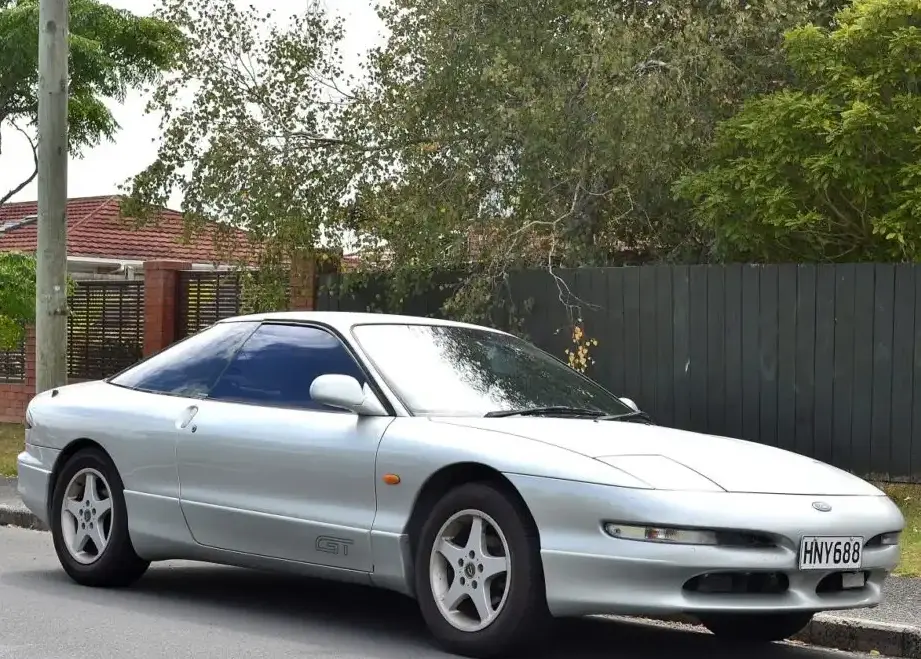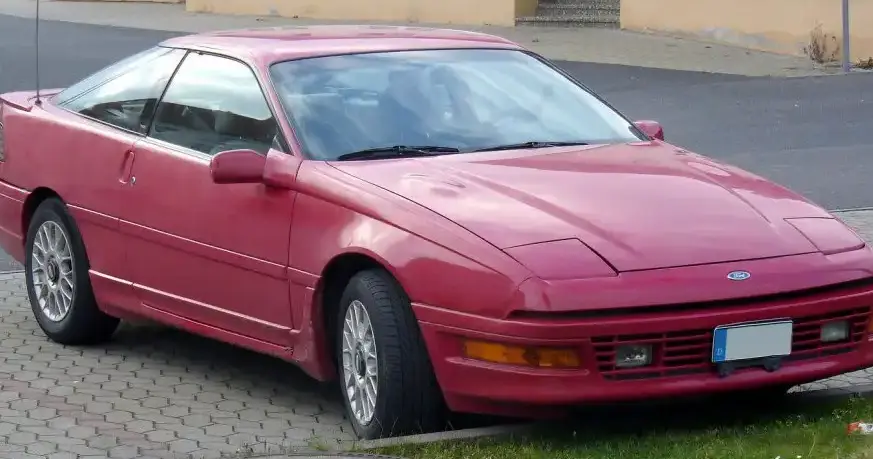
The Ford Probe I 2.2 GT, produced between 1988 and 1992, represented a significant departure for Ford, moving away from the Mustang-based platform for a more modern, aerodynamic coupe. Positioned as the top-tier performance variant of the first-generation Probe (designated chassis code 1HX0), the 2.2 GT aimed to attract buyers seeking a sporty, technologically advanced alternative to traditional American muscle cars. It was Ford’s attempt to capture a segment of the market increasingly interested in Japanese and European sports coupes. The Probe I, as a whole, was a key part of Ford’s effort to modernize its image and offer more fuel-efficient and technologically advanced vehicles.
Technical Specifications
| Brand | Ford |
| Model | Probe |
| Generation | Probe I |
| Type (Engine) | 2.2 GT (147 Hp) |
| Start of production | 1988 |
| End of production | 1992 |
| Powertrain Architecture | Internal Combustion engine |
| Body type | Coupe |
| Seats | 4 |
| Doors | 3 |
| Fuel consumption (urban) | 11.3 l/100 km (20.8 US mpg) |
| Fuel consumption (extra urban) | 6.1-8.1 l/100 km (38.6 – 29 US mpg) |
| Fuel Type | Petrol (Gasoline) |
| Acceleration 0 – 100 km/h | 8.6 sec |
| Acceleration 0 – 62 mph | 8.6 sec |
| Acceleration 0 – 60 mph | 8.2 sec |
| Maximum speed | 220 km/h (136.7 mph) |
| Weight-to-power ratio | 9.1 kg/Hp |
| Weight-to-torque ratio | 5.2 kg/Nm |
| Power | 147 Hp @ 4300 rpm |
| Torque | 258 Nm @ 3500 rpm (190.29 lb.-ft. @ 3500 rpm) |
| Engine layout | Front, Transverse |
| Engine Model/Code | F2T |
| Engine displacement | 2184 cm3 (133.28 cu. in.) |
| Number of cylinders | 4 |
| Engine configuration | Inline |
| Cylinder Bore | 86 mm (3.39 in.) |
| Piston Stroke | 94 mm (3.7 in.) |
| Compression ratio | 7.8:1 |
| Number of valves per cylinder | 3 |
| Fuel injection system | Multi-port manifold injection |
| Engine aspiration | Turbocharger, Intercooler |
| Valvetrain | SOHC |
| Engine oil capacity | 4.6 l (4.86 US qt | 4.05 UK qt) |
| Coolant capacity | 7.5 l (7.93 US qt | 6.6 UK qt) |
| Kerb Weight | 1340 kg (2954.19 lbs.) |
| Max. weight | 1730 kg (3814 lbs.) |
| Max load | 390 kg (859.8 lbs.) |
| Trunk (boot) space – minimum | 337 l (11.9 cu. ft.) |
| Trunk (boot) space – maximum | 1158 l (40.89 cu. ft.) |
| Fuel tank capacity | 57 l (15.06 US gal | 12.54 UK gal) |
| Length | 4520 mm (177.95 in.) |
| Width | 1740 mm (68.5 in.) |
| Height | 1320 mm (51.97 in.) |
| Wheelbase | 2515 mm (99.02 in.) |
| Front track | 1455 mm (57.28 in.) |
| Rear track | 1466 mm (57.72 in.) |
| Drag coefficient (Cd) | 0.312 |
| Minimum turning circle | 11.8 m (38.71 ft.) |
| Drivetrain Architecture | Front wheel drive |
| Number of gears | 5 gears, manual transmission |
| Front suspension | Independent, McPherson with coil spring and anti-roll bar |
| Rear suspension | McPherson, Transverse stabilizer |
| Front brakes | Ventilated discs |
| Rear brakes | Disc |
| Assisting systems | ABS (Anti-lock braking system) |
| Steering type | Steering rack and pinion |
| Power steering | Hydraulic |
| Tires size | 205/60 VR15 |
| Wheel rims size | 6J x 15 |
Powertrain & Engine Architecture
The heart of the Probe I 2.2 GT was the Ford F2T engine, a 2.2-liter inline-four cylinder powerplant. This engine was notable for its use of a turbocharger and an intercooler, boosting output to 147 horsepower and 190 lb-ft of torque. The F2T utilized multi-port fuel injection, a relatively advanced system for its time, contributing to improved fuel efficiency and throttle response. The engine featured a single overhead camshaft (SOHC) valvetrain with three valves per cylinder (two intake, one exhaust). This configuration aimed to balance performance with cost-effectiveness. The engine was transversely mounted, driving the front wheels. The five-speed manual transmission was the only transmission option for the 2.2 GT, providing drivers with full control over the engine’s power. The turbocharger was a Garrett T25, and the intercooler was an air-to-air design, helping to cool the intake charge and increase power.
Driving Characteristics
The 2.2 GT offered a noticeably more engaging driving experience than the base model Probes. The turbocharger provided a surge of power in the mid-range, making for quick acceleration. Zero to sixty mph times were consistently in the low 8-second range, respectable for a front-wheel-drive coupe of the early 1990s. The five-speed manual transmission allowed drivers to keep the engine in its optimal power band. While the turbo lag was present, it wasn’t overly intrusive. Handling was generally good, thanks to the independent front suspension and the relatively low curb weight. However, torque steer – a common characteristic of turbocharged front-wheel-drive cars – was noticeable under hard acceleration. Compared to a hypothetical Probe with a naturally aspirated V6, the 2.2 GT would have offered similar peak power but with a different power delivery curve, favoring mid-range punch over high-end horsepower.
Equipment & Trim Levels
The 2.2 GT was the best-equipped Probe I variant. Standard features included power windows, power door locks, a premium sound system, and a tilt steering wheel. The interior featured sport seats with a unique cloth upholstery pattern. Optional extras included a sunroof, upgraded audio systems, and alloy wheels. The dashboard layout was modern for its time, with a driver-focused design and easy-to-read gauges. The GT trim also featured unique exterior styling cues, such as a rear spoiler and body-colored side skirts.
Chassis & Braking
The Probe I utilized a McPherson strut suspension setup at both the front and rear. The front suspension incorporated a coil spring and anti-roll bar to reduce body roll during cornering. The rear suspension also featured a transverse stabilizer. Braking duties were handled by ventilated discs at the front and solid discs at the rear. An anti-lock braking system (ABS) was standard on the 2.2 GT, enhancing safety and control during hard braking. The steering system was a rack-and-pinion setup with hydraulic power assistance, providing precise and responsive steering feel.
Market Reception & Comparison
The Ford Probe I 2.2 GT was generally well-received by automotive critics. It was praised for its sporty handling, strong acceleration, and modern styling. However, some reviewers noted the presence of turbo lag and torque steer. Compared to other coupes in its price range, such as the Toyota Celica and Mazda MX-6, the Probe offered a unique blend of performance and technology. The 2.2 GT was more powerful than the base model Probes, but it also came with a higher price tag. Fuel economy was reasonable for a turbocharged vehicle, averaging around 25 mpg on the highway.
Legacy
The Ford Probe I 2.2 GT, while not a massive sales success, left a lasting impression on enthusiasts. The F2T engine proved to be relatively reliable, although turbocharger maintenance was crucial for long-term durability. Today, well-maintained examples of the 2.2 GT are becoming increasingly collectible. The Probe I represented a bold step for Ford, showcasing its willingness to experiment with new designs and technologies. It paved the way for future Ford performance models and helped to establish the company’s reputation for building sporty and innovative vehicles. The engine, while not without its quirks, remains a popular choice for engine swaps and modifications in the Ford community.