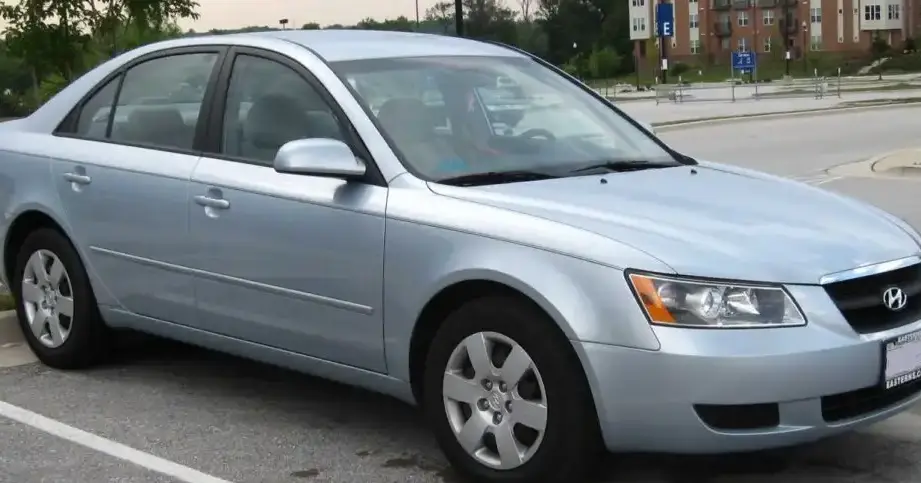
The Hyundai Sonata V (NF) 2.0i 16V Automatic, produced between 2004 and 2007, represented a significant step forward for Hyundai in the mid-size sedan segment. Part of the fifth generation Sonata (NF), this variant was positioned as a mainstream offering, balancing affordability with a reasonable level of equipment and comfort. It served as a key model in Hyundai’s efforts to gain market share in North America and Europe, offering a compelling alternative to established Japanese and European competitors. The NF generation, built on the Hyundai-Kia Y3 platform, aimed to provide a more refined and spacious interior, coupled with improved ride quality and a more modern aesthetic.
Technical Specifications
| Brand | Hyundai |
| Model | Sonata |
| Generation | Sonata V (NF) |
| Type (Engine) | 2.0i 16V (144 Hp) Automatic |
| Start of production | 2004 |
| End of production | 2007 |
| Powertrain Architecture | Internal Combustion engine |
| Body type | Sedan |
| Seats | 5 |
| Doors | 4 |
| Fuel consumption (urban) | 10 l/100 km (23.5 US mpg) |
| Fuel consumption (extra urban) | 6.7 l/100 km (35.1 US mpg) |
| Fuel consumption (combined) | 7.9 l/100 km (29.8 US mpg) |
| Fuel Type | Petrol (Gasoline) |
| Acceleration 0 – 100 km/h | 11.5 sec |
| Acceleration 0 – 62 mph | 11.5 sec |
| Acceleration 0 – 60 mph | 10.9 sec |
| Maximum speed | 194 km/h (120.55 mph) |
| Weight-to-power ratio | 10.2 kg/Hp |
| Weight-to-torque ratio | 7.8 kg/Nm |
| Power | 144 Hp @ 6000 rpm |
| Torque | 189 Nm @ 4250 rpm (139.4 lb.-ft. @ 4250 rpm) |
| Engine layout | Front, Transverse |
| Engine Model/Code | Theta II / G4KA |
| Engine displacement | 1998 cm3 (121.93 cu. in.) |
| Number of cylinders | 4 |
| Engine configuration | Inline |
| Cylinder Bore | 86 mm (3.39 in.) |
| Piston Stroke | 86 mm (3.39 in.) |
| Compression ratio | 10.5:1 |
| Number of valves per cylinder | 4 |
| Fuel injection system | Multi-port manifold injection |
| Engine aspiration | Naturally aspirated |
| Engine oil capacity | 4.3 l (4.54 US qt | 3.78 UK qt) |
| Coolant capacity | 7.3 l (7.71 US qt | 6.42 UK qt) |
| Kerb Weight | 1465 kg (3229.77 lbs.) |
| Max. weight | 2030 kg (4475.38 lbs.) |
| Max load | 565 kg (1245.61 lbs.) |
| Trunk (boot) space – minimum | 523 l (18.47 cu. ft.) |
| Fuel tank capacity | 70 l (18.49 US gal | 15.4 UK gal) |
| Max. roof load | 100 kg (220.46 lbs.) |
| Permitted towbar download | 80 kg (176.37 lbs.) |
| Length | 4800 mm (188.98 in.) |
| Width | 1832 mm (72.13 in.) |
| Height | 1475 mm (58.07 in.) |
| Wheelbase | 2730 mm (107.48 in.) |
| Front track | 1565 mm (61.61 in.) |
| Rear track | 1550 mm (61.02 in.) |
| Ride height (ground clearance) | 160 mm (6.3 in.) |
| Drag coefficient (Cd) | 0.32 |
| Minimum turning circle | 12.0 m (39.37 ft.) |
| Drivetrain Architecture | Front wheel drive |
| Number of gears | 4 |
| Gearbox type | Automatic transmission |
| Front suspension | Independent, McPherson with coil spring and anti-roll bar |
| Rear suspension | Independent multi-link with stabilizer |
| Front brakes | Ventilated discs |
| Rear brakes | Disc |
| Assisting systems | ABS (Anti-lock braking system) |
| Steering type | Steering rack and pinion |
| Tires size | 215/60 R16 |
| Wheel rims size | 6.5J x 16 |
Powertrain & Engine Architecture
The heart of the Sonata V 2.0i Automatic is the Hyundai Theta II engine, specifically the G4KA code. This 1.998-liter inline-four cylinder engine utilizes a cast iron block and an aluminum cylinder head. It features dual overhead camshafts (DOHC) and four valves per cylinder, contributing to its relatively efficient operation. Fuel delivery is managed by a multi-point fuel injection system. The engine produces 144 horsepower at 6000 rpm and 189 Nm (139.4 lb-ft) of torque at 4250 rpm. The engine’s 10.5:1 compression ratio strikes a balance between performance and fuel economy. The engine is transversely mounted, driving the front wheels. The automatic transmission is a conventional four-speed unit, chosen for its smoothness and ease of use, appealing to a broader customer base than a manual transmission.
Driving Characteristics
The 2.0-liter engine paired with the four-speed automatic transmission delivers adequate, but not exhilarating, performance. Acceleration from 0 to 60 mph takes around 10.9 seconds, and the top speed is approximately 120.55 mph. The automatic transmission is tuned for comfort, with relatively smooth shifts, but it can feel somewhat sluggish during quick acceleration or overtaking maneuvers. Compared to the more powerful 2.4-liter engine option available in the Sonata V, the 2.0-liter feels noticeably less responsive. However, the 2.0-liter offers better fuel economy and a more relaxed driving experience, making it suitable for daily commuting and long highway drives. The gear ratios are optimized for fuel efficiency rather than outright performance.
Equipment & Trim Levels
The 2.0i Automatic trim typically included standard features such as air conditioning, power windows and locks, a basic audio system, and cloth upholstery. Higher trim levels, often denoted with designations like “LX” or “Limited,” added features like alloy wheels, a sunroof, upgraded audio systems, and leather upholstery. Safety features generally included dual front airbags and ABS brakes. Optional extras could include a CD changer, cruise control, and power-adjustable seats.
Chassis & Braking
The Sonata V utilizes an independent McPherson strut suspension in the front and an independent multi-link suspension in the rear, providing a comfortable ride quality. The front suspension incorporates a stabilizer bar to reduce body roll during cornering. Braking duties are handled by ventilated disc brakes in the front and solid disc brakes in the rear. The ABS system helps to maintain steering control during emergency braking situations. The chassis is designed to prioritize ride comfort over sporty handling.
Market Reception & Comparison
The Sonata V 2.0i Automatic was generally well-received as a practical and affordable mid-size sedan. Critics praised its spacious interior, comfortable ride, and competitive price. However, some reviewers noted that the engine lacked the power and refinement of some of its Japanese rivals. Fuel economy was considered a strong point, and the automatic transmission was appreciated for its smoothness. Compared to the higher-output 2.4-liter Sonata, the 2.0-liter offered a more budget-friendly option, appealing to buyers who prioritized fuel efficiency and value over performance.
Legacy
The Hyundai Sonata V 2.0i Automatic has proven to be a relatively reliable vehicle, with many examples still on the road today. The Theta II engine is generally considered durable, although regular maintenance is crucial to prevent issues such as oil leaks and timing chain wear. The four-speed automatic transmission is also known for its reliability. In the used car market, these Sonatas represent an affordable and practical option for buyers seeking a dependable mid-size sedan. While not a performance icon, the 2.0i Automatic played a vital role in establishing Hyundai as a credible competitor in the global automotive market.