
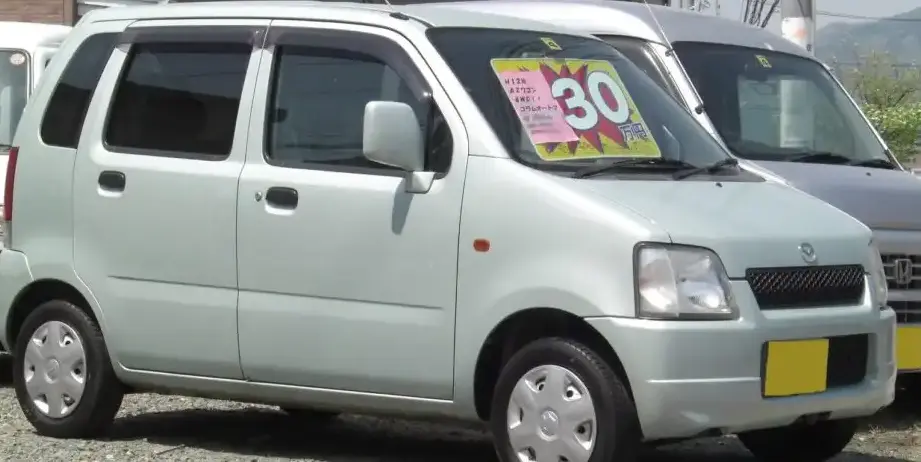
Technical Specifications
| Brand | Mazda |
| Model | Az-wagon |
| Generation | Az-wagon II |
| Type (Engine) | 0.7 12V Turbo (64 Hp) |
| Start of production | 1998 year |
| End of production | 2000 year |
| Powertrain Architecture | Internal Combustion engine |
| Body type | Minivan |
| Seats | 4 |
| Doors | 3/5 |
| Fuel consumption (urban) | 8 l/100 km (29.4 US mpg, 35.3 UK mpg, 12.5 km/l) |
| Fuel consumption (extra urban) | 4 l/100 km (58.8 US mpg, 70.6 UK mpg, 25 km/l) |
| Fuel Type | Petrol (Gasoline) |
| Maximum speed | 140 km/h (86.99 mph) |
| Weight-to-power ratio | 11.7 kg/Hp, 85.3 Hp/tonne |
| Weight-to-torque ratio | 7.1 kg/Nm, 141.3 Nm/tonne |
| Power | 64 Hp @ 6500 rpm |
| Power per litre | 97.3 Hp/l |
| Torque | 106 Nm @ 3500 rpm (78.18 lb.-ft. @ 3500 rpm) |
| Engine layout | Front, Transverse |
| Engine displacement | 658 cm3 (40.15 cu. in.) |
| Number of cylinders | 3 |
| Engine configuration | Inline |
| Cylinder Bore | 68 mm (2.68 in.) |
| Piston Stroke | 60.4 mm (2.38 in.) |
| Compression ratio | 8.4:1 |
| Number of valves per cylinder | 4 |
| Fuel injection system | Multi-port manifold injection |
| Engine aspiration | Turbocharger |
| Valvetrain | DOHC |
| Kerb Weight | 750 kg (1653.47 lbs.) |
| Fuel tank capacity | 30 l (7.93 US gal | 6.6 UK gal) |
| Length | 3395 mm (133.66 in.) |
| Width | 1475 mm (58.07 in.) |
| Height | 1690 mm (66.54 in.) |
| Wheelbase | 2360 mm (92.91 in.) |
| Front track | 1290 mm (50.79 in.) |
| Rear track | 1290 mm (50.79 in.) |
| Minimum turning circle | 8.4 m (27.56 ft.) |
| Drivetrain Architecture | The Internal combustion engine (ICE) drives the front wheels of the vehicle. |
| Drive wheel | Front wheel drive |
| Number of gears and type of gearbox | 5 gears, manual transmission |
| Front suspension | Spring Strut |
| Rear suspension | Coil spring |
| Front brakes | Disc |
| Rear brakes | Drum |
| Assisting systems | ABS (Anti-lock braking system) |
| Steering type | Steering rack and pinion |
| Tires size | 155/65 R13 |
The Mazda Az-Wagon II 0.7 12V Turbo, produced between 1998 and 2000, was a distinctive offering within the Japanese Kei car segment. Designed as a compact, affordable, and surprisingly practical vehicle, the Az-Wagon II aimed to meet the transportation needs of urban Japanese drivers. This particular variant, featuring a 64 horsepower turbocharged engine paired with a five-speed manual transmission, occupied a middle ground in the Az-Wagon II lineup, balancing fuel economy with a degree of performance. It was exclusively sold within the Japanese domestic market (JDM), adhering to the unique regulations and preferences of Japanese car buyers.
Powertrain & Engine Architecture
The core of the Az-Wagon II 0.7 Turbo is its 658cc inline-three cylinder engine. This engine, often identified by its internal codes, employed a double overhead camshaft (DOHC) design with four valves per cylinder. The addition of a turbocharger significantly increased power output for its displacement, delivering 64 horsepower at 6500 rpm and 106 Nm (78.18 lb-ft) of torque at 3500 rpm. Fuel delivery was managed by a multi-port fuel injection system, enhancing both efficiency and responsiveness. The five-speed manual transmission was a crucial component, allowing drivers to effectively utilize the engine’s power. The transmission’s gear ratios were carefully tuned to provide a balance between city driving usability and highway cruising, although fuel economy remained a primary consideration. The engine block itself was constructed from lightweight materials to minimize overall vehicle weight.
Driving Characteristics
The 0.7 Turbo variant provided a noticeable performance improvement over the naturally aspirated versions of the Az-Wagon II. While not intended as a performance vehicle, the turbocharger offered a useful boost in acceleration, making overtaking and merging onto highways more manageable. The five-speed manual transmission provided precise control over the engine’s powerband. However, the small displacement engine necessitated frequent gear changes to maintain momentum, particularly when carrying passengers or cargo. Compared to the available automatic transmission options, the manual version offered a more engaging driving experience and slightly improved fuel economy. The steering was light and responsive, making it easy to maneuver in tight urban environments. The suspension, while tuned for comfort, did exhibit some body roll during more aggressive cornering.
Equipment & Trim Levels
The Az-Wagon II 0.7 Turbo typically included basic amenities, reflecting its position as an affordable Kei car. Standard features generally consisted of power steering, air conditioning, and a basic audio system. Interior upholstery was typically cloth, with a functional, though somewhat simple, dashboard layout. Optional extras could include upgraded audio systems, alloy wheels, and body-colored exterior trim. This variant was considered a mid-range trim level, offering more features than the base models but lacking the luxury appointments found in higher-specification versions. Features like electric windows and central locking were often available as optional upgrades.
Chassis & Braking
The Az-Wagon II featured a front-engine, front-wheel-drive layout. Suspension consisted of a MacPherson strut setup at the front and a coil spring arrangement at the rear. Braking was provided by disc brakes on the front wheels and drum brakes on the rear. An Anti-lock Braking System (ABS) was included as a standard safety feature. The vehicle’s relatively lightweight construction, at 750 kg (1653.47 lbs), contributed to its nimble handling. The suspension was tuned for comfort rather than outright performance, providing a reasonably smooth ride on typical urban roads. The compact size and tight turning radius made it particularly well-suited for navigating crowded city streets.
Market Reception & Comparison
The Mazda Az-Wagon II 0.7 Turbo was generally well-received in the Japanese market as a practical and economical city car. Critics praised its compact size, fuel efficiency, and surprisingly spacious interior for its class. Compared to other Kei cars, such as the Suzuki Wagon R or the Daihatsu Mira, the Az-Wagon II offered a slightly more refined driving experience and a more stylish exterior design. However, some reviewers noted that the engine could feel strained at higher speeds, and the interior materials were somewhat basic. Fuel economy figures were competitive, averaging around 4 liters per 100 kilometers (58.8 US mpg) on the extra-urban cycle. The turbocharger gave it an edge in terms of acceleration compared to many of its naturally aspirated competitors.
Legacy
The Mazda Az-Wagon II, and particularly the 0.7 Turbo variant, has garnered a modest following among enthusiasts of JDM cars. While not as highly sought after as some other iconic Japanese models, it is appreciated for its unique character and affordability. The 658cc turbocharged engine, while relatively simple in design, has proven to be reasonably reliable with proper maintenance. In the used car market, these vehicles are often found in good condition, having been well-maintained by their original owners. The Az-Wagon II represents a significant example of Japanese engineering ingenuity, demonstrating how to maximize space and efficiency within the constraints of the Kei car regulations. Its compact size and fuel efficiency continue to appeal to buyers seeking an economical and practical urban vehicle.
