Technical Specifications
| Brand | Ford |
| Model | Puma |
| Generation | Puma (facelift 2024) |
| Type (Engine) | 1.0 EcoBoost (125 Hp) Mild Hybrid Powershift |
| Start of production | February, 2024 |
| Powertrain Architecture | MHEV (Mild Hybrid Electric Vehicle) |
| Body type | SUV, Crossover |
| Seats | 5 |
| Doors | 5 |
| Combined fuel consumption (WLTP) | 5.6-6.3 l/100 km (42 – 37.3 US mpg, 50.4 – 44.8 UK mpg, 17.9 – 15.9 km/l) |
| CO2 emissions (WLTP) | 127-143 g/km |
| Fuel Type | Petrol (Gasoline) |
| Acceleration 0 – 100 km/h | 9.6 sec |
| Acceleration 0 – 62 mph | 9.6 sec |
| Acceleration 0 – 60 mph | 9.1 sec |
| Maximum speed | 190 km/h (118.06 mph) |
| Emission standard | Euro 6d |
| Weight-to-power ratio | 10.3 kg/Hp, 96.7 Hp/tonne |
| Weight-to-torque ratio | 6.2 kg/Nm, 162.4 Nm/tonne |
| Battery voltage | 48 V |
| Battery technology | Lithium-ion (Li-Ion) |
| Battery location | Under the front seats |
| Electric motor power | 16 Hp |
| Electric motor location | Front, Transverse |
| Power | 125 Hp @ 6000 rpm |
| Power per litre | 125.1 Hp/l |
| Torque | 210 Nm @ 1750 rpm (154.89 lb.-ft. @ 1750 rpm) |
| Engine layout | Front, Transverse |
| Engine displacement | 999 cm3 (60.96 cu. in.) |
| Number of cylinders | 3 |
| Engine configuration | Inline |
| Cylinder Bore | 71.9 mm (2.83 in.) |
| Piston Stroke | 82 mm (3.23 in.) |
| Compression ratio | 10.5:1 |
| Number of valves per cylinder | 4 |
| Fuel injection system | Direct injection |
| Engine aspiration | Turbocharger, Intercooler |
| Valvetrain | DOHC, Ti-VCT |
| Engine systems | Start & Stop System, Particulate filter |
| Kerb Weight | 1293 kg (2850.58 lbs.) |
| Max. weight | 1835 kg (4045.48 lbs.) |
| Max load | 542 kg (1194.91 lbs.) |
| Trunk (boot) space – minimum | 456 l (16.1 cu. ft.) |
| Trunk (boot) space – maximum | 1216 l (42.94 cu. ft.) |
| Fuel tank capacity | 42 l (11.1 US gal | 9.24 UK gal) |
| Max. roof load | 50 kg (110.23 lbs.) |
| Permitted trailer load with brakes (12%) | 900 kg (1984.16 lbs.) |
| Permitted trailer load without brakes | 665 kg (1466.07 lbs.) |
| Permitted towbar download | 75 kg (165.35 lbs.) |
| Length | 4186 mm (164.8 in.) |
| Width with mirrors folded | 1805 mm (71.06 in.) |
| Width including mirrors | 1930 mm (75.98 in.) |
| Height | 1550 mm (61.02 in.) |
| Wheelbase | 2588 mm (101.89 in.) |
| Front track | 1567 mm (61.69 in.) |
| Rear (Back) track | 1526 mm (60.08 in.) |
| Front overhang | 850 mm (33.46 in.) |
| Rear overhang | 748 mm (29.45 in.) |
| Ride height (ground clearance) | 163 mm (6.42 in.) |
| Minimum turning circle (turning diameter) | 10.4 m (34.12 ft.) |
| Approach angle | 17.5° |
| Departure angle | 26.6° |
| Drivetrain Architecture | ICE and electric motor drive the front wheels in mixed mode. |
| Drive wheel | Front wheel drive |
| Number of gears and type of gearbox | 7 gears, automatic transmission Powershift |
| Front suspension | Independent, type McPherson with coil spring and anti-roll bar |
| Rear suspension | Coil spring, Elastic beam |
| Front brakes | Ventilated discs, 278×25 mm |
| Rear brakes | Drum, 228×40 mm |
| Assisting systems | ABS (Anti-lock braking system) |
| Steering type | Steering rack and pinion |
| Power steering | Electric Steering |
| Tires size | 215/55 R17; 215/50 R18; 225/40 R19 |
| Wheel rims size | 7J x 17; 7J x 18; 7.5J x 19 |
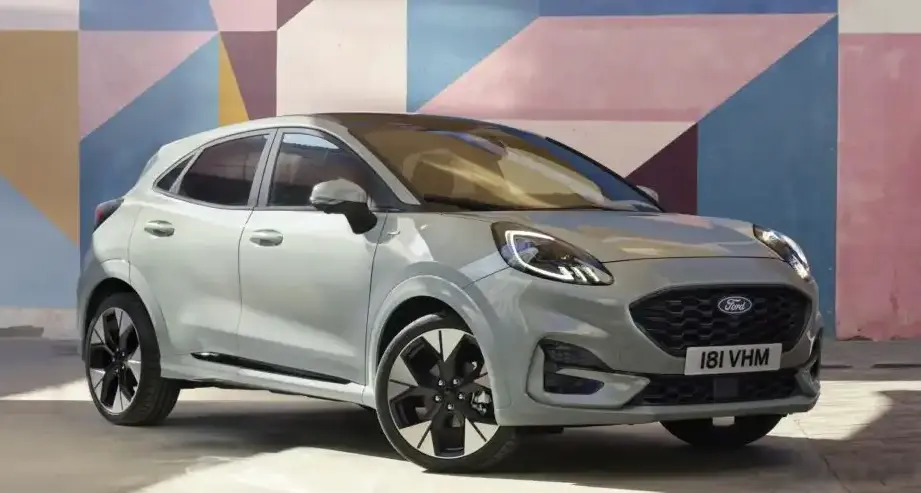
The 2024 Ford Puma 1.0 EcoBoost 125 hp Mild Hybrid Powershift is a front-wheel-drive subcompact SUV designed to appeal to buyers seeking a fuel-efficient and practical vehicle. Positioned within the Puma lineup as a mid-range option, it slots between the lower-powered, more basic trims and the higher-output ST models. The facelifted Puma builds upon the success of the original, launched in 2019, offering a refreshed design and updated technology. The “Powershift” designation refers to Ford’s dual-clutch transmission (DCT), offering quicker shifts and improved fuel economy compared to a traditional automatic. The mild-hybrid system, utilizing a 48V battery, provides a small power boost and enables start-stop functionality for enhanced efficiency.
Powertrain & Engine Architecture
At the heart of this Puma variant lies the Ford 1.0 EcoBoost engine, specifically the latest iteration. This is a three-cylinder, inline gasoline engine with a displacement of 999cc. It utilizes direct fuel injection and is equipped with a turbocharger and intercooler to boost power output. The engine code varies depending on the specific market, but it generally falls within the updated EcoBoost family. The 125 hp output is achieved at 6000 rpm, while peak torque of 210 Nm (154.89 lb.-ft.) is delivered at 1750 rpm. The mild-hybrid system adds a small electric motor and a 48V lithium-ion battery, located under the front seats. This system provides regenerative braking and assists the engine during acceleration, improving fuel economy and reducing emissions. The seven-speed Powershift dual-clutch transmission (DCT) is a key component, offering smooth and rapid gear changes. The DCT operates with two separate clutches, one for odd gears and one for even gears, allowing for pre-selection of the next gear and minimizing interruption in power delivery.
Driving Characteristics
The 1.0 EcoBoost 125 hp Powershift Puma delivers a comfortable and generally responsive driving experience. Acceleration from 0-60 mph takes approximately 9.1 seconds, which is adequate for everyday driving but doesn’t offer particularly sporty performance. The Powershift transmission contributes to a smooth driving experience, with quick and precise gear changes. However, some drivers have reported occasional hesitation at low speeds. The mild-hybrid system is largely seamless in operation, providing a subtle boost during acceleration. The gear ratios are tuned for fuel efficiency, meaning the engine can feel slightly strained when climbing hills or accelerating quickly. Compared to the higher-output EcoBoost variants, this version feels less eager to rev, but it offers a more relaxed and economical driving experience. Compared to manual transmission versions, the Powershift offers convenience, but some drivers may prefer the greater control of a manual gearbox.
Equipment & Trim Levels
The 2024 Puma 1.0 EcoBoost 125 hp Mild Hybrid Powershift typically comes well-equipped, even in its mid-range trim. Standard features often include air conditioning, a touchscreen infotainment system with Apple CarPlay and Android Auto compatibility, Ford’s SYNC 4 system, a digital instrument cluster, and a suite of safety features such as automatic emergency braking, lane-keeping assist, and cruise control. Interior upholstery is typically cloth, with options for upgraded materials. Optional extras can include a panoramic sunroof, heated seats, a premium sound system, and parking assistance features. Trim levels vary by market, but generally, this configuration sits between the base “Active” trim and the more luxurious “Titanium” or “ST-Line” trims.
Chassis & Braking
The Puma utilizes a front-wheel-drive chassis with independent McPherson strut suspension at the front and a semi-independent elastic beam suspension at the rear. This setup provides a good balance between ride comfort and handling. The front brakes are ventilated discs measuring 278x25mm, while the rear brakes are drum brakes measuring 228x40mm. This configuration is typical for vehicles in this weight class. Anti-lock Braking System (ABS) is standard, along with Electronic Stability Control (ESC). The steering is electric power-assisted, providing light and precise steering feel. The suspension is tuned for comfort, but the Puma still offers decent handling characteristics, with minimal body roll in corners.
Market Reception & Comparison
The Ford Puma, and specifically this 1.0 EcoBoost 125 hp Powershift variant, has been well-received by critics and consumers alike. It’s praised for its fuel efficiency, practicality, and stylish design. Compared to other subcompact SUVs like the Volkswagen T-Cross or the Renault Captur, the Puma offers a competitive level of equipment and a more engaging driving experience. The mild-hybrid system contributes to excellent fuel economy, typically ranging from 5.6 to 6.3 l/100 km (42-37.3 US mpg). Reliability has been generally good, although some owners have reported minor issues with the Powershift transmission. However, these issues are not widespread and are often covered under warranty.
Legacy
The 1.0 EcoBoost engine has become a mainstay in Ford’s lineup, known for its fuel efficiency and surprisingly strong performance for its size. The Powershift transmission, while offering benefits in terms of fuel economy and smoothness, has had a mixed reputation for long-term reliability. However, Ford has addressed many of the early issues with the transmission. As a used car, the 2024 Puma 1.0 EcoBoost 125 hp Mild Hybrid Powershift is expected to hold its value well, thanks to its fuel efficiency, practicality, and the Ford brand’s reputation for reliability. It represents a compelling option for buyers seeking a well-rounded and economical subcompact SUV.