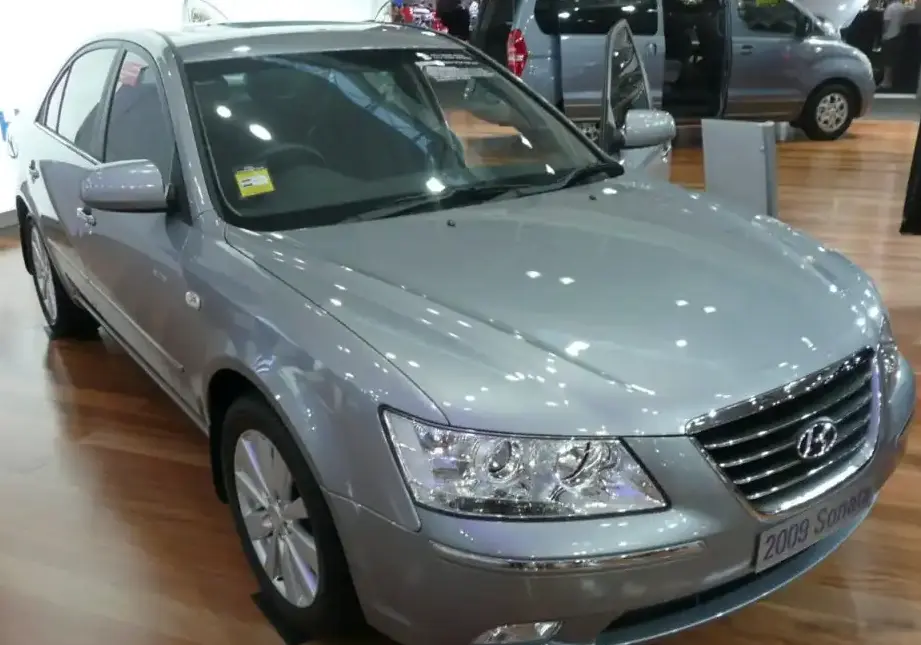
The Hyundai Sonata V (NF facelift), produced from 2008 to 2009, represented a significant mid-cycle refresh of the fifth-generation Sonata. Within the NF range, the 3.3-liter V6 with an automatic transmission occupied the premium position, offering a substantial step up in performance and features compared to the base 2.4-liter four-cylinder models. This variant was primarily aimed at buyers seeking a comfortable, well-equipped, and relatively powerful family sedan. The facelift brought revised styling cues, including a new front fascia, taillights, and interior refinements, enhancing the Sonata’s appeal in a competitive segment.
Technical Specifications
| Brand | Hyundai |
| Model | Sonata |
| Generation | Sonata V (NF, facelift 2008) |
| Type (Engine) | 3.3 V6 (250 Hp) Automatic |
| Start of production | 2008 |
| End of production | 2009 |
| Powertrain Architecture | Internal Combustion engine |
| Body type | Sedan |
| Seats | 5 |
| Doors | 4 |
| Fuel consumption (urban) | 14 l/100 km (16.8 US mpg, 20.2 UK mpg, 7.1 km/l) |
| Fuel consumption (extra urban) | 7.4 l/100 km (31.8 US mpg, 38.2 UK mpg, 13.5 km/l) |
| Fuel consumption (combined) | 9.9 l/100 km (23.8 US mpg, 28.5 UK mpg, 10.1 km/l) |
| Fuel Type | Petrol (Gasoline) |
| Acceleration 0 – 100 km/h | 7.7 sec |
| Acceleration 0 – 62 mph | 7.7 sec |
| Acceleration 0 – 60 mph | 7.3 sec |
| Maximum speed | 230 km/h (142.92 mph) |
| Emission standard | Euro 4 |
| Weight-to-power ratio | 6.3 kg/Hp, 157.8 Hp/tonne |
| Weight-to-torque ratio | 5.1 kg/Nm, 195.7 Nm/tonne |
| Power | 250 Hp @ 6000 rpm |
| Power per litre | 74.8 Hp/l |
| Torque | 310 Nm @ 4500 rpm (228.64 lb.-ft. @ 4500 rpm) |
| Engine layout | Front, Transverse |
| Engine Model/Code | Lambda / G6DB |
| Engine displacement | 3342 cm3 (203.94 cu. in.) |
| Number of cylinders | 6 |
| Engine configuration | V-engine |
| Cylinder Bore | 92 mm (3.62 in.) |
| Piston Stroke | 83.8 mm (3.3 in.) |
| Compression ratio | 10.4:1 |
| Number of valves per cylinder | 4 |
| Fuel injection system | Multi-port manifold injection |
| Engine aspiration | Naturally aspirated engine |
| Valvetrain | DOHC, CVVT |
| Engine oil capacity | 5.2 l (5.49 US qt | 4.58 UK qt) |
| Coolant | 8.2 l (8.66 US qt | 7.21 UK qt) |
| Kerb Weight | 1584 kg (3492.12 lbs.) |
| Max. weight | 2130 kg (4695.85 lbs.) |
| Max load | 546 kg (1203.72 lbs.) |
| Trunk (boot) space – minimum | 523 l (18.47 cu. ft.) |
| Fuel tank capacity | 70 l (18.49 US gal | 15.4 UK gal) |
| Length | 4800 mm (188.98 in.) |
| Width | 1832 mm (72.13 in.) |
| Height | 1475 mm (58.07 in.) |
| Wheelbase | 2730 mm (107.48 in.) |
| Front track | 1565 mm (61.61 in.) |
| Rear (Back) track | 1550 mm (61.02 in.) |
| Drag coefficient (Cd) | 0.32 |
| Minimum turning circle | 12 m (39.37 ft.) |
| Drivetrain Architecture | The Internal combustion engine (ICE) drives the front wheels of the vehicle. |
| Drive wheel | Front wheel drive |
| Number of gears and type of gearbox | 5 gears, automatic transmission |
| Front suspension | Independent, type McPherson with coil spring and anti-roll bar |
| Rear suspension | Independent multi-link suspension |
| Front brakes | Ventilated discs |
| Rear brakes | Disc |
| Assisting systems | ABS (Anti-lock braking system) |
| Steering type | Steering rack and pinion |
| Tires size | 215/55 R17 |
| Wheel rims size | 17 |
Powertrain & Engine Architecture
The heart of this Sonata variant is the Hyundai Lambda 3.3-liter V6 engine, designated G6DB. This engine is a naturally aspirated, 60-degree V6 featuring a dual overhead camshaft (DOHC) design with continuously variable valve timing (CVVT) on both intake and exhaust valves. The multi-port fuel injection system delivers fuel directly to each cylinder, optimizing combustion efficiency. The engine produces 250 horsepower at 6000 rpm and 310 Nm (228.64 lb-ft) of torque at 4500 rpm. Paired with this engine is a 5-speed automatic transmission, designed for smooth and comfortable shifts. This transmission, while not offering the sportiness of a manual, was tuned for relaxed cruising and everyday drivability. The engine’s transverse mounting and front-wheel-drive configuration were standard for the NF Sonata platform.
Driving Characteristics
The 3.3L V6 automatic Sonata offered a noticeable performance advantage over the base 2.4L models. Acceleration to 60 mph was achieved in approximately 7.3-7.7 seconds, making it competitive with other mid-size sedans of the era. The automatic transmission, while smooth, wasn’t particularly quick to downshift, resulting in a slightly less responsive feel compared to a manual transmission. The gear ratios were optimized for fuel economy and comfortable highway cruising. In real-world driving, the engine provided ample power for merging onto highways and passing maneuvers. However, it lacked the outright punch of some competitors with larger displacement engines or forced induction. The suspension tuning prioritized ride comfort over sporty handling, resulting in a generally smooth and composed ride.
Equipment & Trim Levels
The 3.3L V6 automatic Sonata typically came well-equipped, representing the top trim level within the NF facelift range. Standard features often included air conditioning, power windows and locks, a CD player with an auxiliary input, and alloy wheels. Higher-spec versions could be equipped with leather upholstery, a sunroof, heated front seats, and an upgraded audio system. Safety features such as ABS and front airbags were standard. The interior design featured a relatively straightforward layout with user-friendly controls. The overall ambiance was geared towards comfort and practicality rather than luxury.
Chassis & Braking
The Sonata V utilized a McPherson strut front suspension and a multi-link rear suspension, providing a good balance of ride comfort and handling. The front suspension incorporated a coil spring and anti-roll bar to reduce body roll during cornering. Braking duties were handled by ventilated discs at the front and solid discs at the rear. ABS (Anti-lock Braking System) was standard, enhancing braking performance and stability, particularly in adverse conditions. The steering system employed a rack and pinion setup, offering reasonably precise steering feel.
Market Reception & Comparison
The 2008-2009 Hyundai Sonata V 3.3L V6 Automatic was generally well-received by automotive critics. It was praised for its spacious interior, comfortable ride, and strong value proposition. However, some reviewers noted that the automatic transmission could feel somewhat sluggish and that the handling wasn’t as engaging as some competitors. Compared to the 2.4L four-cylinder models, the V6 offered significantly more power and refinement, but at a higher price point. Fuel economy was also lower with the V6, averaging around 23.8 US mpg combined. Compared to rivals like the Toyota Camry and Honda Accord, the Sonata offered a similar level of features and performance at a more competitive price.
Legacy
The Hyundai Lambda 3.3L V6 engine proved to be a relatively reliable powertrain. While not without its potential issues (such as occasional oil consumption), it generally held up well over time with proper maintenance. Today, used examples of the 2008-2009 Sonata V 3.3L are relatively affordable and can represent a good value for buyers seeking a comfortable and spacious family sedan. However, potential buyers should be aware of the car’s age and mileage and should thoroughly inspect the vehicle for any signs of wear or neglect. The Sonata V played a crucial role in establishing Hyundai as a serious contender in the mid-size sedan segment, paving the way for the brand’s continued success in the US market.