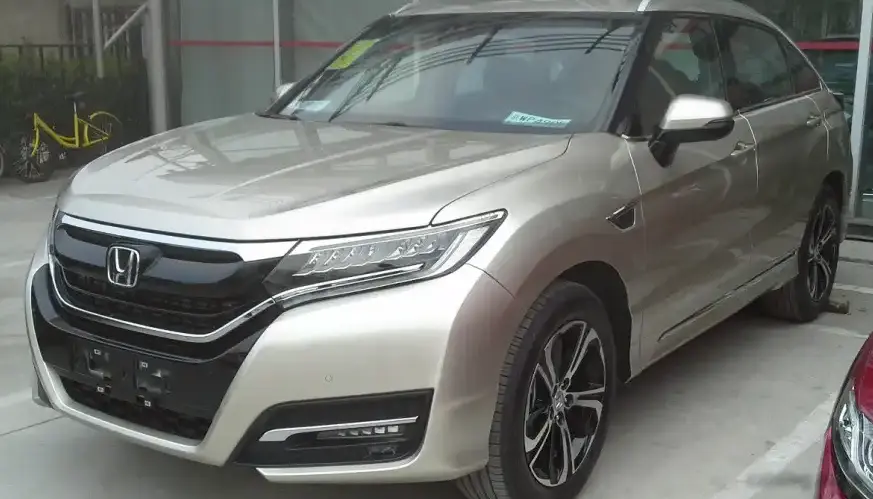
The Honda UR-V (facelift 2020) 370 Turbo, equipped with a 272 horsepower engine and automatic transmission, represents a significant offering in the mid-size SUV segment, primarily targeted towards the Chinese automotive market. Introduced as part of the UR-V’s facelift in 2020, this variant aimed to provide a balance of performance, technology, and comfort for discerning buyers. The UR-V itself is a China-specific model, not generally sold outside of that market, positioned as a more premium alternative to Honda’s globally available CR-V. This particular trim level sits at the higher end of the UR-V lineup, offering a more potent engine option compared to the base models.
Technical Specifications
| Brand | Honda |
| Model | UR-V |
| Generation | UR-V (facelift 2020) |
| Type (Engine) | 370 Turbo (272 Hp) Automatic |
| Start of production | 2020 |
| Powertrain Architecture | Internal Combustion engine |
| Body type | SUV |
| Seats | 5 |
| Doors | 5 |
| Fuel consumption (combined) | 8.3 l/100 km (28.3 US mpg, 34 UK mpg, 12 km/l) |
| Fuel Type | Petrol (Gasoline) |
| Acceleration 0 – 100 km/h | 8.1 sec |
| Acceleration 0 – 62 mph | 8.1 sec |
| Acceleration 0 – 60 mph | 7.7 sec |
| Emission standard | China VI |
| Weight-to-power ratio | 6.7 kg/Hp, 150.3 Hp/tonne |
| Weight-to-torque ratio | 4.9 kg/Nm, 204.4 Nm/tonne |
| Power | 272 Hp @ 6500 rpm |
| Power per litre | 136.3 Hp/l |
| Torque | 370 Nm @ 2250-4500 rpm (272.9 lb.-ft. @ 2250-4500 rpm) |
| Engine layout | Front, Transverse |
| Engine Model/Code | K20C3 |
| Engine displacement | 1996 cm3 (121.8 cu. in.) |
| Number of cylinders | 4 |
| Engine configuration | Inline |
| Compression ratio | 9.8:1 |
| Fuel injection system | Direct injection |
| Engine aspiration | Turbocharger, Intercooler |
| Valvetrain | DOHC, VTEC |
| Engine oil capacity | 5 l (5.28 US qt | 4.4 UK qt) |
| Coolant capacity | 5.93 l (6.27 US qt | 5.22 UK qt) |
| Kerb Weight | 1810 kg (3990.37 lbs.) |
| Length | 4856 mm (191.18 in.) |
| Width | 1942 mm (76.46 in.) |
| Height | 1670 mm (65.75 in.) |
| Wheelbase | 2820 mm (111.02 in.) |
| Minimum turning circle | 11.4 m (37.4 ft.) |
| Drivetrain | Front wheel drive |
| Number of gears | 9 |
| Gearbox type | Automatic transmission |
| Front suspension | Independent, McPherson with coil spring and anti-roll bar |
| Rear suspension | Independent multi-link spring suspension with stabilizer |
| Front brakes | Ventilated discs |
| Rear brakes | Disc |
| Tire size | 245/55 R19 103H |
| Wheel rims size | 19 |
Powertrain & Engine Architecture
The heart of the UR-V 370 Turbo is the K20C3 engine, a 2.0-liter turbocharged inline-four cylinder powerplant. This engine utilizes direct injection technology, contributing to both power output and fuel efficiency. The K20C3 also features Honda’s Variable Timing and Lift Electronic Control (VTEC) system, optimizing valve timing for improved performance across the rev range. The turbocharger, coupled with an intercooler, provides a significant boost in power and torque compared to naturally aspirated engines. The engine is transversely mounted in the front of the vehicle. The 9-speed automatic transmission is a crucial component, designed to efficiently deliver power to the front wheels. This transmission offers smooth shifts and contributes to the overall driving experience. The transmission’s gear ratios are tuned to balance acceleration with fuel economy, providing adequate power for both city driving and highway cruising.
Driving Characteristics
The 272 hp and 370 Nm (272.9 lb-ft) of torque delivered by the K20C3 engine and 9-speed automatic transmission provide a noticeably more spirited driving experience compared to lower-powered UR-V variants. Acceleration from 0-60 mph is achieved in approximately 7.7 seconds, making it competitive within its class. The automatic transmission generally provides smooth and responsive shifts, although some reviewers have noted a slight hesitation during quick downshifts. The front-wheel-drive configuration offers predictable handling, but it lacks the all-weather capability of all-wheel-drive systems found in some competing SUVs. The suspension is tuned for comfort, providing a relatively smooth ride over most road surfaces, but it may exhibit some body roll during aggressive cornering.
Equipment & Trim Levels
The UR-V 370 Turbo typically comes well-equipped with features aimed at enhancing comfort, convenience, and safety. Standard equipment often includes leather upholstery, a panoramic sunroof, a touchscreen infotainment system with navigation, and a suite of advanced driver-assistance systems (ADAS) such as adaptive cruise control, lane departure warning, and automatic emergency braking. Higher trim levels may add features like premium audio systems, ventilated front seats, and a 360-degree camera system. The interior design emphasizes a modern and spacious feel, with high-quality materials and attention to detail.
Chassis & Braking
The UR-V utilizes an independent suspension system both front and rear. The front suspension employs a McPherson strut design with coil springs and an anti-roll bar, while the rear suspension features a multi-link setup with a stabilizer bar. This configuration aims to provide a balance of ride comfort and handling stability. The braking system consists of ventilated discs at the front and solid discs at the rear, providing adequate stopping power for the vehicle’s weight and performance. Anti-lock braking system (ABS) is standard, enhancing safety during emergency braking situations.
Market Reception & Comparison
The Honda UR-V 370 Turbo was generally well-received in the Chinese market, praised for its powerful engine, comfortable ride, and spacious interior. Critics noted that it offered a compelling alternative to other mid-size SUVs, particularly those from European brands. Compared to the base UR-V models with smaller engines, the 370 Turbo provided a significant performance upgrade, but at a higher price point. Fuel economy, while respectable at 8.3 l/100 km, was slightly higher than that of some of the more fuel-efficient competitors. Reliability, typical of Honda products, was generally considered to be good.
Legacy
The Honda UR-V 370 Turbo, while not available globally, established itself as a popular choice among Chinese SUV buyers seeking a blend of performance and luxury. The K20C3 engine, with its turbocharging and VTEC technology, represents a significant advancement in Honda’s powertrain offerings. As a used vehicle, the UR-V 370 Turbo continues to hold its value relatively well, thanks to Honda’s reputation for reliability and the desirability of its features. Long-term reliability reports suggest that the K20C3 engine is generally robust, with proper maintenance. The UR-V’s success in the Chinese market demonstrates Honda’s ability to adapt its products to meet the specific needs and preferences of local consumers.