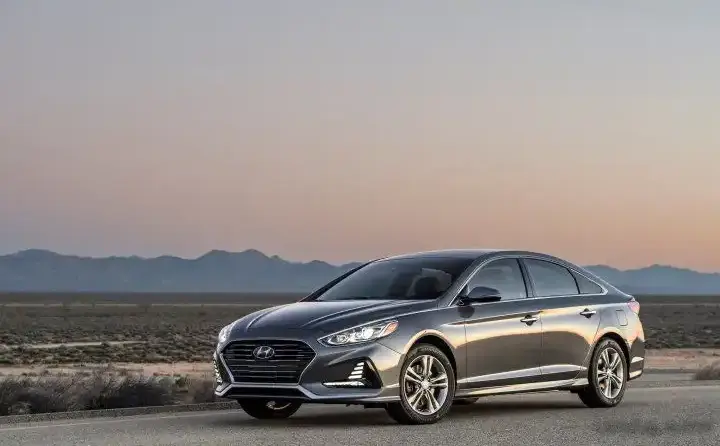
The Hyundai Sonata VII (LF facelift, produced 2018-2019) 1.6 T-GDi with a 7-speed Dual Clutch Transmission (DCT) represented a significant step forward for Hyundai in the mid-size sedan segment. This variant was positioned as a balance between fuel efficiency and performance, offering a more engaging driving experience than the base engine options while remaining more accessible than the higher-output 2.0-liter turbocharged models. It was primarily marketed in markets outside of North America, where smaller displacement turbocharged engines were more readily accepted and aligned with prevailing fuel economy standards. The LF facelift brought updated styling and technology to the seventh-generation Sonata, enhancing its appeal in a competitive market.
Technical Specifications
| Brand | Hyundai |
| Model | Sonata |
| Generation | Sonata VII (LF facelift 2017) |
| Type (Engine) | 1.6 T-GDi (178 Hp) DCT |
| Start of production | 2018 |
| End of production | 2019 |
| Powertrain Architecture | Internal Combustion engine |
| Body type | Sedan |
| Seats | 5 |
| Doors | 4 |
| Fuel consumption (urban) | 8.4 l/100 km (28 US mpg, 33.6 UK mpg, 11.9 km/l) |
| Fuel consumption (extra urban) | 6.4 l/100 km (36.8 US mpg, 44.1 UK mpg, 15.6 km/l) |
| Fuel consumption (combined) | 7.6 l/100 km (30.9 US mpg, 37.2 UK mpg, 13.2 km/l) |
| Fuel Type | Petrol (Gasoline) |
| Weight-to-power ratio | 8.3 kg/Hp, 120.8 Hp/tonne |
| Weight-to-torque ratio | 5.6 kg/Nm, 179.2 Nm/tonne |
| Power | 178 Hp @ 5500 rpm |
| Power per litre | 111.9 Hp/l |
| Torque | 264 Nm @ 1500-4500 rpm (194.72 lb.-ft. @ 1500-4500 rpm) |
| Engine layout | Front, Transverse |
| Engine Model/Code | Gamma II / G4FJ |
| Engine displacement | 1591 cm3 (97.09 cu. in.) |
| Number of cylinders | 4 |
| Engine configuration | Inline |
| Cylinder Bore | 77 mm (3.03 in.) |
| Piston Stroke | 85.4 mm (3.36 in.) |
| Compression ratio | 10:1 |
| Number of valves per cylinder | 4 |
| Fuel injection system | Direct injection |
| Engine aspiration | Twin-scroll turbo, Intercooler |
| Valvetrain | DOHC, D-CVVT |
| Engine oil capacity | 4.5 l (4.76 US qt | 3.96 UK qt) |
| Coolant capacity | 7.1 l (7.5 US qt | 6.25 UK qt) |
| Kerb Weight | 1473 kg (3247.41 lbs.) |
| Max. weight | 1960 kg (4321.06 lbs.) |
| Max load | 487 kg (1073.65 lbs.) |
| Trunk (boot) space – minimum | 462 l (16.32 cu. ft.) |
| Fuel tank capacity | 70 l (18.49 US gal | 15.4 UK gal) |
| Length | 4855 mm (191.14 in.) |
| Width | 1865 mm (73.43 in.) |
| Height | 1475 mm (58.07 in.) |
| Wheelbase | 2805 mm (110.43 in.) |
| Front track | 1614 mm (63.54 in.) |
| Rear track | 1621 mm (63.82 in.) |
| Ride height (ground clearance) | 135 mm (5.31 in.) |
| Drag coefficient (Cd) | 0.27 |
| Minimum turning circle | 10.9 m (35.76 ft.) |
| Drivetrain Architecture | Front wheel drive |
| Number of gears | 7 |
| Gearbox type | Automatic transmission DCT |
| Front suspension | Independent, McPherson with coil spring and anti-roll bar |
| Rear suspension | Independent multi-link spring suspension with stabilizer |
| Front brakes | Ventilated discs, 305 mm |
| Rear brakes | Disc, 284 mm |
| Assisting systems | ABS (Anti-lock braking system) |
| Steering type | Steering rack and pinion |
| Power steering | Electric |
| Tires size | 205/65 R16 |
| Wheel rims size | 6.5J x 16 |
Powertrain & Engine Architecture
The heart of this Sonata variant is the Hyundai Gamma II engine, specifically the G4FJ code. This 1.6-liter inline-four cylinder engine utilizes direct injection and a twin-scroll turbocharger to deliver a respectable 178 horsepower and 264 Nm (194.72 lb-ft) of torque. The twin-scroll turbocharger design helps to minimize turbo lag and improve low-end responsiveness. The engine also features Hyundai’s Dual Continuous Variable Valve Timing (D-CVVT) technology, optimizing valve timing for improved efficiency and performance across the rev range. The 7-speed Dual Clutch Transmission (DCT) was a key component, offering quicker and smoother shifts compared to a traditional automatic transmission. This DCT utilizes two separate clutches for odd and even gears, pre-selecting the next gear for faster transitions.
Driving Characteristics
The 1.6 T-GDi DCT Sonata offered a noticeable improvement in driving dynamics compared to the base 1.6-liter naturally aspirated engine. While not as overtly sporty as the 2.0 T-GDi models, the turbocharger provided ample torque for everyday driving and overtaking maneuvers. The DCT contributed to a more engaging experience, with responsive shifts and a more connected feel. The gear ratios were tuned for a balance of acceleration and fuel economy. In real-world conditions, the 1.6 T-GDi felt adequately powered, but drivers accustomed to larger displacement engines might find the performance somewhat modest. The DCT, while generally smooth, could exhibit some low-speed jerkiness in certain situations.
Equipment & Trim Levels
The 1.6 T-GDi trim typically included features such as alloy wheels, automatic climate control, a touchscreen infotainment system with Apple CarPlay and Android Auto compatibility, and a suite of safety features including ABS, electronic stability control, and multiple airbags. Interior upholstery was generally cloth, with leather options available as an upgrade. Optional extras could include a sunroof, navigation system, premium sound system, and advanced driver-assistance systems like lane departure warning and automatic emergency braking. The specific standard equipment varied depending on the regional market.
Chassis & Braking
The Sonata VII utilized a front-wheel-drive platform with an independent McPherson strut suspension in the front and an independent multi-link suspension in the rear. This setup provided a comfortable ride quality while maintaining reasonable handling characteristics. The front brakes were ventilated discs measuring 305mm, while the rear brakes were solid discs measuring 284mm. ABS (Anti-lock Braking System) was standard, providing enhanced braking performance and stability. Stabilizer bars were fitted to both the front and rear suspension to reduce body roll during cornering.
Market Reception & Comparison
Critics generally praised the 1.6 T-GDi Sonata for its fuel efficiency and improved performance compared to the base engine options. However, some reviewers noted that the engine could feel strained under hard acceleration, and the DCT occasionally exhibited some hesitation. Compared to the 2.0 T-GDi models, the 1.6 T-GDi offered a more affordable entry point into the Sonata range, but at the expense of outright performance. In terms of reliability, the Gamma II engine and the DCT transmission proved to be generally reliable, although some owners reported minor issues with the DCT’s mechatronic unit.
Legacy
The Hyundai Sonata VII 1.6 T-GDi DCT represents a pivotal moment in Hyundai’s evolution as a global automaker. It demonstrated the company’s ability to develop and produce sophisticated turbocharged engines and advanced transmissions. On the used car market, these Sonatas are generally well-regarded for their value and fuel efficiency. The Gamma II engine, when properly maintained, has proven to be a durable and reliable unit. However, potential buyers should be aware of the potential for minor issues with the DCT and ensure that the transmission fluid has been regularly serviced. The 1.6 T-GDi variant helped to establish Hyundai as a serious contender in the mid-size sedan segment, paving the way for future generations of Sonatas.