Technical Specifications
| Brand | BMW |
| Model | 5 Series |
| Generation | 5 Series Touring (G31 LCI, facelift 2020) |
| Type (Engine) | 520e (204 Hp) Plug-in Hybrid Steptronic |
| Start of production | March, 2021 |
| End of production | May, 2022 |
| Powertrain Architecture | PHEV (Plug-in Hybrid Electric Vehicle) |
| Body type | Station wagon (estate) |
| Seats | 5 |
| Doors | 5 |
| Combined fuel consumption (WLTP) | 1.5-1.9 l/100 km (156.8 – 123.8 US mpg, 188.3 – 148.7 UK mpg, 66.7 – 52.6 km/l) |
| CO2 emissions (WLTP) | 34-43 g/km |
| Fuel consumption (NEDC, WLTP equivalent) | 1.8-2.0 l/100 km (130.7 – 117.6 US mpg, 156.9 – 141.2 UK mpg, 55.6 – 50 km/l) |
| CO2 emissions (NEDC, WLTP equivalent) | 42-46 g/km |
| Fuel Type | Petrol / electricity |
| Acceleration 0 – 100 km/h | 8.2 sec |
| Acceleration 0 – 62 mph | 8.2 sec |
| Acceleration 0 – 60 mph | 7.8 sec |
| Maximum speed | 218 km/h (135.46 mph) |
| Emission standard | Euro 6d |
| Weight-to-power ratio | 9.3 kg/Hp, 107.4 Hp/tonne |
| Weight-to-torque ratio | 5.4 kg/Nm, 184.2 Nm/tonne |
| Gross battery capacity | 12 kWh |
| Battery voltage | 354 V |
| Battery technology | Lithium-ion (Li-Ion) |
| Battery location | Under the rear seats |
| All-electric range (WLTP) | 52-57 km (32.31 – 35.42 mi) |
| Average Energy consumption (WLTP) | 17-18.4 kWh/100 km (27.36 – 29.61 kWh/100 mi, 123 – 114 MPGe, 5.9 – 5.4 km/kWh, 3.7 – 3.4 mi/kWh) |
| Average Energy consumption (NEDC, WLTP equivalent) | 15-15.6 kWh/100 km (24.14 – 25.11 kWh/100 mi, 140 – 134 MPGe, 6.7 – 6.4 km/kWh, 4.1 – 4 mi/kWh) |
| Max speed (electric) | 140 km/h (86.99 mph) |
| Electric motor power | 109 Hp @ 3140 rpm (195.45 lb.-ft. @ 100-2500 rpm) |
| Electric motor Torque | 265 Nm @ 100-2500 rpm |
| Electric motor location | Between the combustion engine and the transmission |
| System power | 204 Hp |
| System torque | 350 Nm (258.15 lb.-ft.) |
| Power | 163 Hp @ 5000-6500 rpm (81.6 Hp/l) |
| Torque | 300 Nm @ 1350-3700 rpm (221.27 lb.-ft. @ 1350-3700 rpm) |
| Engine layout | Front, Longitudinal |
| Engine Model/Code | B48B20A |
| Engine displacement | 1998 cm3 (121.93 cu. in.) |
| Number of cylinders | 4 |
| Engine configuration | Inline |
| Cylinder Bore | 82 mm (3.23 in.) |
| Piston Stroke | 94.6 mm (3.72 in.) |
| Compression ratio | 11:1 |
| Number of valves per cylinder | 4 |
| Fuel injection system | Direct injection |
| Engine aspiration | Twin-power turbo, Intercooler |
| Valvetrain | VALVETRONIC |
| Engine oil capacity | 5.25 l (5.55 US qt | 4.62 UK qt) |
| Coolant | 6 l (6.34 US qt | 5.28 UK qt) |
| Kerb Weight | 1900 kg (4188.78 lbs.) |
| Max. weight | 2550 kg (5621.79 lbs.) |
| Max load | 650 kg (1433 lbs.) |
| Trunk (boot) space – minimum | 430 l (15.19 cu. ft.) |
| Trunk (boot) space – maximum | 1560 l (55.09 cu. ft.) |
| Fuel tank capacity | 46 l (12.15 US gal | 10.12 UK gal) |
| Max. roof load | 100 kg (220.46 lbs.) |
| Permitted trailer load with brakes (12%) | 1700 kg (3747.86 lbs.) |
| Permitted trailer load without brakes | 750 kg (1653.47 lbs.) |
| Permitted towbar download | 90 kg (198.42 lbs.) |
| Length | 4963 mm (195.39 in.) |
| Width | 1868 mm (73.54 in.) |
| Height | 1498 mm (58.98 in.) |
| Wheelbase | 2975 mm (117.13 in.) |
| Front track | 1605 mm (63.19 in.) |
| Rear (Back) track | 1630 mm (64.17 in.) |
| Ride height (ground clearance) | 143 mm (5.63 in.) |
| Drag coefficient (Cd) | 0.29 |
| Minimum turning circle (turning diameter) | 12 m (39.37 ft.) |
| Drivetrain Architecture | The Internal combustion engine (ICE) and electric motor drive the rear wheels of the car with the ability to work in full electric or mixed mode. |
| Drive wheel | Rear wheel drive |
| Number of gears and type of gearbox | 8 gears, automatic transmission Steptronic |
| Front suspension | Double wishbone |
| Rear suspension | Independent multi-link suspension |
| Front brakes | Ventilated discs |
| Rear brakes | Ventilated discs |
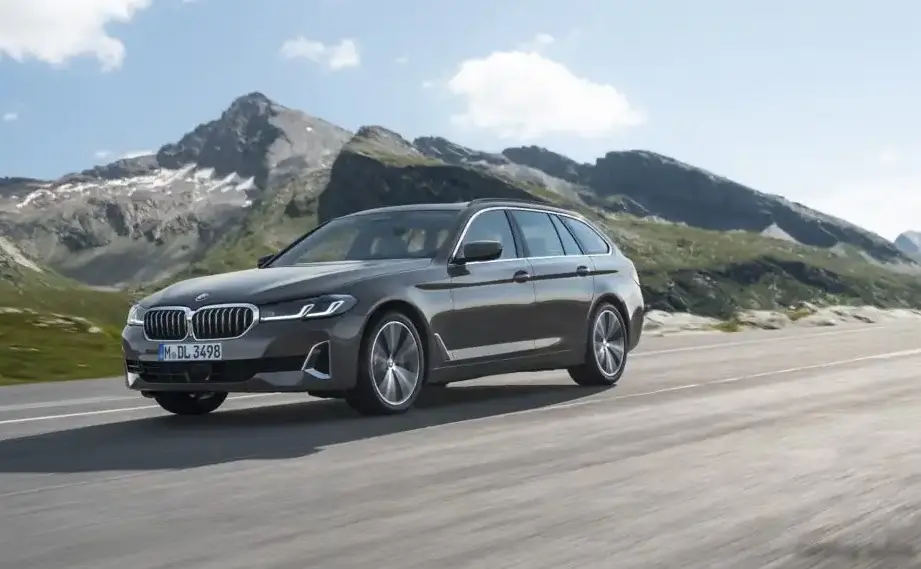
The BMW 520e Touring, launched in 2021 as part of the LCI (Life Cycle Impulse) facelift of the G31 5 Series, represented BMW’s commitment to electrification. Built on the 1HX0/A3 platform, this model combined a 2.0-liter four-cylinder gasoline engine with an electric motor, offering a total system output of 204 horsepower. The 520e Touring aimed to provide a practical and efficient option for buyers seeking a premium estate car with the benefits of plug-in hybrid technology. It slotted into the 5 Series Touring range as the entry-level hybrid option, positioned below the more powerful 530e and 545e models.
Powertrain & Engine Architecture
At the heart of the 520e Touring lies the BMW B48B20A 2.0-liter inline-four cylinder gasoline engine. This engine utilizes direct fuel injection and a twin-scroll turbocharger with intercooling, producing 163 horsepower and 300 Nm (221 lb-ft) of torque. The engine features BMW’s VALVETRONIC technology, which allows for precise control of valve lift and timing, optimizing efficiency and responsiveness. The electric motor, integrated between the engine and the 8-speed Steptronic automatic transmission, delivers an additional 109 horsepower and 265 Nm (195 lb-ft) of torque. The combined system output is 204 horsepower and 350 Nm (258 lb-ft). The 12 kWh lithium-ion battery pack is located under the rear seats, providing an all-electric range of 52-57 km (32-35 miles) according to WLTP standards. The Steptronic transmission is a sophisticated 8-speed automatic, known for its smooth shifts and responsiveness, and is specifically tuned to work seamlessly with the electric motor for optimal efficiency and performance.
Driving Characteristics
The 520e Touring offers a refined and comfortable driving experience. In electric mode, the vehicle operates silently and provides brisk acceleration for urban driving. When the gasoline engine engages, the transition is smooth and nearly imperceptible. The combined power output delivers adequate performance, with a 0-60 mph time of around 7.8 seconds. Compared to the 530e, the 520e offers less outright performance, but its lighter weight and optimized gearing contribute to a more agile feel. The 8-speed Steptronic transmission provides quick and precise gear changes, enhancing the driving experience. The gear ratios are optimized for both fuel efficiency and responsiveness, providing ample torque for everyday driving situations. While not a sports car, the 520e Touring offers a balanced and enjoyable driving experience, particularly for those prioritizing comfort and efficiency.
Equipment & Trim Levels
The 520e Touring typically came well-equipped as standard, reflecting its position as a premium model. Standard features included BMW’s iDrive infotainment system with a touchscreen display, navigation, automatic climate control, leather upholstery, and a suite of driver-assistance systems such as lane departure warning and collision warning. Optional extras included a premium sound system, adaptive cruise control, a head-up display, and various interior trim options. The interior design was consistent with other 5 Series Touring models, offering a luxurious and comfortable cabin. The specific trim levels and available options varied depending on the market.
Chassis & Braking
The 520e Touring utilizes a double wishbone front suspension and an independent multi-link rear suspension, providing a comfortable and controlled ride. The suspension is tuned to balance handling and comfort, offering a stable and predictable driving experience. The braking system consists of ventilated discs on all four wheels, providing ample stopping power. Anti-lock braking system (ABS) and electronic stability control (ESC) are standard features, enhancing safety and control. Due to the added weight of the battery pack, the 520e Touring may have slightly stiffer spring rates compared to the standard 5 Series Touring models to maintain handling balance.
Market Reception & Comparison
The BMW 520e Touring was generally well-received by critics, who praised its fuel efficiency, comfortable ride, and refined driving experience. However, some reviewers noted that its performance was not as exhilarating as the more powerful 530e or 545e models. Compared to the 530e, the 520e offered a lower price point and slightly better fuel economy, making it an attractive option for buyers prioritizing efficiency. The 520e also offered a more accessible entry point into the world of plug-in hybrid technology for BMW customers. Its real-world fuel economy was highly dependent on driving habits and charging frequency, but owners consistently reported significant fuel savings compared to traditional gasoline-powered vehicles.
Legacy
The BMW 520e Touring represents an important step in BMW’s electrification strategy. While it has been superseded by newer plug-in hybrid models, the G31 520e Touring remains a popular choice in the used car market. The B48 engine and Steptronic transmission are known for their reliability, and the hybrid powertrain has proven to be durable with proper maintenance. The 520e Touring offers a compelling combination of practicality, efficiency, and luxury, making it a desirable option for buyers seeking a premium estate car with plug-in hybrid technology. Its long-term reliability is generally good, though regular maintenance of the hybrid components is essential to ensure optimal performance and longevity.