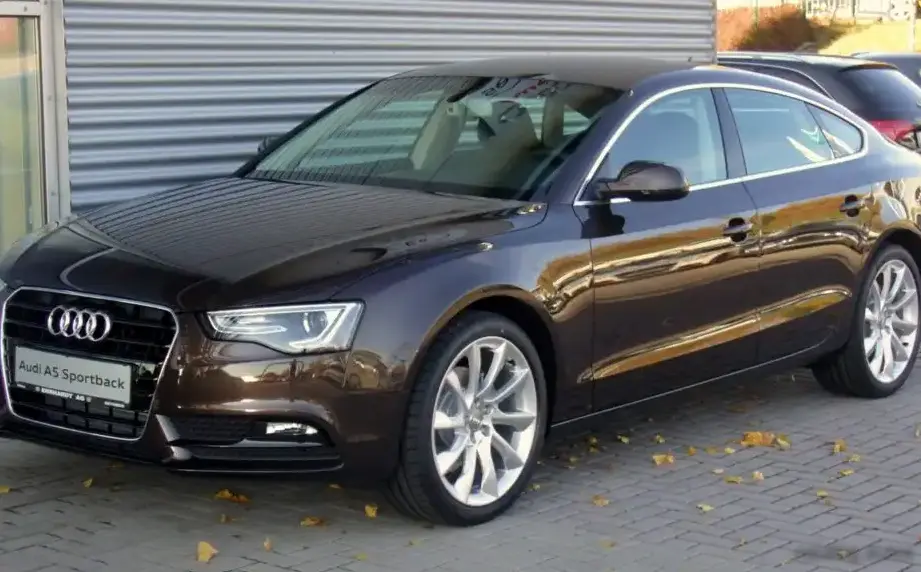
The Audi A5 Sportback 2.0 TDI ultra (136 hp) represents a fuel-efficient variant within the 8TA generation of the A5 Sportback, produced from 2014 to 2016 following the facelift of the original A5 line. Positioned as a mid-range offering, it aimed to balance practicality, running costs, and a degree of performance within Audi’s premium compact executive class. This model was particularly significant in European markets where diesel engines and fuel economy were highly valued, offering a compelling alternative to petrol-powered A5 Sportbacks and competing models from BMW and Mercedes-Benz.
Technical Specifications
| Brand | Audi |
| Model | A5 |
| Generation | A5 Sportback (8TA, facelift 2011) |
| Type (Engine) | 2.0 TDI ultra (136 Hp) |
| Start of production | 2014 |
| End of production | 2016 |
| Powertrain Architecture | Internal Combustion engine |
| Body type | Fastback |
| Seats | 5 |
| Doors | 5 |
| Fuel consumption (urban) | 5 l/100 km (47 US mpg, 56.5 UK mpg, 20 km/l) |
| Fuel consumption (extra urban) | 3.8 l/100 km (61.9 US mpg, 74.3 UK mpg, 26.3 km/l) |
| Fuel consumption (combined) | 4.3 l/100 km (54.7 US mpg, 65.7 UK mpg, 23.3 km/l) |
| CO2 emissions | 111 g/km |
| Fuel Type | Diesel |
| Acceleration 0 – 100 km/h | 9.5 sec |
| Acceleration 0 – 62 mph | 9.5 sec |
| Acceleration 0 – 60 mph | 9 sec |
| Maximum speed | 212 km/h (131.73 mph) |
| Emission standard | Euro 6 |
| Weight-to-power ratio | 11.6 kg/Hp, 86.1 Hp/tonne |
| Weight-to-torque ratio | 4.9 kg/Nm, 202.5 Nm/tonne |
| Power | 136 Hp @ 3000-4400 rpm |
| Power per litre | 69.1 Hp/l |
| Torque | 320 Nm @ 1500-3000 rpm (236.02 lb.-ft. @ 1500-3000 rpm) |
| Engine layout | Front, Longitudinal |
| Engine Model/Code | CJCB |
| Engine displacement | 1968 cm3 (120.09 cu. in.) |
| Number of cylinders | 4 |
| Engine configuration | Inline |
| Cylinder Bore | 81 mm (3.19 in.) |
| Piston Stroke | 95.5 mm (3.76 in.) |
| Compression ratio | 19.5:1 |
| Number of valves per cylinder | 4 |
| Fuel injection system | Diesel Commonrail |
| Engine aspiration | Turbocharger, Intercooler |
| Valvetrain | DOHC |
| Engine oil capacity | 5 l (5.28 US qt | 4.4 UK qt) |
| Kerb Weight | 1580 kg (3483.3 lbs.) |
| Max. weight | 2130 kg (4695.85 lbs.) |
| Max load | 550 kg (1212.54 lbs.) |
| Trunk (boot) space – minimum | 480 l (16.95 cu. ft.) |
| Trunk (boot) space – maximum | 980 l (34.61 cu. ft.) |
| Fuel tank capacity | 63 l (16.64 US gal | 13.86 UK gal) |
| AdBlue tank | 20.5 l (5.42 US gal | 4.51 UK gal) |
| Max. roof load | 90 kg (198.42 lbs.) |
| Permitted trailer load with brakes (8%) | 1500 kg (3306.93 lbs.) |
| Permitted trailer load with brakes (12%) | 1300 kg (2866.01 lbs.) |
| Permitted trailer load without brakes | 750 kg (1653.47 lbs.) |
| Permitted towbar download | 80 kg (176.37 lbs.) |
| Length | 4712 mm (185.51 in.) |
| Width | 1854 mm (72.99 in.) |
| Width including mirrors | 2020 mm (79.53 in.) |
| Height | 1391 mm (54.76 in.) |
| Wheelbase | 2810 mm (110.63 in.) |
| Front track | 1590 mm (62.6 in.) |
| Rear (Back) track | 1575 mm (62.01 in.) |
| Front overhang | 861 mm (33.9 in.) |
| Rear overhang | 1041 mm (40.98 in.) |
| Minimum turning circle (turning diameter) | 11.5 m (37.73 ft.) |
| Drivetrain Architecture | The Internal combustion engine (ICE) drives the front wheels of the vehicle. |
| Drive wheel | Front wheel drive |
| Number of gears and type of gearbox | 6 gears, manual transmission |
| Front suspension | Independent multi-link suspension |
| Rear suspension | Independent on trapezoidal lever |
| Front brakes | Ventilated discs |
| Rear brakes | Disc |
| Assisting systems | ABS (Anti-lock braking system) |
| Steering type | Steering rack and pinion |
| Power steering | Electric Steering |
| Tires size | 225/50 R 17 |
| Wheel rims size | 7.5J x 17 |
Powertrain & Engine Architecture
The heart of the A5 Sportback 2.0 TDI ultra is the CJCB engine, a 2.0-liter inline-four cylinder diesel. This engine is part of the Volkswagen Group’s modular engine family, known for its compact dimensions and efficiency. The CJCB utilizes a common rail direct injection system, delivering fuel at extremely high pressures for optimized combustion. A turbocharger with an intercooler is employed to boost power output and improve torque across a wide rev range. The engine also features a Diesel Particulate Filter (DPF) to reduce harmful emissions, complying with Euro 6 standards. The engine produces 136 horsepower at 3000-4400 rpm and 320 Nm (236 lb-ft) of torque between 1500-3000 rpm. This engine was paired with a six-speed manual transmission, sending power to the front wheels.
Driving Characteristics
The 2.0 TDI ultra with the manual transmission delivers a balanced driving experience. While not overtly sporty, it provides adequate acceleration for everyday driving, achieving 0-62 mph (0-100 km/h) in 9.5 seconds. The engine’s torque is readily available from low RPMs, making it easy to navigate city traffic and execute overtaking maneuvers. Compared to the more powerful 2.0 TDI variants or the petrol-powered A5s, this version prioritizes fuel efficiency over outright performance. The six-speed manual gearbox offers precise shifts, but the gear ratios are tuned for economy rather than aggressive acceleration. The front-wheel-drive configuration provides good traction in most conditions, but can exhibit some torque steer under hard acceleration.
Equipment & Trim Levels
The A5 Sportback 2.0 TDI ultra typically came equipped with a respectable level of standard features. These included Audi’s Multi Media Interface (MMI) infotainment system, automatic climate control, alloy wheels, and a leather-wrapped steering wheel. Interior upholstery was generally cloth, though leather options were available. Common optional extras included a sunroof, navigation system, parking sensors, and upgraded sound systems. The ‘ultra’ designation often indicated a focus on lightweight construction and aerodynamic enhancements to further improve fuel economy. Trim levels varied by market, but generally offered packages that added features like heated seats, upgraded interior trim, and advanced driver-assistance systems.
Chassis & Braking
The A5 Sportback’s chassis features an independent multi-link suspension at the front and an independent trapezoidal lever suspension at the rear, providing a comfortable and controlled ride. The suspension setup was tuned to balance handling and comfort, offering a good compromise for everyday driving. Braking duties are handled by ventilated discs at the front and solid discs at the rear, equipped with ABS (Anti-lock Braking System). The steering is a rack-and-pinion system with electric power assistance, providing precise and responsive steering feel.
Market Reception & Comparison
The Audi A5 Sportback 2.0 TDI ultra was generally well-received by automotive critics, particularly for its impressive fuel economy and comfortable ride. It was often praised as a practical and efficient option for those seeking a premium compact executive car. Compared to the higher-output TDI variants, the 136 hp version offered lower running costs but sacrificed some performance. Against competitors like the BMW 3 Series and Mercedes-Benz C-Class, the A5 Sportback 2.0 TDI ultra held its own in terms of fuel efficiency and interior quality. However, some critics noted that the front-wheel-drive configuration and manual transmission might not appeal to all buyers.
Legacy
The CJCB engine, found in the A5 Sportback 2.0 TDI ultra, has proven to be a relatively reliable powertrain when properly maintained. Common issues include DPF clogging (particularly with frequent short trips) and potential problems with the turbocharger. However, these are generally manageable with regular servicing and preventative maintenance. On the used car market, the A5 Sportback 2.0 TDI ultra represents a good value proposition for buyers seeking a fuel-efficient and well-equipped premium car. Its combination of practicality, comfort, and running costs continues to make it a popular choice.