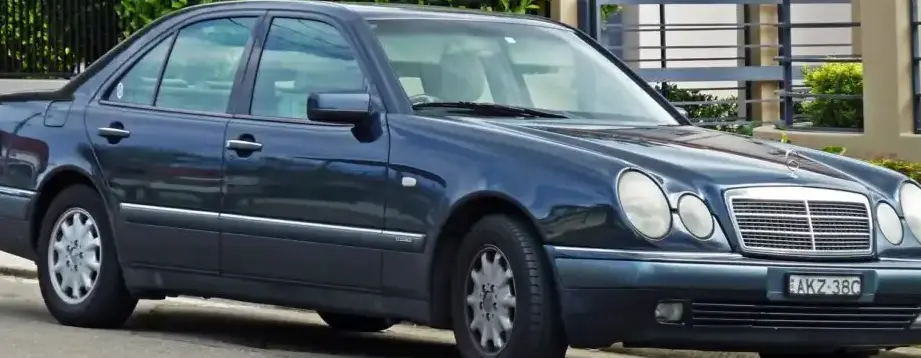
The Mercedes-Benz E 320 V6 Automatic, produced between January 1996 and July 1999, represents a significant iteration of the W210 E-Class. Positioned as a mid-to-upper range offering within the W210 lineup, it bridged the gap between the more economical four-cylinder models and the high-performance E 420 and E 55 AMG variants. This model aimed to deliver a blend of luxury, performance, and refinement, appealing to buyers seeking a sophisticated and capable executive sedan. The W210 generation, introduced in 1995, was a pivotal model for Mercedes-Benz, incorporating numerous technological advancements and a redesigned chassis compared to its predecessor, the W124.
Technical Specifications
| Brand | Mercedes-Benz |
| Model | E-class |
| Generation | E-class (W210) |
| Type (Engine) | E 320 V6 (224 Hp) Automatic |
| Start of production | January, 1996 |
| End of production | July, 1999 |
| Powertrain Architecture | Internal Combustion engine |
| Body type | Sedan |
| Seats | 5 |
| Doors | 4 |
| Fuel consumption (urban) | 15.4 l/100 km (15.3 US mpg, 18.3 UK mpg, 6.5 km/l) |
| Fuel consumption (extra urban) | 7.5 l/100 km (31.4 US mpg, 37.7 UK mpg, 13.3 km/l) |
| Fuel consumption (combined) | 10.3 l/100 km (22.8 US mpg, 27.4 UK mpg, 9.7 km/l) |
| Fuel Type | Petrol (Gasoline) |
| Acceleration 0 – 100 km/h | 7.7 sec |
| Acceleration 0 – 62 mph | 7.7 sec |
| Acceleration 0 – 60 mph | 7.3 sec |
| Maximum speed | 238 km/h (147.89 mph) |
| Weight-to-power ratio | 7.1 kg/Hp, 141.8 Hp/tonne |
| Weight-to-torque ratio | 5 kg/Nm, 199.4 Nm/tonne |
| Power | 224 Hp @ 5600 rpm |
| Power per litre | 70 Hp/l |
| Torque | 315 Nm @ 3000-4800 rpm (232.33 lb.-ft. @ 3000-4800 rpm) |
| Engine layout | Front, Longitudinal |
| Engine Model/Code | M 112 E 32 / 112.941 |
| Engine displacement | 3199 cm3 (195.21 cu. in.) |
| Number of cylinders | 6 |
| Engine configuration | V-engine |
| Cylinder Bore | 89.89 mm (3.54 in.) |
| Piston Stroke | 84 mm (3.31 in.) |
| Compression ratio | 10:1 |
| Number of valves per cylinder | 3 |
| Fuel injection system | Multi-port manifold injection |
| Engine aspiration | Naturally aspirated engine |
| Valvetrain | SOHC |
| Engine oil capacity | 8 l (8.45 US qt | 7.04 UK qt) |
| Coolant | 10 l (10.57 US qt | 8.8 UK qt) |
| Kerb Weight | 1580 kg (3483.3 lbs.) |
| Max. weight | 2110 kg (4651.75 lbs.) |
| Max load | 530 kg (1168.45 lbs.) |
| Fuel tank capacity | 80 l (21.13 US gal | 17.6 UK gal) |
| Length | 4795 mm (188.78 in.) |
| Width | 1799 mm (70.83 in.) |
| Height | 1438 mm (56.61 in.) |
| Wheelbase | 2833 mm (111.54 in.) |
| Front track | 1534 mm (60.39 in.) |
| Rear (Back) track | 1528 mm (60.16 in.) |
| Drivetrain Architecture | The Internal combustion engine (ICE) drives the rear wheels of the vehicle. |
| Drive wheel | Rear wheel drive |
| Number of gears and type of gearbox | 5 gears, automatic transmission |
| Front suspension | Double wishbone |
| Rear suspension | Independent multi-link spring suspension with stabilizer |
| Front brakes | Ventilated discs |
| Rear brakes | Disc |
| Assisting systems | ABS (Anti-lock braking system) |
| Steering type | Steering rack and pinion |
| Power steering | Hydraulic Steering |
| Tires size | 215/55 R16 |
| Wheel rims size | 7.5J x 16 |
Powertrain & Engine Architecture
The heart of the E 320 V6 is the M112 E 32 engine, a 3.2-liter naturally aspirated V6. This engine marked a significant departure for Mercedes-Benz, being the first entirely new V6 engine design since the 1950s. It featured a 60-degree V-angle, all-aluminum construction, and a single overhead camshaft (SOHC) per cylinder bank operating four valves per cylinder. The M112 utilized a multi-port fuel injection system, delivering precise fuel metering for optimal combustion. The engine’s robust bottom end and well-designed cylinder heads contributed to its smooth power delivery and relatively high specific output. Paired with the M112 was a five-speed automatic transmission (typically the 722.3 or 722.6 series), known for its smooth shifting characteristics and reliability. This transmission was electronically controlled, adapting shift points based on driving conditions and throttle input.
Driving Characteristics
The E 320 V6 Automatic offered a refined and comfortable driving experience. While not overtly sporty, the 224 horsepower and 232 lb-ft of torque provided ample power for both city driving and highway cruising. Acceleration from 0-60 mph took approximately 7.3-7.7 seconds, respectable for a luxury sedan of its era. The automatic transmission, while smooth, wasn’t particularly quick to downshift, meaning the engine sometimes felt slightly strained during aggressive acceleration. The gear ratios were tuned for comfort and fuel efficiency rather than outright performance. Compared to the E 420 with its larger V8, the E 320 felt less powerful, but it offered a better balance between performance and fuel economy. Against the diesel-powered E 300 TDI, the E 320 provided significantly more responsive acceleration, but at the cost of higher fuel consumption.
Equipment & Trim Levels
The E 320 V6 Automatic typically came well-equipped, reflecting its position in the Mercedes-Benz lineup. Standard features included automatic climate control, power windows and locks, a premium sound system, and leather upholstery. Wood trim adorned the interior, enhancing the sense of luxury. Optional extras included a sunroof, heated seats, a navigation system, and upgraded audio options. The E 320 could also be specified with various exterior enhancements, such as alloy wheels and a sport package that included a lowered suspension and sport seats.
Chassis & Braking
The W210 E-Class featured a robust chassis with a double wishbone front suspension and an independent multi-link rear suspension. This setup provided a comfortable ride while maintaining good handling characteristics. The E 320 typically came equipped with ventilated disc brakes at the front and solid disc brakes at the rear. Anti-lock braking system (ABS) was standard, enhancing safety and control during emergency braking. The steering was a hydraulic power-assisted rack and pinion system, offering precise and responsive steering feel.
Market Reception & Comparison
The E 320 V6 Automatic was generally well-received by automotive critics. It was praised for its refined engine, comfortable ride, and luxurious interior. However, some reviewers noted that the automatic transmission could feel sluggish at times. Fuel economy was considered average for a V6-powered luxury sedan. Compared to its competitors, such as the BMW 530i and the Audi A6 2.8, the E 320 offered a more comfortable ride and a more traditional luxury experience. Reliability was generally good, although some owners reported issues with the electronic systems and the automatic transmission over the long term.
Legacy
The M112 engine family, of which the 3.2-liter V6 in the E 320 is a part, proved to be a durable and reliable powerplant. While not without its quirks, the engine is generally considered to be well-engineered and capable of high mileage with proper maintenance. Today, the W210 E 320 V6 Automatic remains a popular choice among enthusiasts seeking a classic Mercedes-Benz sedan. Parts availability is generally good, and the car’s relatively simple mechanical design makes it relatively easy to maintain. However, potential buyers should be aware of potential issues with the electronic systems and the automatic transmission, and a thorough pre-purchase inspection is recommended.