
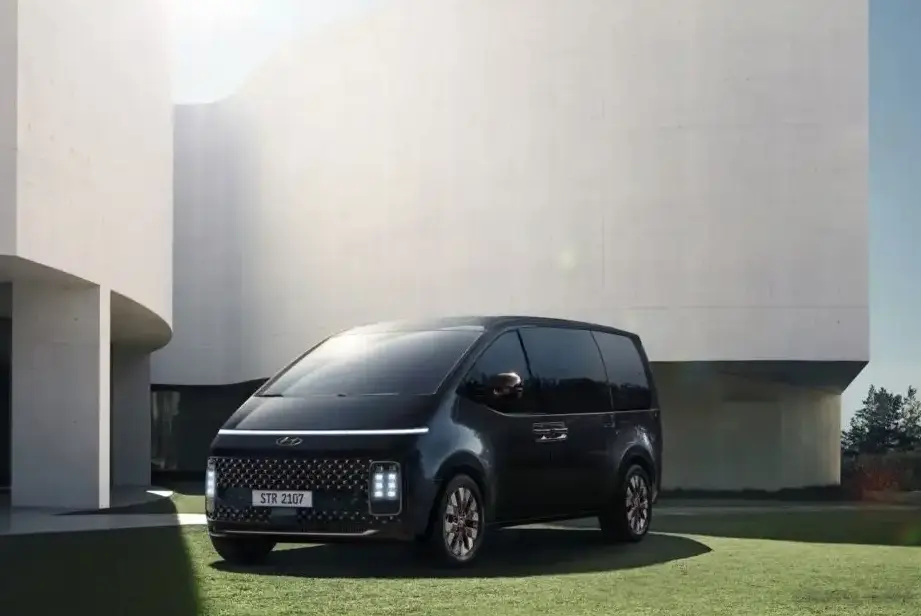
The Hyundai Staria 2.2 CRDi Automatic 7-Seat, launched in August 2021 and produced through October 2024, represents Hyundai’s entry into the modern, spacious multi-purpose vehicle (MPV) segment. Designed as a replacement for the aging iMax, the Staria aimed to offer a more futuristic aesthetic and a greater emphasis on passenger comfort and versatility. This particular variant, powered by the 2.2-liter CRDi diesel engine paired with an 8-speed automatic transmission, served as a core offering within the Staria lineup, balancing fuel efficiency, performance, and practicality for families and commercial users alike. The Staria is primarily marketed in Asia, Australia, and select emerging markets, offering a compelling alternative to established MPV competitors.
Technical Specifications
| Brand | Hyundai |
| Model | Staria |
| Generation | Staria |
| Type | 2.2 CRDi (177 Hp) Automatic 7 Seat |
| Start of production | August, 2021 |
| End of production | October, 2024 |
| Powertrain Architecture | Internal Combustion engine |
| Body type | Minivan |
| Seats | 7 |
| Doors | 5 |
| Fuel consumption at Low speed (WLTP) | 11.1 l/100 km (21.2 US mpg, 25.4 UK mpg, 9 km/l) |
| Fuel consumption at Medium speed (WLTP) | 8.5 l/100 km (27.7 US mpg, 33.2 UK mpg, 11.8 km/l) |
| Fuel consumption at high speed (WLTP) | 7.2 l/100 km (32.7 US mpg, 39.2 UK mpg, 13.9 km/l) |
| Fuel consumption at very high speed (WLTP) | 8.6 l/100 km (27.4 US mpg, 32.8 UK mpg, 11.6 km/l) |
| Combined fuel consumption (WLTP) | 8.5 l/100 km (27.7 US mpg, 33.2 UK mpg, 11.8 km/l) |
| CO2 emissions (WLTP) | 222 g/km |
| Fuel Type | Diesel |
| Acceleration 0 – 100 km/h | 12.4 sec |
| Acceleration 0 – 62 mph | 12.4 sec |
| Acceleration 0 – 60 mph | 11.8 sec |
| Maximum speed | 185 km/h (114.95 mph) |
| Emission standard | Euro 6d |
| Weight-to-power ratio | 12.9 kg/Hp, 77.2 Hp/tonne |
| Weight-to-torque ratio | 5.3 kg/Nm, 187.6 Nm/tonne |
| Power | 177 Hp @ 3800 rpm |
| Power per litre | 80.5 Hp/l |
| Torque | 430 Nm @ 1500-2500 rpm (317.15 lb.-ft. @ 1500-2500 rpm) |
| Engine layout | Front, Transverse |
| Engine Model/Code | D4HB |
| Engine displacement | 2199 cm3 (134.19 cu. in.) |
| Number of cylinders | 4 |
| Engine configuration | Inline |
| Cylinder Bore | 85.4 mm (3.36 in.) |
| Piston Stroke | 96 mm (3.78 in.) |
| Number of valves per cylinder | 4 |
| Fuel injection system | Diesel Commonrail |
| Engine aspiration | Turbocharger, Intercooler |
| Engine oil capacity | 5.6 l (5.92 US qt | 4.93 UK qt) |
| Coolant | 9.96 l (10.52 US qt | 8.76 UK qt) |
| Kerb Weight | 2292-2363 kg (5053 – 5209.52 lbs.) |
| Max. weight | 2960 kg (6525.68 lbs.) |
| Max load | 597-668 kg (1316.16 – 1472.69 lbs.) |
| Trunk (boot) space – minimum | 117-431 l (4.13 – 15.22 cu. ft.) |
| Fuel tank capacity | 75 l (19.81 US gal | 16.5 UK gal) |
| Max. roof load | 100 kg (220.46 lbs.) |
| Permitted trailer load with brakes (12%) | 1500 kg (3306.93 lbs.) |
| Permitted trailer load without brakes | 750 kg (1653.47 lbs.) |
| Permitted towbar download | 100 kg (220.46 lbs.) |
| Length | 5253 mm (206.81 in.) |
| Width | 1997 mm (78.62 in.) |
| Height | 1990 mm (78.35 in.) |
| Wheelbase | 3273 mm (128.86 in.) |
| Front track | 1721 mm (67.76 in.) |
| Rear (Back) track | 1732 mm (68.19 in.) |
| Ride height (ground clearance) | 186 mm (7.32 in.) |
| Drivetrain Architecture | Front wheel drive |
| Number of gears and type of gearbox | 8 gears, automatic transmission |
| Front suspension | Independent type McPherson |
| Rear suspension | Independent multi-link suspension |
| Front brakes | Ventilated discs |
| Rear brakes | Ventilated discs |
| Assisting systems | ABS (Anti-lock braking system) |
| Steering type | Steering rack and pinion |
| Power steering | Electric Steering |
| Tires size | 235/55 R18 |
| Wheel rims size | 18 |
Powertrain & Engine Architecture
The heart of the Staria 2.2 CRDi is the Hyundai-Kia D4HB engine, a 2.2-liter inline-four cylinder diesel. This engine utilizes a common-rail direct injection system, delivering fuel at extremely high pressure for optimized combustion. A variable geometry turbocharger (VGT) and intercooler work in tandem to boost power and torque while managing exhaust gas temperatures. The D4HB engine produces 177 horsepower at 3,800 rpm and a substantial 430 Nm (317 lb-ft) of torque between 1,500 and 2,500 rpm. This broad torque curve is particularly well-suited for a vehicle of the Staria’s size and intended use. The engine is paired with a smooth-shifting 8-speed automatic transmission, designed to maximize fuel efficiency and provide comfortable cruising. This transmission features a torque converter and electronically controlled gear changes.
Driving Characteristics
The 177 hp/automatic combination in the Staria delivers adequate, though not exhilarating, performance. Acceleration from 0-60 mph takes around 11.8 seconds, and top speed is limited to 115 mph. The focus is on smooth, relaxed driving rather than sporty handling. The 8-speed automatic transmission is well-tuned, providing seamless gear changes and helping to keep the engine within its optimal torque band. Compared to higher-output versions of the Staria (not widely available in all markets), this variant offers a more economical driving experience, but sacrifices some outright speed and responsiveness. The front-wheel-drive configuration contributes to decent fuel economy, but can exhibit some torque steer under hard acceleration.
Equipment & Trim Levels
The Staria 2.2 CRDi Automatic 7-Seat typically came equipped with a generous array of standard features. These included air conditioning, power windows and locks, a touchscreen infotainment system with Bluetooth connectivity, and a rearview camera. Higher trim levels added features such as leather upholstery, heated front seats, a panoramic sunroof, and advanced driver-assistance systems (ADAS) like lane keeping assist and forward collision avoidance. Interior materials were generally durable and practical, reflecting the vehicle’s intended use as a family hauler or commercial vehicle. The 7-seat configuration offered flexible seating arrangements, with the second and third-row seats capable of folding flat to maximize cargo space.
Chassis & Braking
The Staria utilizes a McPherson strut front suspension and a multi-link rear suspension, providing a comfortable ride quality. Stabilizer bars are fitted to both axles to reduce body roll during cornering. Braking duties are handled by ventilated disc brakes on all four wheels, providing ample stopping power. Anti-lock Braking System (ABS) is standard. The Staria’s chassis is designed to prioritize ride comfort and stability over sporty handling. The relatively long wheelbase contributes to a smooth and composed ride, even on uneven road surfaces.
Market Reception & Comparison
The Hyundai Staria was generally well-received by automotive critics for its spacious interior, comfortable ride, and modern design. The 2.2 CRDi engine was praised for its fuel efficiency and ample torque. However, some reviewers noted that the engine could be somewhat noisy under heavy acceleration. Compared to other MPVs in its class, the Staria offered a compelling value proposition, with a generous level of standard equipment and a competitive price point. Fuel economy figures of around 27.7 US mpg combined were respectable for a vehicle of its size and weight. Reliability reports have been generally positive, with few major issues reported with the D4HB engine or the 8-speed automatic transmission.
Legacy
The Hyundai Staria 2.2 CRDi Automatic 7-Seat has established itself as a popular choice in markets where MPVs remain in demand. The D4HB engine has proven to be a durable and reliable powerplant, and the 8-speed automatic transmission has also demonstrated good long-term reliability. On the used car market, Staria models in good condition hold their value reasonably well, reflecting their practicality and reputation for dependability. As Hyundai continues to expand its global presence, the Staria is likely to remain a significant player in the MPV segment for years to come.
