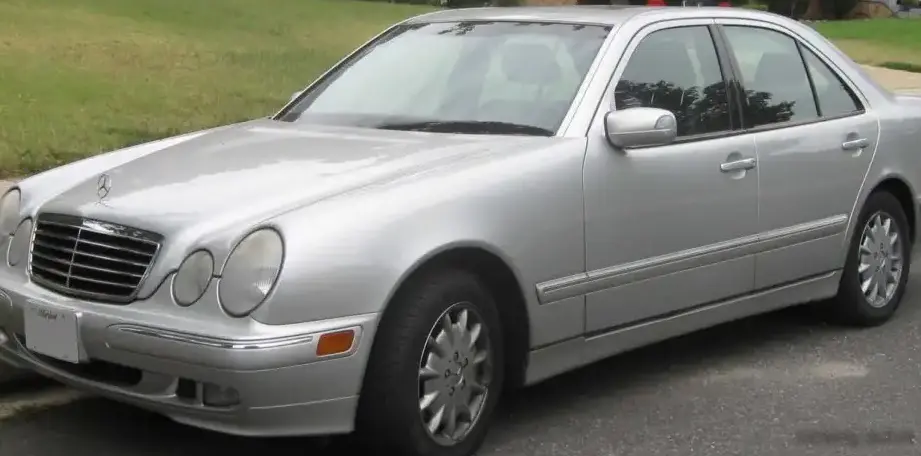
The Mercedes-Benz E 55 AMG, produced from July 1999 to March 2002, represented the high-performance variant of the W210 E-Class facelift. Positioned as the flagship sedan within the W210 range, it offered a substantial increase in power and luxury compared to other E-Class models like the E320 or E430. This model year marked a significant step forward for AMG, solidifying its reputation for creating potent and refined performance sedans. The E 55 AMG was primarily marketed towards buyers seeking a blend of luxury, performance, and prestige, competing with vehicles like the BMW M5 and Audi S8.
Technical Specifications
| Brand | Mercedes-Benz |
| Model | E-class |
| Generation | E-class (W210, facelift 1999) |
| Type | AMG E 55 V8 (354 Hp) Automatic |
| Start of production | July, 1999 |
| End of production | March, 2002 |
| Powertrain Architecture | Internal Combustion engine |
| Body type | Sedan |
| Seats | 5 |
| Doors | 4 |
| Fuel consumption (urban) | 17.8 l/100 km (13.2 US mpg, 15.9 UK mpg, 5.6 km/l) |
| Fuel consumption (extra urban) | 8.8 l/100 km (26.7 US mpg, 32.1 UK mpg, 11.4 km/l) |
| Fuel consumption (combined) | 12.1 l/100 km (19.4 US mpg, 23.3 UK mpg, 8.3 km/l) |
| Fuel Type | Petrol (Gasoline) |
| Acceleration 0 – 100 km/h | 5.7 sec |
| Acceleration 0 – 62 mph | 5.7 sec |
| Acceleration 0 – 60 mph | 5.4 sec |
| Maximum speed | 250 km/h (155.34 mph), Electronically limited |
| Weight-to-power ratio | 4.8 kg/Hp, 207 Hp/tonne |
| Weight-to-torque ratio | 3.2 kg/Nm, 309.9 Nm/tonne |
| Power | 354 Hp @ 5500 rpm |
| Power per litre | 65.1 Hp/l |
| Torque | 530 Nm @ 3000 rpm (390.91 lb.-ft. @ 3000 rpm) |
| Engine layout | Front, Longitudinal |
| Engine Model/Code | M 113 E 55 |
| Engine displacement | 5439 cm3 (331.91 cu. in.) |
| Number of cylinders | 8 |
| Engine configuration | V-engine |
| Cylinder Bore | 97 mm (3.82 in.) |
| Piston Stroke | 92 mm (3.62 in.) |
| Compression ratio | 10.5:1 |
| Number of valves per cylinder | 3 |
| Fuel injection system | Multi-port manifold injection |
| Engine aspiration | Naturally aspirated engine |
| Valvetrain | SOHC |
| Engine oil capacity | 8 l (8.45 US qt | 7.04 UK qt) |
| Coolant | 11 l (11.62 US qt | 9.68 UK qt) |
| Kerb Weight | 1710 kg (3769.9 lbs.) |
| Max. weight | 2210 kg (4872.22 lbs.) |
| Max load | 500 kg (1102.31 lbs.) |
| Trunk (boot) space – maximum | 520 l (18.36 cu. ft.) |
| Fuel tank capacity | 70 l (18.49 US gal | 15.4 UK gal) |
| Length | 4818 mm (189.69 in.) |
| Width | 1799 mm (70.83 in.) |
| Height | 1411 mm (55.55 in.) |
| Wheelbase | 2833 mm (111.54 in.) |
| Front track | 1560 mm (61.42 in.) |
| Rear (Back) track | 1543 mm (60.75 in.) |
| Drag coefficient (Cd) | 0.29 |
| Drivetrain Architecture | The Internal combustion engine (ICE) drives the rear wheels of the vehicle. |
| Drive wheel | Rear wheel drive |
| Number of gears and type of gearbox | 5 gears, automatic transmission |
| Front suspension | Coil spring |
| Rear suspension | Independent multi-link spring suspension with stabilizer |
| Front brakes | Ventilated discs |
| Rear brakes | Disc |
| Assisting systems | ABS (Anti-lock braking system), Power steering Hydraulic Steering |
| Tires size | Front wheel tires: 235/40 R18, Rear wheel tires: 265/35 R18 |
| Wheel rims size | Front wheel rims: 8J x 18, Rear wheel rims: 9J x 18 |
INTRODUCTION
The W210 E 55 AMG, introduced in 1999 as part of the facelifted W210 series, was a significant evolution of the E-Class performance model. Building upon the already refined W210 platform, the E 55 aimed to deliver a more engaging driving experience without sacrificing the comfort and luxury expected of a Mercedes-Benz. It represented a shift towards a more focused AMG identity, moving away from subtle enhancements and embracing a more assertive performance character. The facelift brought updated styling cues, improved interior materials, and enhanced safety features, all integrated into the E 55’s high-performance package.
Powertrain & Engine Architecture
The heart of the E 55 AMG is the M113 E 55 5.4-liter naturally aspirated V8 engine. This engine, a cornerstone of AMG’s engineering prowess, produced 354 horsepower at 5500 rpm and 390 lb-ft of torque at 3000 rpm. The M113 featured a cast iron block with aluminum cylinder heads, a robust design intended for high performance and longevity. Fuel delivery was handled by a multi-port fuel injection system, ensuring precise fuel metering for optimal combustion. The engine utilized a single overhead camshaft (SOHC) valvetrain with three valves per cylinder, a configuration that balanced performance and efficiency. The engine was paired with a five-speed automatic transmission, specifically tuned by AMG for quicker shifts and improved responsiveness. This transmission featured a torque converter lock-up clutch to enhance efficiency at cruising speeds.
Driving Characteristics
The E 55 AMG delivered a compelling driving experience, blending effortless power with a comfortable ride. The 5.4-liter V8 provided strong acceleration, propelling the car from 0 to 60 mph in approximately 5.4 seconds and reaching a electronically limited top speed of 155 mph. The automatic transmission, while not as engaging as a manual, offered smooth and relatively quick shifts. The gear ratios were optimized for both acceleration and highway cruising. Compared to the E430, the E 55 offered a noticeably more potent power delivery, with a more aggressive throttle response and a more pronounced exhaust note. While the E 55 wasn’t as nimble as some of its European rivals, its substantial torque and well-tuned suspension provided a confident and stable driving experience.
Equipment & Trim Levels
The E 55 AMG came standard with a comprehensive list of features, reflecting its position as the flagship E-Class model. Interior appointments included leather upholstery, wood trim, and power-adjustable front seats with memory function. Standard equipment also included automatic climate control, a premium sound system, and a sunroof. Optional extras included heated seats, a navigation system, and upgraded leather options. The exterior featured AMG-specific body styling, including a unique front spoiler, side skirts, and rear diffuser. The E 55 also came equipped with 18-inch AMG alloy wheels and a sport-tuned suspension.
Chassis & Braking
The E 55 AMG benefited from a revised suspension system designed to handle the increased power and improve handling. The front suspension utilized coil springs, while the rear featured an independent multi-link setup with a stabilizer bar. This configuration provided a good balance between ride comfort and handling precision. Braking duties were handled by ventilated disc brakes on all four wheels, providing ample stopping power. An Anti-lock Braking System (ABS) was standard, enhancing safety and control during hard braking. The steering was hydraulic power steering, offering a responsive and precise feel.
Market Reception & Comparison
The E 55 AMG was generally well-received by automotive critics, who praised its powerful engine, comfortable ride, and luxurious interior. However, some critics noted that the automatic transmission lacked the engagement of a manual gearbox. Compared to the E430, the E 55 offered a significant performance upgrade, but at a higher price point. Fuel economy was predictably lower than the less powerful E-Class models, averaging around 19 mpg combined. Reliability was generally good, although the complex engine and transmission systems required regular maintenance.
Legacy
The W210 E 55 AMG remains a desirable classic among Mercedes-Benz enthusiasts. The M113 engine is known for its durability and potential for modification. Well-maintained examples command a premium in the used car market. The E 55 AMG represents a pivotal moment in AMG’s history, marking a transition towards a more focused and performance-oriented brand identity. Its blend of luxury, performance, and prestige continues to appeal to collectors and enthusiasts today, solidifying its place as a significant model in the E-Class lineage.