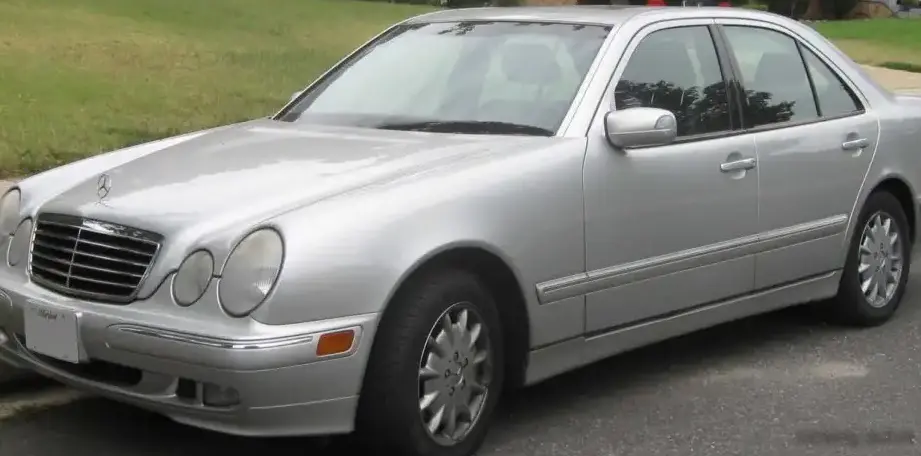
The Mercedes-Benz E 240 V6 Automatic, produced from July 1999 to June 2000, represents a significant iteration within the W210 E-Class facelift series. Positioned as a mid-range offering, it aimed to balance performance and luxury with a focus on comfortable, refined driving. This variant was primarily sold in European markets, where it competed with BMW’s 5 Series and Audi’s A6, offering a compelling alternative with Mercedes-Benz’s renowned build quality and technological features. The W210 facelift, introduced in 1999, addressed many criticisms of the earlier W210 models, improving aesthetics, reliability, and overall refinement.
Technical Specifications
| Brand | Mercedes-Benz |
| Model | E-class |
| Generation | E-class (W210, facelift 1999) |
| Type (Engine) | E 240 V6 (170 Hp) Automatic |
| Start of production | July, 1999 |
| End of production | June, 2000 |
| Powertrain Architecture | Internal Combustion engine |
| Body type | Sedan |
| Seats | 5 |
| Doors | 4 |
| Fuel consumption (urban) | 14.5 l/100 km (16.2 US mpg, 19.5 UK mpg, 6.9 km/l) |
| Fuel consumption (extra urban) | 7.7 l/100 km (30.5 US mpg, 36.7 UK mpg, 13 km/l) |
| Fuel consumption (combined) | 10.3 l/100 km (22.8 US mpg, 27.4 UK mpg, 9.7 km/l) |
| Fuel Type | Petrol (Gasoline) |
| Acceleration 0 – 100 km/h | 10.8 sec |
| Acceleration 0 – 62 mph | 10.8 sec |
| Acceleration 0 – 60 mph | 10.3 sec |
| Maximum speed | 222 km/h (137.94 mph) |
| Weight-to-power ratio | 9.3 kg/Hp, 107.6 Hp/tonne |
| Weight-to-torque ratio | 7 kg/Nm, 142.4 Nm/tonne |
| Power | 170 Hp @ 5900 rpm |
| Power per litre | 70.9 Hp/l |
| Torque | 225 Nm @ 3000-3500 rpm (165.95 lb.-ft. @ 3000-3500 rpm) |
| Engine layout | Front, Longitudinal |
| Engine Model/Code | M 112 E 24 / 112.911 |
| Engine displacement | 2398 cm3 (146.33 cu. in.) |
| Number of cylinders | 6 |
| Engine configuration | V-engine |
| Cylinder Bore | 83.21 mm (3.28 in.) |
| Piston Stroke | 73.5 mm (2.89 in.) |
| Compression ratio | 10:1 |
| Number of valves per cylinder | 3 |
| Fuel injection system | Multi-port manifold injection |
| Engine aspiration | Naturally aspirated engine |
| Valvetrain | SOHC |
| Engine oil capacity | 8 l (8.45 US qt | 7.04 UK qt) |
| Coolant | 10 l (10.57 US qt | 8.8 UK qt) |
| Kerb Weight | 1580 kg (3483.3 lbs.) |
| Max. weight | 2080 kg (4585.62 lbs.) |
| Max load | 500 kg (1102.31 lbs.) |
| Fuel tank capacity | 65 l (17.17 US gal | 14.3 UK gal) |
| Length | 4818 mm (189.69 in.) |
| Width | 1799 mm (70.83 in.) |
| Height | 1440 mm (56.69 in.) |
| Wheelbase | 2833 mm (111.54 in.) |
| Front track | 1542 mm (60.71 in.) |
| Rear (Back) track | 1536 mm (60.47 in.) |
| Drivetrain Architecture | The Internal combustion engine (ICE) drives the rear wheels of the vehicle. |
| Drive wheel | Rear wheel drive |
| Number of gears and type of gearbox | 5 gears, automatic transmission |
| Front suspension | Double wishbone |
| Rear suspension | Independent multi-link spring suspension with stabilizer |
| Front brakes | Ventilated discs |
| Rear brakes | Disc |
| Assisting systems | ABS (Anti-lock braking system) |
| Steering type | Steering rack and pinion |
| Power steering | Hydraulic Steering |
| Tires size | 205/65 R15 |
| Wheel rims size | 7J x 15 |
Powertrain & Engine Architecture
The E 240 V6 was powered by the M112 E 24 engine, a 2.4-liter naturally aspirated V6. This engine was a key component of Mercedes-Benz’s new modular engine family, designed for smooth operation and reduced NVH (Noise, Vibration, and Harshness). The M112 featured a single overhead camshaft (SOHC) design per cylinder bank, three valves per cylinder (two intake, one exhaust), and a multi-point fuel injection system. The engine produced 170 horsepower at 5900 rpm and 225 Nm (165.95 lb-ft) of torque between 3000 and 3500 rpm. The engine’s relatively high compression ratio of 10:1 contributed to its efficiency and responsiveness. Paired with the engine was a 5-speed automatic transmission, offering smooth shifts and a focus on comfort rather than outright performance. This transmission was a conventional torque converter automatic, known for its reliability and ease of maintenance.
Driving Characteristics
The E 240 V6 Automatic offered a comfortable and refined driving experience. While not particularly sporty, the V6 engine provided adequate power for everyday driving and highway cruising. Acceleration from 0 to 60 mph took around 10.3 seconds, and the top speed was electronically limited to 137.94 mph. The automatic transmission, while smooth, did contribute to a slight loss of responsiveness compared to the available manual transmission. Gear ratios were tuned for fuel efficiency and relaxed cruising, rather than aggressive acceleration. The car felt stable and planted on the road, thanks to its well-tuned suspension and rear-wheel-drive layout.
Equipment & Trim Levels
The E 240 V6 Automatic typically came standard with features such as automatic climate control, power windows and locks, a multi-function steering wheel, and a basic audio system. Upholstery was typically cloth, although leather was available as an option. Common optional extras included a sunroof, upgraded audio systems, heated seats, and parking assistance systems. The W210 facelift also introduced improved interior trim materials and a more modern dashboard design compared to pre-facelift models. Safety features included ABS anti-lock brakes and airbags.
Chassis & Braking
The E 240 V6 utilized a double wishbone suspension at the front and an independent multi-link suspension at the rear, providing a comfortable ride and good handling characteristics. The car was equipped with ventilated disc brakes at the front and solid disc brakes at the rear. ABS (Anti-lock Braking System) was standard, enhancing braking performance and stability. The steering was a hydraulic power-assisted rack and pinion system, offering precise and responsive steering feel. The standard tire size was 205/65 R15, mounted on 7J x 15 inch alloy wheels.
Market Reception & Comparison
The E 240 V6 Automatic was generally well-received by automotive critics as a comfortable and refined mid-range option. It was praised for its smooth engine, comfortable ride, and build quality. However, some critics noted that its performance was not as exciting as that of the higher-powered E 320 or the sportier AMG models. Compared to the E 280, the E 240 offered slightly better fuel economy but less power. The E 240 also provided a more affordable entry point into the W210 E-Class range than the six-cylinder alternatives. Reliability was generally good, although like all cars of this era, regular maintenance was crucial.
Legacy
The M112 engine family, including the 2.4-liter V6 found in the E 240, proved to be a durable and reliable powerplant. While not known for exceptional performance, these engines are capable of high mileage with proper maintenance. Today, the W210 E 240 V6 Automatic represents an affordable entry point into Mercedes-Benz ownership. Used examples are readily available, and parts are generally accessible. However, potential buyers should be aware of the age-related issues common to cars of this era, such as corrosion, worn suspension components, and potential electrical problems. The E 240 V6 remains a popular choice for those seeking a comfortable, reliable, and relatively affordable luxury sedan.