
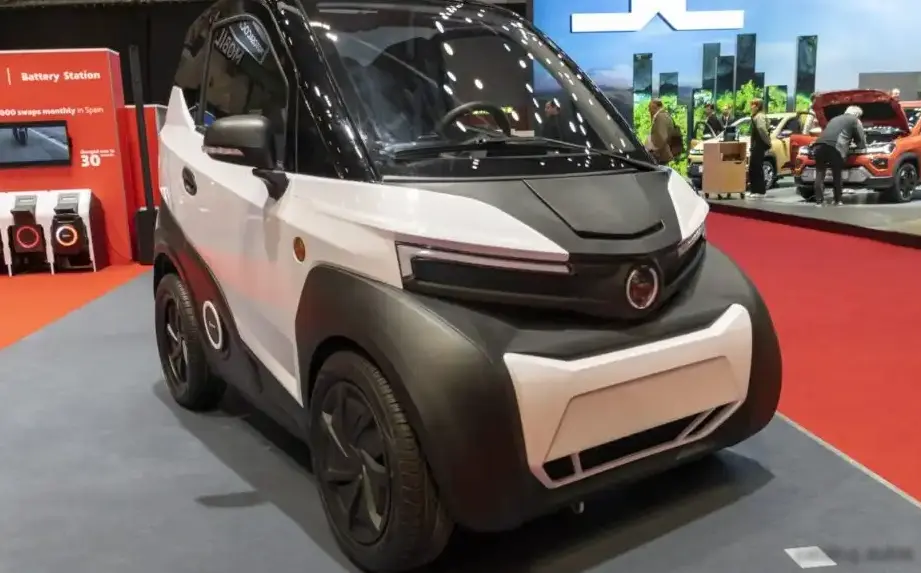
The Silence S04 Nanocar is a small, two-seater electric quadricycle manufactured by the Spanish company Silence. Introduced in June 2023, the S04 is designed for urban mobility, offering a compact footprint and zero-emission operation. Classified as an L6e vehicle under European regulations, it occupies a niche between traditional motorcycles and automobiles, providing a weather-protected alternative for short-distance commutes and city errands. The S04 represents Silence’s entry into the micro-mobility market, aiming to provide a practical and sustainable transportation solution for congested urban environments.
Technical Specifications
| Brand | Silence |
| Model | S04 Nanocar |
| Generation | S04 Nanocar |
| Type (Engine) | L6e 11.2 kWh (14 Hp) |
| Start of production | June, 2023 |
| Powertrain Architecture | BEV (Electric Vehicle) |
| Body type | Quadricycle |
| Seats | 2 |
| Doors | 3 |
| Fuel Type | Electricity |
| Maximum speed | 45 km/h (27.96 mph) |
| Weight-to-power ratio | 30 kg/Hp, 33.3 Hp/tonne |
| Gross battery capacity | 11.2 kWh |
| Battery voltage | 51 V |
| Battery technology | Lithium-ion (Li-Ion) |
| Battery weight | 82 kg (180.78 lbs.) |
| Battery location | Below the floor |
| All-electric range | 175 km (108.74 mi) |
| Kerb Weight | 420 kg (925.94 lbs.) |
| Max. weight | 785 kg (1730.63 lbs.) |
| Max load | 365 kg (804.69 lbs.) |
| Trunk (boot) space – minimum | 247 l (8.72 cu. ft.) |
| Length | 2282 mm (89.84 in.) |
| Width | 1268 mm (49.92 in.) |
| Width including mirrors | 1536 mm (60.47 in.) |
| Height | 1590 mm (62.6 in.) |
| Wheelbase | 1582 mm (62.28 in.) |
| Front overhang | 382 mm (15.04 in.) |
| Rear overhang | 318 mm (12.52 in.) |
| Minimum turning circle (turning diameter) | 7 m (22.97 ft.) |
| Drivetrain Architecture | Two electric motors drive the rear wheels. |
| Drive wheel | Rear wheel drive |
| Front brakes | Disc |
| Rear brakes | Disc |
| Tires size | 155/65 R14 |
| Wheel rims size | 14 |
Powertrain & Engine Architecture
The Silence S04 is powered by a fully electric powertrain, utilizing a 11.2 kWh lithium-ion battery pack. This battery is positioned under the floor of the vehicle, contributing to a low center of gravity and maximizing interior space. The S04 employs a unique dual-motor setup, with individual electric motors powering each rear wheel. This configuration provides rear-wheel drive and eliminates the need for a traditional differential. Each motor delivers approximately 7 horsepower, combining for a total system output of 14 horsepower. The battery operates at 51 volts. The charging ports and specific charging times are not widely publicized, but the vehicle is designed for standard Level 2 AC charging infrastructure. The powertrain is designed for simplicity and efficiency, prioritizing range and ease of use over outright performance.
Driving Characteristics
With only 14 horsepower, the Silence S04 Nanocar is not designed for rapid acceleration or high-speed driving. Its maximum speed is limited to 45 km/h (27.96 mph), making it suitable for urban environments with speed restrictions. The rear-wheel-drive configuration and dual-motor setup provide surprisingly nimble handling, particularly in tight spaces. The low weight of the vehicle (420 kg / 925.94 lbs. unladen) contributes to its agility. Power delivery is instant and linear, characteristic of electric motors. Compared to potential future higher-performance variants, this base model prioritizes efficiency and ease of driving over sporty performance. The gear ratios are optimized for maximizing range and providing sufficient torque for navigating city streets and inclines.
Equipment & Trim Levels
The Silence S04 Nanocar is offered with a relatively basic level of standard equipment, reflecting its positioning as an affordable urban mobility solution. Standard features include three doors, two seats, disc brakes on all wheels, and a small trunk space of 247 liters (8.72 cu. ft.). The interior is functional and minimalist, with durable materials. Specific trim levels and optional extras are limited, but potential options may include different color schemes, upgraded interior trim, and basic infotainment systems. The focus is on providing a practical and reliable vehicle rather than luxurious amenities.
Chassis & Braking
The S04 utilizes a lightweight chassis designed to minimize weight and maximize efficiency. The suspension system is relatively simple, consisting of independent suspension on all wheels. The braking system features disc brakes on all four wheels, providing adequate stopping power for its limited speed and weight. The tires are sized 155/65 R14, chosen for a balance of rolling resistance, grip, and cost. The vehicle’s compact dimensions and relatively short wheelbase (1582 mm / 62.28 in.) contribute to its maneuverability in urban environments.
Market Reception & Comparison
The Silence S04 Nanocar has been generally well-received as a practical and sustainable urban mobility solution. Critics have praised its compact size, zero-emission operation, and nimble handling. However, its limited speed and power have also been noted. Compared to other L6e vehicles and microcars, the S04 offers a competitive range and a unique dual-motor rear-wheel-drive configuration. Its fuel economy, being fully electric, is significantly better than that of traditional gasoline-powered vehicles. Reliability is expected to be good, given the simplicity of the electric powertrain, but long-term data is still emerging.
Legacy
The Silence S04 Nanocar represents a growing trend towards micro-mobility and sustainable transportation in urban areas. Its innovative dual-motor rear-wheel-drive configuration and focus on practicality position it as a potential leader in the L6e vehicle segment. While it’s too early to assess its long-term reliability definitively, the simplicity of the electric powertrain suggests a potentially long service life. In the used car market, the S04 is likely to appeal to environmentally conscious urban dwellers seeking an affordable and convenient transportation solution. As cities increasingly prioritize sustainability and reduce reliance on traditional automobiles, vehicles like the Silence S04 Nanocar are poised to play an increasingly important role in the future of urban mobility.
