
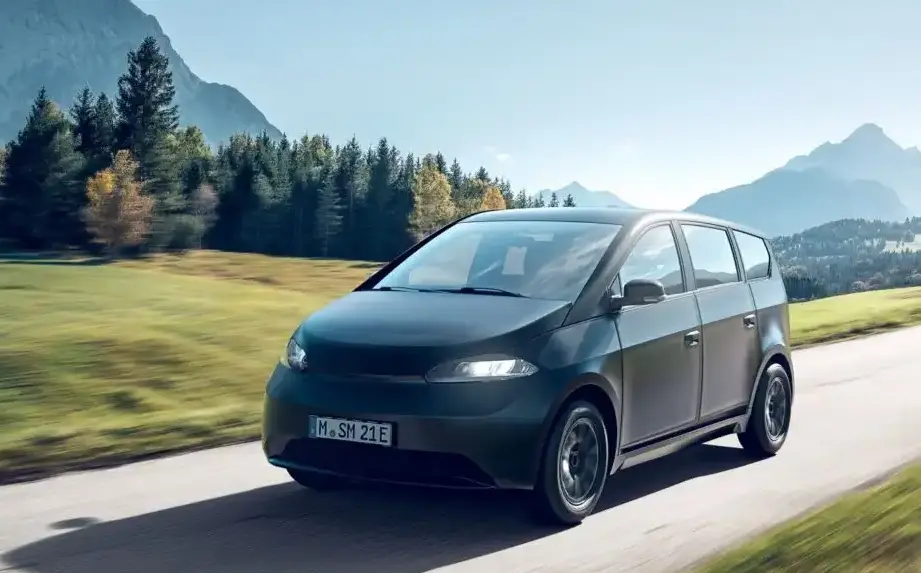
The Sono Motors Sion, specifically the 54 kWh (163 Hp) Electric variant, represents a unique attempt to bring solar-powered electric vehicles to the mass market. Production commenced in January 2023, though the company faced significant financial difficulties leading to insolvency in 2024. The Sion is a five-door hatchback designed to integrate photovoltaic cells into its body panels, supplementing the battery charge and extending range. This particular version, with its 54 kWh battery and 163 horsepower electric motor, was positioned as the core offering within the Sion lineup, aiming for a balance between affordability, range, and practicality. It was intended to compete with other entry-level EVs like the Nissan Leaf and Renault Zoe, but with the added appeal of solar charging.
Technical Specifications
| Brand | Sono Motors |
| Model | Sion |
| Generation | Sion |
| Type (Engine) | 54 kWh (163 Hp) Electric |
| Start of production | January, 2023 |
| Powertrain Architecture | BEV (Electric Vehicle) |
| Body type | Hatchback |
| Seats | 5 |
| Doors | 5 |
| Fuel Type | Electricity |
| Acceleration 0 – 100 km/h | 9 sec |
| Acceleration 0 – 62 mph | 9 sec |
| Acceleration 0 – 60 mph | 8.6 sec |
| Maximum speed | 140 km/h (86.99 mph) |
| Weight-to-power ratio | 10.6 kg/Hp, 94.2 Hp/tonne |
| Gross battery capacity | 54 kWh |
| All-electric range (WLTP) | 305 km (189.52 mi) |
| Average Energy consumption (WLTP) | 16 kWh/100 km (25.75 kWh/100 mi) |
| MPGe | 131 |
| km/kWh | 6.3 |
| mi/kWh | 3.9 |
| Electric motor power | 163 Hp |
| Electric motor Torque | 270 Nm (199.14 lb.-ft.) |
| Electric motor location | Front, Transverse |
| System power | 163 Hp |
| Kerb Weight | 1730 kg (3814 lbs.) |
| Max. weight | 2180 kg (4806.08 lbs.) |
| Max load | 450 kg (992.08 lbs.) |
| Trunk (boot) space – minimum | 650 l (22.95 cu. ft.) |
| Trunk (boot) space – maximum | 1250 l (44.14 cu. ft.) |
| Length | 4470 mm (175.98 in.) |
| Width | 1830 mm (72.05 in.) |
| Width including mirrors | 2080 mm (81.89 in.) |
| Height | 1660 mm (65.35 in.) |
| Wheelbase | 2830 mm (111.42 in.) |
| Front track | 1580 mm (62.2 in.) |
| Rear (Back) track | 1580 mm (62.2 in.) |
| Ride height (ground clearance) | 165 mm (6.5 in.) |
| Minimum turning circle | 11 m (36.09 ft.) |
| Drivetrain Architecture | One electric motor drives the front wheels. |
| Drive wheel | Front wheel drive |
| Number of gears and type of gearbox | 1 gears, automatic transmission |
| Front suspension | Independent type McPherson |
| Rear suspension | McPherson |
| Front brakes | Disc |
| Rear brakes | Drum |
| Assisting systems | ABS (Anti-lock braking system) |
| Steering type | Steering rack and pinion |
| Tires size | 205/60 R16 |
Powertrain & Engine Architecture
The Sono Sion utilizes a single electric motor, mounted transversely at the front of the vehicle, driving the front wheels. The motor produces 163 horsepower and 270 Nm (199.14 lb.-ft.) of torque. The 54 kWh lithium-ion battery pack provides an estimated WLTP range of 305 kilometers (189.52 miles). A key feature of the Sion is its integrated solar panels, covering a significant portion of the vehicle’s surface. These panels are designed to generate enough energy to add approximately 34 kilometers (21 miles) of range per day under optimal conditions. The vehicle employs a single-speed automatic transmission, typical for most battery electric vehicles, prioritizing efficiency and smooth acceleration. The battery management system (BMS) is crucial for optimizing battery life and performance, monitoring cell voltages, temperatures, and overall health.
Driving Characteristics
The Sion 54 kWh, with its 163 hp output and single-speed automatic transmission, delivers adequate, though not particularly exhilarating, performance. Acceleration from 0 to 60 mph takes approximately 8.6 seconds. The single-gear ratio provides linear power delivery, making it easy to drive in urban environments. Compared to potential higher-performance variants (which were never fully realized due to the company’s financial situation), this version prioritizes efficiency and range over outright speed. The automatic transmission contributes to a relaxed driving experience, but lacks the engagement offered by a manual gearbox. The front-wheel-drive configuration provides predictable handling, but can exhibit some torque steer under hard acceleration.
Equipment & Trim Levels
The Sono Sion was designed with a focus on practicality and sustainability. Standard equipment included air conditioning, a touchscreen infotainment system, and basic safety features like ABS. The interior was intended to be minimalist and functional, utilizing recycled materials wherever possible. Optional extras included a larger touchscreen, upgraded audio system, and various driver-assistance features. The Sion’s interior design was relatively spartan, reflecting its affordability target. The emphasis was on providing essential features without unnecessary luxury.
Chassis & Braking
The Sion utilizes a McPherson strut suspension setup at both the front and rear, a common configuration for vehicles in this class. The front brakes are disc brakes, providing adequate stopping power, while the rear brakes are drum brakes, a cost-saving measure. The suspension is tuned for comfort rather than sporty handling. The vehicle’s relatively high curb weight of 1730 kg (3814 lbs.) impacts its handling dynamics, making it feel less agile than lighter vehicles. The steering is a rack and pinion system, providing reasonable precision.
Market Reception & Comparison
The Sono Sion faced an uphill battle in the competitive EV market. While the concept of a solar-powered EV garnered significant attention, the vehicle’s limited range, relatively modest performance, and the company’s financial instability hampered its market prospects. Critics noted the Sion’s unconventional design and the uncertainty surrounding the effectiveness of the solar charging system in real-world conditions. Compared to rivals like the Nissan Leaf and Renault Zoe, the Sion offered a unique selling point with its solar panels, but lacked the established brand recognition and extensive charging infrastructure support of those competitors. The projected fuel economy, expressed as 131 MPGe, was competitive with other EVs in its class.
Legacy
Despite the company’s insolvency, the Sono Sion represents an intriguing experiment in sustainable transportation. The vehicle’s innovative use of solar panels and its focus on recycled materials demonstrated a commitment to environmental responsibility. While the Sion may not have achieved widespread commercial success, it helped to raise awareness of the potential for solar-powered vehicles and inspired further research and development in this area. The Sion’s long-term reliability remains largely unknown due to the limited number of vehicles produced and the company’s collapse. However, the core electric powertrain components are relatively standard, suggesting that maintenance and repairs may be feasible with access to compatible parts. The Sion’s legacy lies in its ambition and its contribution to the evolving landscape of electric mobility.
