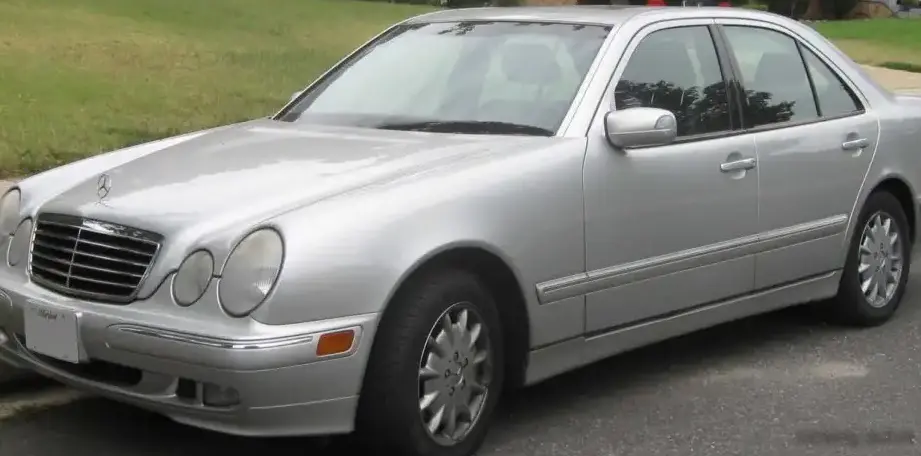
The Mercedes-Benz E 320 CDI, part of the W210 facelift series produced from January 1999 to March 2002, represented a significant step forward in diesel technology for the E-Class. Positioned as a premium offering within the W210 range, it bridged the gap between the more affordable E 270 CDI and the flagship E 430. This variant was primarily aimed at buyers seeking a blend of luxury, performance, and fuel efficiency, particularly in European markets where diesel engines held a strong preference. The introduction of the Commonrail Direct Injection system marked a turning point for Mercedes-Benz diesel engines, offering improved refinement and power delivery compared to previous generations.
Technical Specifications
| Brand | Mercedes-Benz |
| Model | E-class |
| Generation | E-class (W210, facelift 1999) |
| Type (Engine) | E 320 CDI (197 Hp) Automatic |
| Start of production | January, 1999 |
| End of production | March, 2002 |
| Powertrain Architecture | Internal Combustion engine |
| Body type | Sedan |
| Seats | 5 |
| Doors | 4 |
| Fuel consumption (urban) | 11.1 l/100 km (21.2 US mpg, 25.4 UK mpg, 9 km/l) |
| Fuel consumption (extra urban) | 5.9 l/100 km (39.9 US mpg, 47.9 UK mpg, 16.9 km/l) |
| Fuel consumption (combined) | 7.8 l/100 km (30.2 US mpg, 36.2 UK mpg, 12.8 km/l) |
| Fuel Type | Diesel |
| Acceleration 0 – 100 km/h | 8.3 sec |
| Acceleration 0 – 62 mph | 8.3 sec |
| Acceleration 0 – 60 mph | 7.9 sec |
| Maximum speed | 230 km/h (142.92 mph) |
| Weight-to-power ratio | 8 kg/Hp, 124.3 Hp/tonne |
| Weight-to-torque ratio | 3.4 kg/Nm, 296.5 Nm/tonne |
| Power | 197 Hp @ 4200 rpm |
| Power per litre | 61.1 Hp/l |
| Torque | 470 Nm @ 1800 rpm (346.65 lb.-ft. @ 1800 rpm) |
| Engine layout | Front, Longitudinal |
| Engine Model/Code | OM 613 DE 32 LA / 613.961 |
| Engine displacement | 3222 cm3 (196.62 cu. in.) |
| Number of cylinders | 6 |
| Engine configuration | Inline |
| Cylinder Bore | 88 mm (3.46 in.) |
| Piston Stroke | 88.34 mm (3.48 in.) |
| Compression ratio | 18:1 |
| Number of valves per cylinder | 4 |
| Fuel injection system | Diesel Commonrail |
| Engine aspiration | Turbocharger, Intercooler |
| Valvetrain | DOHC |
| Engine oil capacity | 7.5 l (7.93 US qt | 6.6 UK qt) |
| Coolant | 15.5 l (16.38 US qt | 13.64 UK qt) |
| Kerb Weight | 1585 kg (3494.33 lbs.) |
| Max. weight | 2160 kg (4761.98 lbs.) |
| Max load | 575 kg (1267.66 lbs.) |
| Trunk (boot) space – minimum | 520 l (18.36 cu. ft.) |
| Fuel tank capacity | 65 l (17.17 US gal | 14.3 UK gal) |
| Max. roof load | 100 kg (220.46 lbs.) |
| Permitted trailer load with brakes (12%) | 1900 kg (4188.78 lbs.) |
| Permitted trailer load without brakes | 750 kg (1653.47 lbs.) |
| Length | 4818 mm (189.69 in.) |
| Width | 1799 mm (70.83 in.) |
| Width including mirrors | 1985 mm (78.15 in.) |
| Height | 1418 mm (55.83 in.) |
| Wheelbase | 2833 mm (111.54 in.) |
| Front track | 1534 mm (60.39 in.) |
| Rear (Back) track | 1528 mm (60.16 in.) |
| Drag coefficient (Cd) | 0.28 |
| Minimum turning circle (turning diameter) | 11.3 m (37.07 ft.) |
| Drivetrain Architecture | The Internal combustion engine (ICE) drives the rear wheels of the vehicle. |
| Drive wheel | Rear wheel drive |
| Number of gears and type of gearbox | 5 gears, automatic transmission |
| Front suspension | Double wishbone |
| Rear suspension | Independent multi-link spring suspension with stabilizer |
| Front brakes | Ventilated discs |
| Rear brakes | Disc |
| Assisting systems | ABS (Anti-lock braking system) |
| Steering type | Steering rack and pinion |
| Power steering | Hydraulic Steering |
| Tires size | 215/55 R16 |
| Wheel rims size | 7.5J x 15 |
Powertrain & Engine Architecture
The heart of the E 320 CDI is the OM 613 DE 32 LA inline-six cylinder diesel engine. This 3.2-liter engine utilizes a sophisticated Commonrail Direct Injection system, a significant advancement over earlier diesel designs. Commonrail injection allowed for multiple injection events per combustion cycle, resulting in quieter operation, reduced emissions, and improved fuel economy. The engine featured a turbocharger with an intercooler to boost power output. The valvetrain employed a Double Overhead Camshaft (DOHC) design with four valves per cylinder, optimizing airflow for enhanced performance. The 5-speed automatic transmission (typically the 722.6) was specifically calibrated to handle the engine’s substantial 470 Nm (346.65 lb-ft) of torque, providing smooth and responsive shifts.
Driving Characteristics
The E 320 CDI Automatic offered a distinctly different driving experience compared to its gasoline-powered siblings or even the manual diesel variants. While not as overtly sporty as the E 430, the CDI provided ample torque from low engine speeds, making it effortless to accelerate and overtake. The automatic transmission, while smooth, prioritized comfort over outright performance. Gear ratios were tuned for relaxed cruising, and the transmission wasn’t particularly quick to downshift. Compared to the 197 hp E 270 CDI, the E 320 CDI offered noticeably more power and a more refined driving experience. The added torque also made it a capable tow vehicle.
Equipment & Trim Levels
The E 320 CDI typically came well-equipped, reflecting its position as a premium model. Standard features included automatic climate control, power windows and locks, a multi-function steering wheel, and a high-quality audio system. Interior upholstery was generally leather or a high-grade fabric. Optional extras included a sunroof, navigation system, heated seats, and upgraded audio options. The wood trim and overall interior finish were a step above the base E-Class models, emphasizing the car’s luxury credentials.
Chassis & Braking
The W210 E-Class featured a double wishbone front suspension and an independent multi-link rear suspension, providing a comfortable and controlled ride. The E 320 CDI, due to its increased weight, often benefited from a slightly stiffer suspension setup compared to the lighter models. Braking duties were handled by ventilated discs at the front and solid discs at the rear, equipped with ABS (Anti-lock Braking System) as standard. The steering was a hydraulic power-assisted rack and pinion system, offering precise and responsive handling.
Market Reception & Comparison
The E 320 CDI was generally well-received by automotive critics. It was praised for its refined engine, comfortable ride, and excellent fuel economy. However, some reviewers noted that the automatic transmission could feel somewhat sluggish, and the car wasn’t as engaging to drive as some of its competitors. Compared to the E 270 CDI, the E 320 CDI offered a significant performance upgrade, but at a higher price point. Against gasoline-powered rivals, the E 320 CDI provided a compelling combination of performance and fuel efficiency.
Legacy
The OM 613 engine family, including the 320 CDI variant, proved to be remarkably durable. With proper maintenance, these engines can reliably exceed 200,000 miles. The Commonrail injection system, while advanced for its time, is generally reliable, although injectors can eventually wear and require replacement. Today, the W210 E 320 CDI is a sought-after classic, particularly among diesel enthusiasts. Its combination of luxury, performance, and fuel efficiency makes it a compelling alternative to more modern vehicles. However, potential buyers should be aware of the age-related issues common to older Mercedes-Benz models, such as corrosion and wear on suspension components.