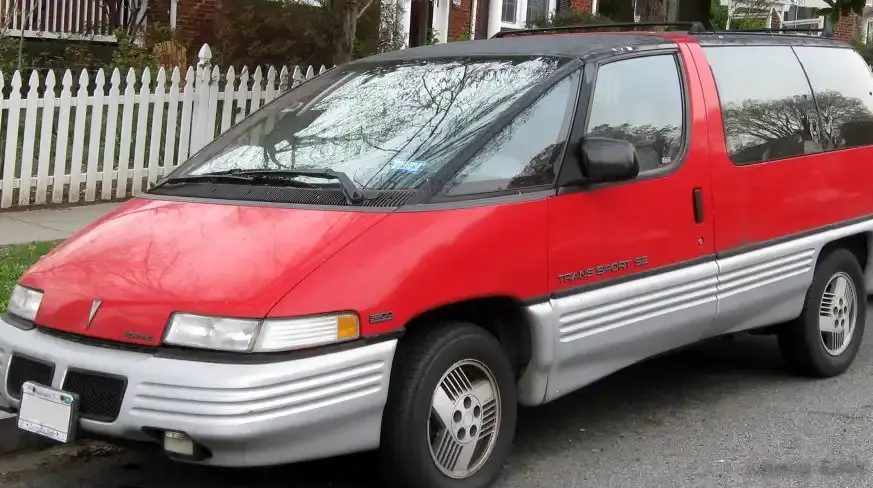
The Pontiac Trans Sport II 3.4 i V6, produced between 1996 and 1999, represented a mid-cycle refresh of the first-generation Trans Sport minivan. Positioned as a family-oriented vehicle, it competed directly with the Dodge Caravan, Chrysler Town & Country, and Ford Windstar in the North American market. This particular variant, equipped with the 3.4-liter V6 engine and a four-speed automatic transmission, occupied a middle ground in the Trans Sport II lineup, offering a balance between performance and affordability. It aimed to provide a more refined driving experience than the base four-cylinder models while remaining more accessible than the higher-trim level options.
Technical Specifications
| Brand | Pontiac |
| Model | Trans Sport |
| Generation | Trans Sport II |
| Type (Engine) | 3.4 i V6 (182 Hp) |
| Start of production | 1996 |
| End of production | 1999 |
| Powertrain Architecture | Internal Combustion engine |
| Body type | Minivan |
| Seats | 5 |
| Doors | 4 |
| Fuel consumption (urban) | 13.1 l/100 km (18 US mpg, 21.6 UK mpg) |
| Fuel consumption (extra urban) | 9.4 l/100 km (25 US mpg, 30.1 UK mpg) |
| Fuel Type | Petrol (Gasoline) |
| Maximum speed | 190 km/h (118.06 mph) |
| Weight-to-power ratio | 9.2 kg/Hp |
| Weight-to-torque ratio | 6 kg/Nm |
| Power | 182 Hp @ 5200 rpm |
| Power per litre | 54.3 Hp/l |
| Torque | 279 Nm @ 4000 rpm (205.78 lb.-ft. @ 4000 rpm) |
| Engine layout | Front, Transverse |
| Engine displacement | 3350 cm3 (204.43 cu. in.) |
| Number of cylinders | 6 |
| Engine configuration | V-engine |
| Cylinder Bore | 92 mm (3.62 in.) |
| Piston Stroke | 84 mm (3.31 in.) |
| Compression ratio | 9.5:1 |
| Number of valves per cylinder | 2 |
| Fuel injection system | Multi-port manifold injection |
| Engine aspiration | Naturally aspirated engine |
| Engine oil capacity | 4.3 l (4.54 US qt | 3.78 UK qt) |
| Coolant | 11.25 l (11.89 US qt | 9.9 UK qt) |
| Kerb Weight | 1680 kg (3703.77 lbs.) |
| Trunk (boot) space – maximum | 3580 l (126.43 cu. ft.) |
| Fuel tank capacity | 76 l (20.08 US gal | 16.72 UK gal) |
| Length | 4750 mm (187.01 in.) |
| Width | 1845 mm (72.64 in.) |
| Height | 1710 mm (67.32 in.) |
| Wheelbase | 2845 mm (112.01 in.) |
| Front track | 1560 mm (61.42 in.) |
| Rear (Back) track | 1610 mm (63.39 in.) |
| Drivetrain Architecture | The Internal combustion engine (ICE) drives the front wheels of the vehicle. |
| Drive wheel | Front wheel drive |
| Number of gears and type of gearbox | 4 gears, automatic transmission |
| Front suspension | Spring Strut |
| Rear suspension | Torsion |
| Front brakes | Ventilated discs |
| Rear brakes | Drum |
| Assisting systems | ABS (Anti-lock braking system) |
| Steering type | Steering rack and pinion |
| Power steering | Hydraulic Steering |
| Tires size | 205/70 R15 |
Powertrain & Engine Architecture
The heart of the Trans Sport II 3.4 i V6 is the 3.4-liter (3400 cc) LH0 V6 engine. This engine, part of GM’s “3800” family (though technically slightly smaller), featured a 90-degree V-configuration, two valves per cylinder, and a multi-port fuel injection system. The LH0 engine was known for its relatively smooth operation and decent power output for its displacement. The engine’s design prioritized reliability and low-end torque, making it well-suited for the demands of a family minivan. The four-speed 4T60 automatic transmission was the sole transmission option for this variant. This transmission was a common choice for GM vehicles of the era and offered smooth shifts, though it wasn’t known for particularly sporty performance. The transmission’s gear ratios were optimized for fuel efficiency and comfortable cruising rather than rapid acceleration.
Driving Characteristics
The 182 horsepower and 205 lb-ft of torque provided by the 3.4L V6 and 4T60 automatic combination resulted in adequate, but not exhilarating, performance. Acceleration from 0 to 60 mph was typically in the 9-10 second range. The automatic transmission, while smooth, did contribute to a noticeable loss of power compared to the available manual transmission options in other Trans Sport trims. The gear ratios were spaced to prioritize fuel economy and ease of driving, meaning the engine often felt strained during aggressive acceleration or when fully loaded with passengers and cargo. Compared to the base 2.4-liter four-cylinder Trans Sport, the V6 offered a significant improvement in both acceleration and overall drivability. However, it didn’t match the more spirited performance of the higher-output 3.8-liter V6 found in some Trans Sport models.
Equipment & Trim Levels
The 3.4 i V6 Trans Sport II typically included features such as air conditioning, power windows and locks, an AM/FM stereo with cassette player, and cloth upholstery. Optional extras included a CD player, upgraded sound system, power driver’s seat, and alloy wheels. The interior design was functional and family-focused, with ample storage compartments and a relatively spacious cabin. The dashboard layout was straightforward and easy to use, though the materials used were generally of lower quality compared to some competitors. The specific trim level (often denoted by a package name) determined the availability of certain features, with higher trims offering more luxurious appointments.
Chassis & Braking
The Trans Sport II utilized a front-wheel-drive layout with an independent front suspension featuring MacPherson struts and a torsion beam rear suspension. This suspension setup provided a comfortable ride quality, but handling was not particularly sharp. The front brakes were ventilated discs, while the rear brakes were drums. Anti-lock braking system (ABS) was standard equipment. The steering was rack-and-pinion with hydraulic power assist, providing reasonably light and responsive steering feel. The relatively modest weight of the vehicle (around 3700 lbs) helped to offset the limitations of the suspension and braking system.
Market Reception & Comparison
Critics generally viewed the Trans Sport II 3.4 i V6 as a competent and practical minivan. The V6 engine was praised for its smooth operation and adequate power, while the automatic transmission was considered reliable but unremarkable. Fuel economy was average for the class, with EPA estimates around 18 mpg city and 25 mpg highway. Compared to the four-cylinder Trans Sport, the V6 offered a noticeable improvement in performance and refinement. However, it was more expensive to purchase and operate. Compared to competitors like the Dodge Caravan and Chrysler Town & Country, the Trans Sport II was often seen as offering a slightly less refined interior and less engaging driving experience, but at a potentially lower price point.
Legacy
The Pontiac Trans Sport II, including the 3.4 i V6 variant, has become a relatively affordable and readily available used car. The 3.4L V6 engine is generally considered reliable, though regular maintenance is crucial to prevent issues such as oil leaks and intake manifold gasket failures. The 4T60 automatic transmission is also generally durable, but can be prone to issues if not properly maintained. Today, these minivans are often sought after by those looking for a practical and affordable family vehicle, or as a nostalgic reminder of 1990s automotive design. While not a performance icon, the Trans Sport II 3.4 i V6 served as a dependable and functional transportation option for many families during its production run.