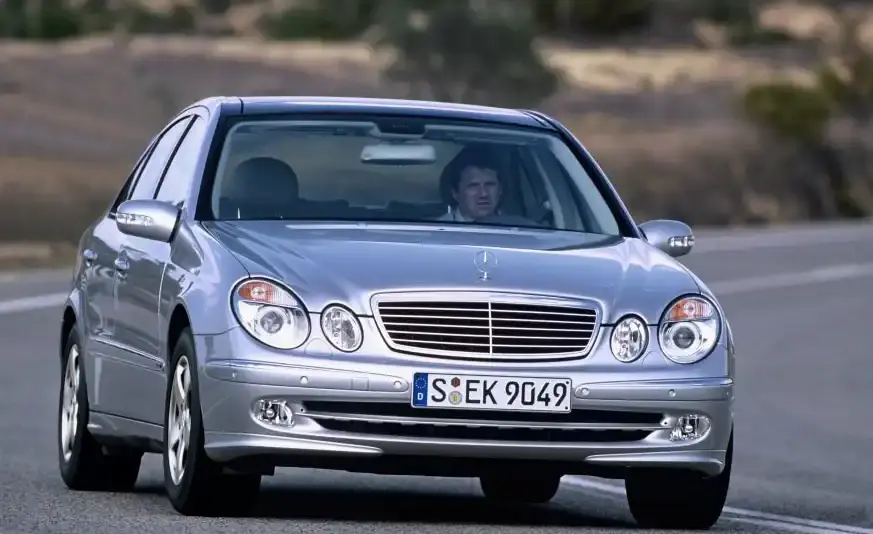
The Mercedes-Benz E 200 Kompressor, produced between 2002 and 2006 as part of the W211 E-Class generation, represented an entry point into the mid-size luxury sedan market for Mercedes-Benz. Positioned below the E 240 and E 320 models, the E 200 Kompressor offered a blend of comfort, technology, and reasonable fuel economy. It was primarily aimed at buyers seeking the prestige of the E-Class badge without the higher price tag of the more powerful variants. This model was particularly popular in European markets, where smaller displacement engines were favored due to tax regulations and fuel costs.
Technical Specifications
| Brand | Mercedes-Benz |
| Model | E-class |
| Generation | E-class (W211) |
| Type (Engine) | E 200 Kompressor (163 Hp) 5G-TRONIC |
| Start of production | 2002 |
| End of production | 2006 |
| Powertrain Architecture | Internal Combustion engine |
| Body type | Sedan |
| Seats | 5 |
| Doors | 4 |
| Fuel consumption (urban) | 12.8 l/100 km (18.4 US mpg, 22.1 UK mpg) |
| Fuel consumption (extra urban) | 6.4 l/100 km (36.8 US mpg, 44.1 UK mpg) |
| Fuel consumption (combined) | 8.7 l/100 km (27 US mpg, 32.5 UK mpg) |
| Fuel Type | Petrol (Gasoline) |
| Acceleration 0 – 100 km/h | 9.8 sec |
| Acceleration 0 – 62 mph | 9.8 sec |
| Acceleration 0 – 60 mph | 9.3 sec |
| Maximum speed | 227 km/h (141.05 mph) |
| Weight-to-power ratio | 9.8 kg/Hp |
| Weight-to-torque ratio | 6.7 kg/Nm |
| Power | 163 Hp @ 5500 rpm |
| Torque | 240 Nm @ 3000 rpm (177.01 lb.-ft. @ 3000 rpm) |
| Engine layout | Front, Longitudinal |
| Engine Model/Code | M 271.941 |
| Engine displacement | 1796 cm3 (109.6 cu. in.) |
| Number of cylinders | 4 |
| Engine configuration | Inline |
| Cylinder Bore | 82 mm (3.23 in.) |
| Piston Stroke | 85 mm (3.35 in.) |
| Compression ratio | 9.5:1 |
| Number of valves per cylinder | 4 |
| Fuel injection system | Multi-port manifold injection |
| Engine aspiration | Supercharger, Intercooler |
| Engine oil capacity | 5.5 l (5.81 US qt | 4.84 UK qt) |
| Coolant capacity | 9.2 l (9.72 US qt | 8.09 UK qt) |
| Kerb Weight | 1605 kg (3538.42 lbs.) |
| Max. weight | 2105 kg (4640.73 lbs.) |
| Max load | 500 kg (1102.31 lbs.) |
| Trunk (boot) space – minimum | 540 l (19.07 cu. ft.) |
| Fuel tank capacity | 65 l (17.17 US gal | 14.3 UK gal) |
| Permitted trailer load with brakes (12%) | 1900 kg (4188.78 lbs.) |
| Permitted trailer load without brakes | 750 kg (1653.47 lbs.) |
| Length | 4818 mm (189.69 in.) |
| Width | 1822 mm (71.73 in.) |
| Height | 1452 mm (57.17 in.) |
| Wheelbase | 2854 mm (112.36 in.) |
| Front track | 1577 mm (62.09 in.) |
| Rear (Back) track | 1570 mm (61.81 in.) |
| Drag coefficient (Cd) | 0.27 |
| Drivetrain Architecture | Rear wheel drive |
| Number of gears and type of gearbox | 5 gears, automatic transmission |
| Front suspension | Double wishbone |
| Rear suspension | Independent multi-link spring suspension with stabilizer |
| Front brakes | Ventilated discs |
| Rear brakes | Disc |
| Assisting systems | ABS (Anti-lock braking system) |
| Steering type | Steering rack and pinion |
| Power steering | Hydraulic Steering |
| Tires size | 205/60 R16 |
| Wheel rims size | 16 |
Powertrain & Engine Architecture
The heart of the E 200 Kompressor is the M271.941 1.8-liter inline-four cylinder engine. This engine is notable for its supercharger, a mechanical device driven by the engine’s crankshaft via a belt, which provides an instant boost in power at lower engine speeds. This addresses the typical lack of low-end torque in naturally aspirated engines. The supercharger is an Eaton Roots-type unit, and an intercooler is used to cool the compressed air, increasing its density and further enhancing performance. Fuel delivery is managed by a multi-port fuel injection system. The engine features four valves per cylinder and a compression ratio of 9.5:1. The 5G-TRONIC automatic transmission, a five-speed torque converter automatic, was standard. This transmission offered smooth shifts and a relatively quick response, though it wasn’t as sporty as some of the more modern automatic gearboxes available today.
Driving Characteristics
The E 200 Kompressor offered a comfortable and refined driving experience. While not a performance machine, the supercharger provided adequate acceleration for everyday driving, with a 0-60 mph time of around 9.3 seconds. The 5G-TRONIC transmission was programmed for comfort, prioritizing smooth gear changes over aggressive downshifts. Compared to the manual transmission versions, the automatic offered less driver engagement but greater convenience. The E 240 and E 320 models, with their larger displacement engines, provided significantly more power and quicker acceleration, but at the expense of fuel economy. The E 200 Kompressor’s power delivery felt more immediate at lower RPMs thanks to the supercharger, a characteristic absent in the naturally aspirated versions.
Equipment & Trim Levels
The E 200 Kompressor typically came standard with features such as automatic climate control, power windows and mirrors, a multi-function steering wheel, and an audio system. Upholstery was generally cloth, with leather options available as an upgrade. Optional extras included a sunroof, navigation system, premium sound system, and parking sensors. Trim levels varied slightly depending on the market, but generally, the E 200 Kompressor was positioned as the entry-level E-Class, offering a good balance of features and affordability. The interior design was typical of Mercedes-Benz at the time, emphasizing luxury and comfort with high-quality materials and a well-laid-out dashboard.
Chassis & Braking
The W211 E-Class featured a double wishbone front suspension and an independent multi-link rear suspension, providing a comfortable ride and good handling characteristics. The E 200 Kompressor typically came equipped with ventilated disc brakes at the front and solid disc brakes at the rear. Anti-lock braking system (ABS) was standard. The suspension was tuned for comfort, prioritizing ride quality over sporty handling. Stabilizer bars were fitted to both the front and rear axles to reduce body roll during cornering.
Market Reception & Comparison
The E 200 Kompressor was generally well-received by critics as a sensible and well-rounded entry-level luxury sedan. It offered the prestige of the E-Class brand at a more accessible price point. Fuel economy was a strong point, particularly compared to the larger-engined models. However, some critics noted that the engine could feel strained when pushed hard, and the automatic transmission wasn’t as responsive as some competitors. Compared to the E 240, the E 200 Kompressor offered lower running costs but less performance. The E 200 CDI diesel variant, available in some markets, provided even better fuel economy but lacked the refinement of the petrol engine.
Legacy
The M271 engine, while generally reliable, is known to have some potential issues, including oil leaks from the valve cover gasket and occasional problems with the supercharger clutch. The 5G-TRONIC transmission is also generally durable, but regular fluid changes are essential to prevent issues. Today, the E 200 Kompressor represents an affordable entry point into Mercedes-Benz ownership. Well-maintained examples can still provide years of reliable service, but potential buyers should be aware of the common issues and factor in the cost of preventative maintenance. The W211 E-Class, as a whole, is remembered as a technologically advanced and comfortable sedan that helped solidify Mercedes-Benz’s position in the mid-size luxury market.