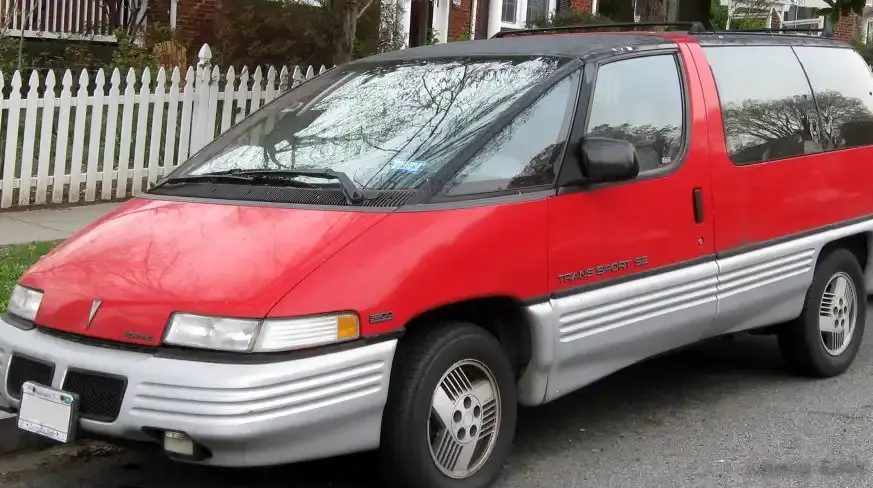
The Pontiac Trans Sport II 3.4 i V6 Long, produced from 1996 to 1999, represented a significant iteration of Pontiac’s foray into the minivan market. Positioned as a more upscale offering within the Trans Sport lineup, this variant featured a 3.4-liter V6 engine paired with a four-speed automatic transmission. It was designed to appeal to families seeking a spacious and comfortable vehicle with a bit more performance than the base models. The Trans Sport II, built on the U-body platform (shared with the Oldsmobile Silhouette, Buick Windstream, and Chevrolet Venture), aimed to compete with established minivan players like the Dodge Caravan and Chrysler Town & Country. This particular configuration, with its larger engine, aimed for a balance between practicality and a more engaging driving experience.
Technical Specifications
| Brand | Pontiac |
| Model | Trans Sport |
| Generation | Trans Sport II |
| Type (Engine) | 3.4 i V6 Long (182 Hp) |
| Start of production | 1996 |
| End of production | 1999 |
| Powertrain Architecture | Internal Combustion engine |
| Body type | Minivan |
| Seats | 5 |
| Doors | 4 |
| Fuel consumption (urban) | 13.1 l/100 km (18 US mpg, 21.6 UK mpg, 7.6 km/l) |
| Fuel consumption (extra urban) | 9.4 l/100 km (25 US mpg, 30.1 UK mpg, 10.6 km/l) |
| Fuel Type | Petrol (Gasoline) |
| Maximum speed | 190 km/h (118.06 mph) |
| Weight-to-power ratio | 9.8 kg/Hp, 101.7 Hp/tonne |
| Weight-to-torque ratio | 6.4 kg/Nm, 155.9 Nm/tonne |
| Power | 182 Hp @ 5200 rpm |
| Power per litre | 54.3 Hp/l |
| Torque | 279 Nm @ 4000 rpm (205.78 lb.-ft. @ 4000 rpm) |
| Engine layout | Front, Transverse |
| Engine displacement | 3350 cm3 (204.43 cu. in.) |
| Number of cylinders | 6 |
| Engine configuration | V-engine |
| Cylinder Bore | 92 mm (3.62 in.) |
| Piston Stroke | 84 mm (3.31 in.) |
| Compression ratio | 9.5:1 |
| Number of valves per cylinder | 2 |
| Fuel injection system | Multi-port manifold injection |
| Engine aspiration | Naturally aspirated engine |
| Engine oil capacity | 4.3 l (4.54 US qt | 3.78 UK qt) |
| Coolant | 11.25 l (11.89 US qt | 9.9 UK qt) |
| Kerb Weight | 1790 kg (3946.27 lbs.) |
| Trunk (boot) space – maximum | 4415 l (155.91 cu. ft.) |
| Fuel tank capacity | 76 l (20.08 US gal | 16.72 UK gal) |
| Length | 5115 mm (201.38 in.) |
| Width | 1845 mm (72.64 in.) |
| Height | 1730 mm (68.11 in.) |
| Wheelbase | 3045 mm (119.88 in.) |
| Front track | 1560 mm (61.42 in.) |
| Rear (Back) track | 1610 mm (63.39 in.) |
| Drivetrain Architecture | The Internal combustion engine (ICE) drives the front wheels of the vehicle. |
| Drive wheel | Front wheel drive |
| Number of gears and type of gearbox | 4 gears, automatic transmission |
| Front suspension | Spring Strut |
| Rear suspension | Torsion |
| Front brakes | Ventilated discs |
| Rear brakes | Drum |
| Assisting systems | ABS (Anti-lock braking system) |
| Steering type | Steering rack and pinion |
| Power steering | Hydraulic Steering |
| Tires size | 205/70 R15 |
Powertrain & Engine Architecture
The heart of the Trans Sport II 3.4 i was the 3.4-liter (3400 cc) 60-degree V6 engine, designated as the L82. This engine belonged to Pontiac’s family of pushrod V6s, known for their relatively simple design and robust construction. It featured a cast iron block and aluminum cylinder heads. The engine utilized a multi-port fuel injection system, delivering fuel directly to each cylinder for improved efficiency and power. The valvetrain employed two valves per cylinder, operated by a single overhead camshaft. The 4L40-E four-speed automatic transmission was the sole transmission option for this variant. This transmission was electronically controlled and offered a relatively smooth shifting experience, though it wasn’t known for particularly sporty performance. The 4L40-E was a common transmission used in many GM vehicles of the era, contributing to its relative reliability and parts availability.
Driving Characteristics
The 182 horsepower and 205 lb-ft of torque provided by the 3.4L V6 and 4L40-E automatic combination resulted in adequate, but not exhilarating, performance. Acceleration from 0 to 60 mph was estimated to be around 9-10 seconds. The automatic transmission’s gear ratios were geared more towards fuel economy and smooth cruising than aggressive acceleration. Compared to the base 3.1-liter V6 Trans Sport, the 3.4-liter offered a noticeable improvement in power, particularly when fully loaded with passengers and cargo. However, it didn’t match the performance of the more expensive and less common Trans Sport models equipped with the supercharged 3.8-liter V6. The ride quality was generally comfortable, typical of a minivan, and the hydraulic power steering provided light and easy maneuverability.
Equipment & Trim Levels
The Trans Sport II 3.4 i V6 Long typically came standard with features such as air conditioning, power windows and locks, an AM/FM stereo with cassette player, and cloth upholstery. Optional extras included a CD player, upgraded sound system, leather upholstery, power driver’s seat, and alloy wheels. The “Long” designation referred to the extended wheelbase version of the Trans Sport, offering increased interior space, particularly in the third row. The interior design was functional and family-oriented, with a focus on practicality and ease of cleaning. Dashboard configuration was fairly standard for the era, with clearly labeled controls and a straightforward instrument cluster.
Chassis & Braking
The Trans Sport II utilized a front-wheel-drive layout with an independent front suspension featuring MacPherson struts and a torsion beam rear suspension. This setup prioritized ride comfort over sporty handling. The front brakes were ventilated discs, providing adequate stopping power, while the rear brakes were drum brakes, a cost-saving measure common in this class of vehicle. Anti-lock braking system (ABS) was standard, enhancing safety by preventing wheel lockup during hard braking. Steering was handled by a rack-and-pinion system with hydraulic power assist, making it easy to maneuver in tight spaces.
Market Reception & Comparison
The Trans Sport II 3.4 i V6 Long was generally well-received by critics as a competent and spacious minivan. However, it wasn’t considered a standout performer in its segment. Fuel economy was rated at around 18 mpg city and 25 mpg highway, which was typical for a minivan of its size and engine displacement. Reliability was generally good, although some owners reported issues with the automatic transmission and the cooling system. Compared to the base 3.1-liter Trans Sport, the 3.4-liter offered a worthwhile performance upgrade for those willing to spend the extra money. However, the supercharged 3.8-liter Trans Sport offered significantly more power, albeit at a higher price point and with potentially higher maintenance costs.
Legacy
The Pontiac Trans Sport II 3.4 i V6 Long, while not a collector’s item, remains a relatively affordable and practical used car option. The 3.4-liter V6 engine, when properly maintained, is known for its durability. However, potential buyers should be aware of potential issues with the 4L40-E automatic transmission, such as slipping or harsh shifting. Parts availability is generally good, as the engine and transmission were used in a wide range of GM vehicles. Today, these minivans are often found as family haulers or work vehicles, appreciated for their spacious interiors and relatively low running costs. The Trans Sport II represents a chapter in Pontiac’s attempt to establish itself in the competitive minivan market, and the 3.4-liter V6 variant offered a solid balance of performance, practicality, and affordability.