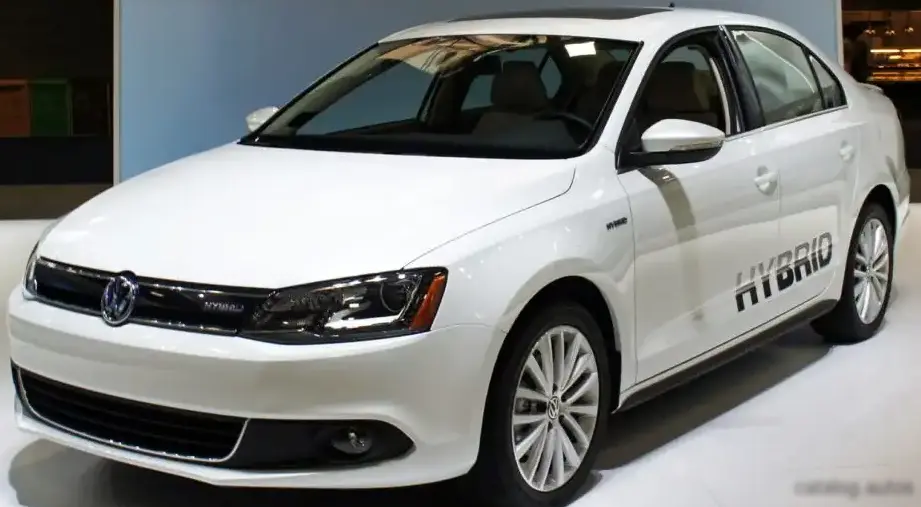
The Volkswagen Jetta VI 1.4 TSI (170 Hp) Hybrid DSG represents Volkswagen’s foray into mainstream hybrid technology within the sixth generation of the Jetta, produced between 2012 and 2014. Positioned as a fuel-efficient and technologically advanced option within the Jetta VI lineup, it aimed to appeal to buyers seeking lower running costs without sacrificing everyday practicality. This variant utilized a combination of a turbocharged gasoline engine and an electric motor, managed by a 7-speed dual-clutch transmission (DSG), to deliver improved fuel economy and reduced emissions compared to traditional gasoline-powered Jettas.
Technical Specifications
| Brand | Volkswagen |
| Model | Jetta |
| Generation | Jetta VI |
| Type (Engine) | 1.4 TSI (170 Hp) Hybrid DSG |
| Start of production | 2012 |
| End of production | 2014 |
| Powertrain Architecture | FHEV (Full Hybrid Electric Vehicle) |
| Body type | Sedan |
| Seats | 5 |
| Doors | 4 |
| Fuel consumption (economy) – urban (NEDC) | 4.4 l/100 km (53.5 US mpg, 64.2 UK mpg, 22.7 km/l) |
| Fuel consumption (economy) – extra urban (NEDC) | 3.9 l/100 km (60.3 US mpg, 72.4 UK mpg, 25.6 km/l) |
| Fuel consumption (economy) – combined (NEDC) | 4.1 l/100 km (57.4 US mpg, 68.9 UK mpg, 24.4 km/l) |
| CO2 emissions (NEDC) | 95 g/km |
| Fuel Type | Petrol (Gasoline) |
| Acceleration 0 – 100 km/h | 8.6 sec |
| Acceleration 0 – 62 mph | 8.6 sec |
| Acceleration 0 – 60 mph | 8.2 sec |
| Maximum speed | 210 km/h (130.49 mph) |
| Emission standard | Euro 6 |
| Weight-to-power ratio | 8.4 kg/Hp, 118.9 Hp/tonne |
| Weight-to-torque ratio | 5.7 kg/Nm, 174.8 Nm/tonne |
| Gross battery capacity | 1.1 kWh |
| Battery voltage | 220 V |
| Battery technology | Lithium-ion (Li-Ion) |
| Battery weight | 36 kg (79.37 lbs) |
| Battery location | Behind the back wall of the passenger cabin |
| Electric motor power | 27 Hp @ 2500 rpm |
| Electric motor location | Between the combustion engine and the transmission |
| System power | 170 Hp |
| Power | 150 Hp @ 5000-6000 rpm |
| Power per litre | 107.5 Hp/l |
| Torque | 250 Nm @ 1600-3500 rpm (184.39 lb.-ft. @ 1600-3500 rpm) |
| Engine layout | Front, Transverse |
| Engine Model/Code | CRJA |
| Engine displacement | 1395 cm3 (85.13 cu. in) |
| Number of cylinders | 4 |
| Engine configuration | Inline |
| Cylinder Bore | 74.5 mm (2.93 in) |
| Piston Stroke | 80 mm (3.15 in) |
| Compression ratio | 10:1 |
| Number of valves per cylinder | 4 |
| Fuel injection system | Direct injection |
| Engine aspiration | Turbocharger, Intercooler |
| Valvetrain | DOHC |
| Engine oil capacity | 4 l (4.23 US qt | 3.52 UK qt) |
| Kerb Weight | 1430 kg (3152.61 lbs) |
| Max. weight | 2020 kg (4453.34 lbs) |
| Max load | 590 kg (1300.73 lbs) |
| Trunk (boot) space – minimum | 374 l (13.21 cu. ft) |
| Fuel tank capacity | 45 l (11.89 US gal | 9.9 UK gal) |
| Max. roof load | 75 kg (165.35 lbs) |
| Length | 4644 mm (182.83 in) |
| Width | 1778 mm (70 in) |
| Width including mirrors | 2020 mm (79.53 in) |
| Height | 1482 mm (58.35 in) |
| Wheelbase | 2651 mm (104.37 in) |
| Front track | 1535 mm (60.43 in) |
| Rear (Back) track | 1538 mm (60.55 in) |
| Ride height (ground clearance) | 134 mm (5.28 in) |
| Minimum turning circle (turning diameter) | 11.1 m (36.42 ft) |
| Drivetrain Architecture | The Internal combustion engine (ICE) and electric motor drive the front wheels of the car with the ability to work in full electric or mixed mode. |
| Drive wheel | Front wheel drive |
| Number of gears and type of gearbox | 7 gears, automatic transmission DSG |
| Front suspension | Coil spring, Wishbone, Transverse stabilizer |
| Rear suspension | Independent multi-link suspension, Transverse stabilizer |
| Front brakes | Ventilated discs |
| Rear brakes | Disc |
| Assisting systems | ABS (Anti-lock braking system) |
| Steering type | Steering rack and pinion |
| Power steering | Electric Steering |
| Tires size | 195/65 R15 |
| Wheel rims size | 6J x 15 |
INTRODUCTION
The Volkswagen Jetta VI 1.4 TSI Hybrid DSG, launched in 2012, was a key component of Volkswagen’s strategy to broaden the appeal of the Jetta VI (produced from 2011-2018) by offering a more fuel-efficient alternative. Built on the A6 platform (shared with models like the Audi A3 and Volkswagen Golf), the Jetta VI aimed to balance comfort, practicality, and modern technology. The hybrid variant specifically targeted environmentally conscious consumers in both North America and Europe, where fuel prices and emissions regulations were becoming increasingly stringent. It represented Volkswagen’s initial steps towards wider electrification of its mainstream models.
Powertrain & Engine Architecture
At the heart of the Jetta Hybrid lies the CRJA engine code, a 1.4-liter turbocharged, direct-injection four-cylinder gasoline engine. This engine produces 150 horsepower, coupled with an electric motor generating an additional 27 horsepower. The combined system output is 170 horsepower. The engine utilizes a Miller cycle combustion process, which improves efficiency by reducing pumping losses. Direct injection ensures precise fuel delivery, while the turbocharger provides increased power output. The electric motor is integrated between the engine and the 7-speed DSG dual-clutch transmission. This configuration allows for electric-only driving at low speeds and assists the gasoline engine during acceleration. The 1.1 kWh lithium-ion battery pack is located behind the rear seats. The DSG transmission is crucial to the hybrid system’s efficiency, offering quick and smooth gear changes and enabling regenerative braking to recapture energy during deceleration.
Driving Characteristics
The Jetta VI 1.4 TSI Hybrid DSG delivers a noticeably different driving experience compared to its gasoline-only counterparts. While not a performance-oriented vehicle, the combined power output provides adequate acceleration for everyday driving. The electric motor provides instant torque, enhancing responsiveness at lower speeds. The DSG transmission contributes to smooth and efficient gear changes. However, the hybrid system adds weight, which slightly impacts handling agility. The steering feels precise, but the suspension is tuned for comfort rather than sporty handling. In real-world conditions, the hybrid system excels in city driving, where the electric motor can operate frequently, resulting in significant fuel savings. On the highway, the gasoline engine takes over more often, but the hybrid system still contributes to improved fuel economy compared to conventional Jetta models. The transition between electric and gasoline power is generally seamless, although some drivers may notice a slight shift in engine sound and vibration.
Equipment & Trim Levels
The Jetta Hybrid was typically offered with a well-equipped trim level, often positioned as a mid-range offering. Standard features generally included alloy wheels, automatic climate control, a touchscreen infotainment system, Bluetooth connectivity, and a rearview camera. Safety features such as ABS, stability control, and multiple airbags were also standard. Optional extras included a premium sound system, leather upholstery, and a sunroof. The interior design was functional and modern, with a focus on ergonomics and ease of use. The hybrid-specific instrumentation included displays showing energy flow and battery charge levels. The overall interior ambiance was similar to other Jetta VI models, but with unique hybrid-themed accents.
Chassis & Braking
The Jetta VI Hybrid utilizes a front-wheel-drive layout with a MacPherson strut front suspension and a multi-link rear suspension. The suspension is tuned for comfort and ride quality, providing a smooth and controlled ride. The braking system consists of ventilated front discs and solid rear discs, equipped with ABS and electronic brake-force distribution. The regenerative braking system captures energy during deceleration, converting it into electricity to recharge the battery. The steering is a rack-and-pinion system with electric power assistance, providing precise and responsive steering feel. The chassis is reinforced to accommodate the added weight of the hybrid components, ensuring structural integrity and handling stability.
Market Reception & Comparison
The Jetta Hybrid received generally positive reviews from automotive critics. It was praised for its fuel efficiency, smooth ride, and well-equipped interior. However, some critics noted that its performance was not as engaging as some of its competitors, and the added weight of the hybrid system slightly impacted handling. Compared to the standard 1.8T Jetta, the Hybrid offered significantly better fuel economy, but at a slightly higher price point. Compared to other hybrid sedans on the market, such as the Toyota Prius, the Jetta Hybrid offered a more conventional driving experience and a more upscale interior. Reliability reports have been generally positive, with few major issues reported with the hybrid system itself. However, like any vehicle, regular maintenance is essential to ensure long-term reliability.
Legacy
The Volkswagen Jetta VI 1.4 TSI Hybrid DSG played a significant role in Volkswagen’s early adoption of hybrid technology. While it wasn’t a massive sales success, it demonstrated Volkswagen’s commitment to fuel efficiency and environmental responsibility. The technology and lessons learned from the Jetta Hybrid paved the way for Volkswagen’s subsequent development of more advanced hybrid and electric vehicles. In the used car market today, the Jetta Hybrid remains a viable option for buyers seeking a fuel-efficient and reliable sedan. Its relatively low running costs and well-equipped interior make it an attractive choice, particularly for those who prioritize fuel economy and environmental consciousness. However, potential buyers should be aware of the potential for battery degradation over time and ensure that the hybrid system is properly maintained.