
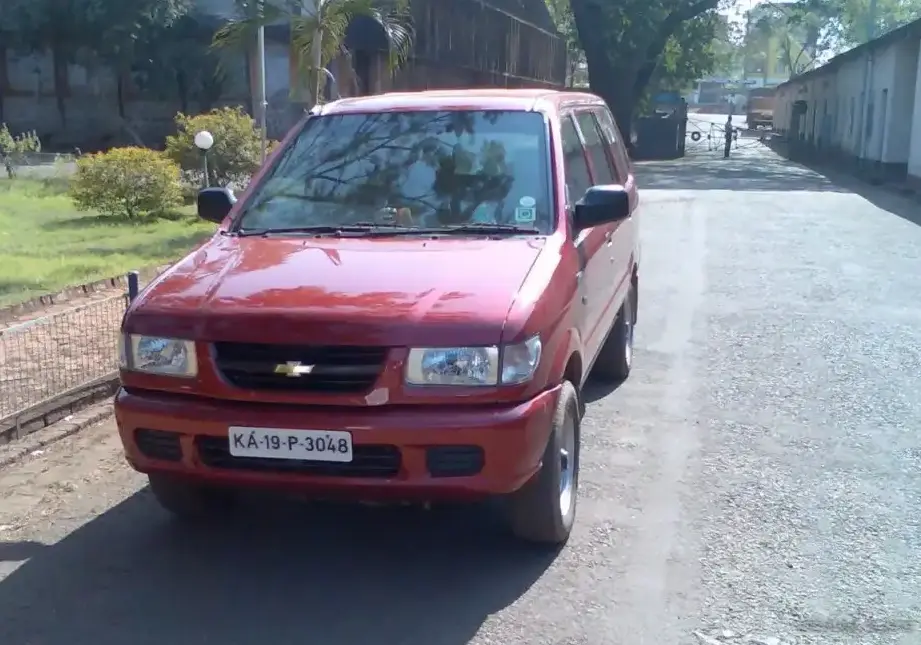
The Chevrolet Tavera 2.2i (117 hp) Automatic, produced from 2002 to 2017, represented a significant offering in the Indian market for a spacious, affordable, and relatively comfortable people carrier. Positioned as a mid-range trim within the Tavera lineup, it catered to families and commercial operators needing a seven or eight-seater vehicle. The Tavera itself was based on the Isuzu Rodeo platform, a collaboration between General Motors and Isuzu, and was primarily designed for the unique demands of the Indian transportation landscape. This variant, with its 2.2-liter petrol engine and four-speed automatic transmission, aimed to provide a more convenient driving experience compared to the standard manual transmission options.
Technical Specifications
| Brand | Chevrolet |
| Model | Tavera |
| Generation | Tavera |
| Type (Engine) | 2.2i (117 Hp) Automatic |
| Start of production | 2002 |
| End of production | 2017 |
| Powertrain Architecture | Internal Combustion engine |
| Body type | Minivan |
| Seats | 7-8 |
| Doors | 5 |
| Fuel Type | Petrol (Gasoline) |
| Power | 117 Hp @ 5000 rpm |
| Power per litre | 53.4 Hp/l |
| Torque | 183 Nm @ 3600 rpm |
| Torque (lb-ft) | 134.97 lb.-ft. @ 3600 rpm |
| Engine layout | Front, Longitudinal |
| Engine displacement | 2190 cm3 |
| Engine displacement (cu. in.) | 133.64 cu. in. |
| Number of cylinders | 4 |
| Engine configuration | Inline |
| Cylinder Bore | 89 mm |
| Cylinder Bore (in.) | 3.5 in. |
| Piston Stroke | 88 mm |
| Piston Stroke (in.) | 3.46 in. |
| Compression ratio | 9:1 |
| Number of valves per cylinder | 2 |
| Fuel injection system | Multi-port manifold injection |
| Engine aspiration | Naturally aspirated engine |
| Drivetrain Architecture | Rear wheel drive |
| Number of gears and type of gearbox | 4 gears, automatic transmission |
| Front suspension | Torsion |
| Rear suspension | Leaf spring |
| Front brakes | Disc |
| Rear brakes | Drum |
| Power steering | Hydraulic Steering |
Powertrain & Engine Architecture
The heart of the Tavera 2.2i Automatic was the 4ZE1 2.2-liter inline-four cylinder petrol engine. This engine, developed by Isuzu and used under license by Chevrolet, was a relatively simple design featuring a cast iron block and an aluminum cylinder head. It employed a multi-port fuel injection system, delivering fuel to each cylinder individually for improved efficiency and responsiveness. The engine utilized a single overhead camshaft (SOHC) design with two valves per cylinder. The 4ZE1 engine was known for its durability and relatively low maintenance requirements, characteristics valued in the Indian market. The four-speed automatic transmission, while providing convenience, was a somewhat dated design by the 2000s. It lacked the smoothness and efficiency of more modern automatic gearboxes, but it was robust and well-suited to the Tavera’s intended use. The transmission was electronically controlled, offering a ‘Drive’ and ‘Overdrive’ mode, along with a manual shift option.
Driving Characteristics
The Tavera 2.2i Automatic offered a noticeable step up in driving ease compared to the manual transmission versions. However, the 117 hp output and the four-speed automatic meant that performance was modest. Acceleration was adequate for city driving and highway cruising, but overtaking required careful planning. The automatic transmission’s gear ratios were spaced to prioritize fuel economy and drivability over outright performance. The rear-wheel-drive configuration provided a stable feel, but the leaf spring rear suspension could result in a somewhat bumpy ride, especially when the vehicle was fully loaded. Compared to the more powerful diesel variants of the Tavera, the 2.2i Automatic felt significantly less responsive, particularly when climbing hills or carrying a full passenger load. The automatic transmission also contributed to slightly lower fuel economy compared to the manual versions.
Equipment & Trim Levels
The 2.2i Automatic trim level typically included features such as power steering, air conditioning, and basic instrumentation. Interior upholstery was usually vinyl or a durable cloth material. Higher-spec versions could be equipped with optional extras like power windows, central locking, and an aftermarket audio system. The dashboard layout was functional and straightforward, prioritizing practicality over aesthetics. The Tavera was not designed to be a luxury vehicle; its focus was on providing a reliable and affordable transportation solution. The automatic transmission was often bundled with a slightly higher trim level, offering a more comfortable and convenient experience for passengers.
Chassis & Braking
The Tavera’s chassis was a body-on-frame construction, providing a robust and durable platform. The front suspension utilized a torsion bar setup, while the rear suspension employed leaf springs. This combination offered a reasonable balance between ride comfort and load-carrying capacity. The braking system consisted of disc brakes on the front wheels and drum brakes on the rear. Hydraulic power steering was standard, making maneuvering the large vehicle easier, especially in urban environments. The braking performance was adequate for the vehicle’s weight and intended use, but it lacked the stopping power of more modern braking systems.
Market Reception & Comparison
The Chevrolet Tavera 2.2i Automatic received mixed reviews. Critics praised its spacious interior, affordability, and the convenience of the automatic transmission. However, the engine’s modest power output and the transmission’s dated design were often criticized. Compared to the diesel-powered Tavera variants, the 2.2i Automatic offered less fuel efficiency and lower torque. The diesel models were generally preferred by commercial operators due to their lower running costs. However, the petrol automatic appealed to private buyers who prioritized driving comfort and convenience. The Tavera competed with other MPVs in the Indian market, such as the Toyota Innova and the Mahindra Xylo, but it typically offered a lower price point.
Legacy
The Chevrolet Tavera, including the 2.2i Automatic variant, enjoyed a relatively long production run in India. While it wasn’t known for groundbreaking innovation, it established itself as a reliable and practical people carrier. The 4ZE1 engine proved to be durable and relatively easy to maintain, contributing to the Tavera’s longevity. In the used car market, the Tavera 2.2i Automatic remains a popular choice for those seeking an affordable and spacious vehicle. However, potential buyers should be aware of the age of the vehicle and the potential for wear and tear on the automatic transmission. Parts availability is generally good, but finding qualified mechanics familiar with the older Isuzu-derived engine may require some effort.
