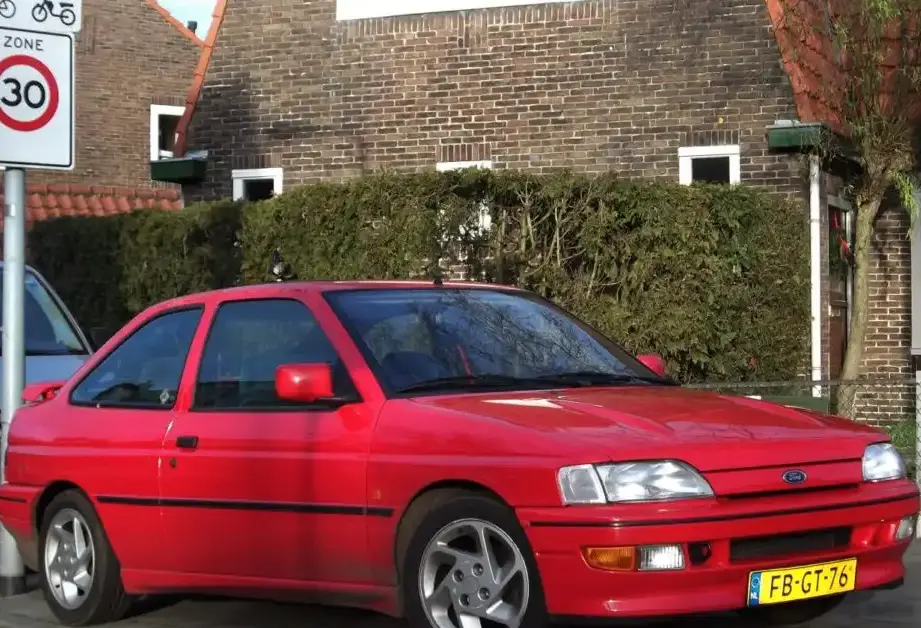
The Ford Escort V (GAL) 1.6, produced between 1990 and 1992, represented a significant evolution of Ford’s popular compact car. Positioned as a mid-range offering within the fifth generation Escort lineup, the 1.6-liter, 105 horsepower variant aimed to balance performance with affordability. This generation, known internally as the GAL project, was a crucial model for Ford in Europe, offering a practical and relatively modern package in the competitive small family car segment. The Escort V saw updates to styling, interior comfort, and mechanical components compared to its predecessor, solidifying its position as a best-seller in several European markets.
Technical Specifications
| Brand | Ford |
| Model | Escort |
| Generation | Escort V (GAL) |
| Type (Engine) | 1.6 (105 Hp) |
| Start of production | 1990 |
| End of production | 1992 |
| Powertrain Architecture | Internal Combustion engine |
| Body type | Hatchback |
| Seats | 5 |
| Doors | 3/5 |
| Fuel consumption (urban) | 9.8 l/100 km (24 US mpg, 28.8 UK mpg, 10.2 km/l) |
| Fuel consumption (extra urban) | 5.9 l/100 km (39.9 US mpg, 47.9 UK mpg, 16.9 km/l) |
| Fuel consumption (combined) | 7.7 l/100 km (30.5 US mpg, 36.7 UK mpg, 13 km/l) |
| Fuel Type | Petrol (Gasoline) |
| Acceleration 0 – 100 km/h | 10.6 sec |
| Acceleration 0 – 62 mph | 10.6 sec |
| Acceleration 0 – 60 mph | 10.1 sec |
| Maximum speed | 186 km/h (115.58 mph) |
| Weight-to-power ratio | 10 kg/Hp, 100 Hp/tonne |
| Weight-to-torque ratio | 7.8 kg/Nm, 128.6 Nm/tonne |
| Power | 105 Hp @ 6000 rpm |
| Power per litre | 65.6 Hp/l |
| Torque | 135 Nm @ 2800 rpm (99.57 lb.-ft. @ 2800 rpm) |
| Engine layout | Front, Transverse |
| Engine Model/Code | LJF |
| Engine displacement | 1600 cm3 (97.64 cu. in.) |
| Number of cylinders | 4 |
| Cylinder Bore | 80 mm (3.15 in.) |
| Piston Stroke | 79 mm (3.11 in.) |
| Compression ratio | 9:1 |
| Number of valves per cylinder | 2 |
| Fuel injection system | Multi-port manifold injection |
| Engine aspiration | Naturally aspirated engine |
| Valvetrain | ohc |
| Engine oil capacity | 3.5 l (3.7 US qt | 3.08 UK qt) |
| Coolant | 7.9 l (8.35 US qt | 6.95 UK qt) |
| Kerb Weight | 1050 kg (2314.85 lbs.) |
| Max. weight | 1650 kg (3637.63 lbs.) |
| Max load | 600 kg (1322.77 lbs.) |
| Trunk (boot) space – minimum | 380 l (13.42 cu. ft.) |
| Trunk (boot) space – maximum | 735 l (25.96 cu. ft.) |
| Fuel tank capacity | 55 l (14.53 US gal | 12.1 UK gal) |
| Length | 4036 mm (158.9 in.) |
| Width | 1692 mm (66.61 in.) |
| Height | 1395 mm (54.92 in.) |
| Wheelbase | 2525 mm (99.41 in.) |
| Front track | 1439 mm (56.65 in.) |
| Rear (Back) track | 1462 mm (57.56 in.) |
| Minimum turning circle | 10 m (32.81 ft.) |
| Drivetrain Architecture | Front wheel drive |
| Drive wheel | Front wheel drive |
| Number of gears | 5 gears, manual transmission |
| Front brakes | Ventilated discs |
| Rear brakes | Drum |
| Steering type | Steering rack and pinion |
| Power steering | Hydraulic Steering |
| Tires size | 175/70 R13; 185/60 R14 |
Powertrain & Engine Architecture
The heart of the Escort V 1.6 was the Ford LJF engine, a 1.6-liter inline-four cylinder gasoline engine. This engine utilized a naturally aspirated configuration with a single overhead camshaft (SOHC) valvetrain operating two valves per cylinder. The LJF engine featured multi-port fuel injection, a significant upgrade from earlier carburetor-equipped Escorts, contributing to improved fuel efficiency and smoother power delivery. The 9:1 compression ratio was typical for the era, balancing performance and the ability to run on readily available fuel grades. The engine produced 105 horsepower at 6000 rpm and 135 Nm (99.57 lb-ft) of torque at 2800 rpm. The engine was transversely mounted, driving the front wheels. The standard transmission was a five-speed manual gearbox, although a three-speed automatic transmission was also available, albeit less common.
Driving Characteristics
The 1.6-liter Escort offered a respectable, if not exhilarating, driving experience. With 105 horsepower, acceleration to 60 mph took around 10.1 seconds, and it reached a top speed of 115.58 mph. Compared to the more powerful 1.8-liter and especially the sporty XR3i models, the 1.6 felt less urgent. However, it provided adequate power for everyday driving and highway cruising. The five-speed manual transmission allowed drivers to keep the engine in its optimal power band, while the optional automatic, though convenient, resulted in some power loss and a less engaging driving experience. The gear ratios were tuned for a balance of fuel economy and usability, prioritizing mid-range torque over peak horsepower. The steering was light and precise, making the Escort easy to maneuver in urban environments.
Equipment & Trim Levels
The 1.6-liter Escort typically came equipped with a reasonable level of standard features. Base models included features like central locking, power steering, and a basic stereo system. Interior upholstery was typically cloth, with a durable and practical design. Higher trim levels, such as the LX, added features like electric windows, upgraded upholstery, and alloy wheels. Optional extras included a sunroof, metallic paint, and more advanced audio systems. The dashboard layout was functional and straightforward, with clearly labeled controls. The 3/5 door configuration offered flexibility in terms of passenger and cargo space.
Chassis & Braking
The Escort V utilized a MacPherson strut front suspension and a semi-independent twist beam rear suspension. This setup provided a comfortable ride quality while maintaining reasonable handling characteristics. Front brakes were ventilated discs, offering good stopping power, while rear brakes were drums, a cost-saving measure common in this class of vehicle. The hydraulic power steering provided light and easy steering, enhancing maneuverability. Tire sizes varied depending on the trim level, with 175/70 R13 and 185/60 R14 being common options. Stabilizer bars were fitted to improve body roll during cornering.
Market Reception & Comparison
The Escort V 1.6 was generally well-received by automotive critics as a practical and affordable family car. It was praised for its fuel efficiency, comfortable ride, and spacious interior. However, some critics noted that the engine lacked the punch of its larger counterparts. Compared to the 1.8-liter version, the 1.6 offered slightly better fuel economy but less performance. The 1.6 was also a more sensible choice than the performance-oriented XR3i, appealing to buyers who prioritized practicality and economy over outright speed. Reliability was generally good, although routine maintenance was essential to prevent issues with the fuel injection system and cooling system.
Legacy
The Ford Escort V 1.6 remains a popular choice among classic car enthusiasts and budget-conscious buyers. The LJF engine, while not particularly powerful, is known for its durability and relative simplicity, making it relatively easy to maintain. Parts availability is generally good, although some components may be becoming increasingly scarce. Today, well-maintained examples of the Escort V 1.6 can be found for relatively low prices, making them an attractive option for those seeking a classic Ford with reasonable running costs. The Escort V, and the 1.6 variant specifically, represents a significant chapter in Ford’s history, embodying the company’s commitment to producing affordable and reliable transportation for the masses.