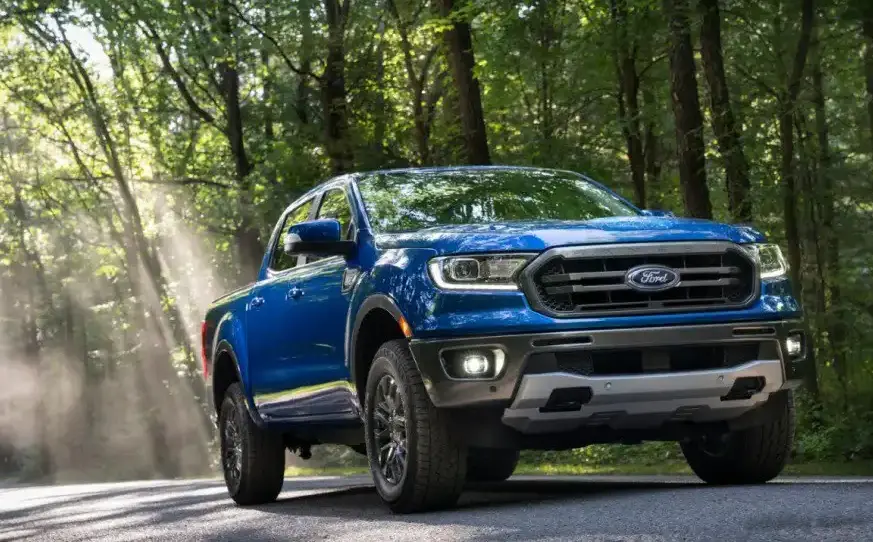
The Ford Ranger III Double Cab, specifically the facelifted version introduced in January 2019 and produced through 2022, represented a significant evolution of Ford’s mid-size pickup truck for the global market. This iteration, built on the T6 platform, aimed to blend rugged capability with modern comfort and technology. The 2.0 EcoBlue 213 horsepower, four-wheel drive variant occupied a strong position in the lineup, offering a balance between performance, fuel efficiency, and towing capacity. It was primarily marketed towards buyers needing a versatile vehicle for both work and family use, and was a key offering in markets outside of North America where the Ranger was a consistently popular choice.
Technical Specifications
| Brand | Ford |
| Model | Ranger |
| Generation | Ranger III Double Cab (facelift 2019) |
| Type (Engine) | 2.0 EcoBlue (213 Hp) 4×4 |
| Start of production | January, 2019 |
| End of production | 2022 |
| Powertrain Architecture | Internal Combustion engine |
| Body type | Pick-up |
| Seats | 5 |
| Doors | 4 |
| Fuel consumption (combined) | 7.8-7.9 l/100 km (30.2 – 29.8 US mpg, 36.2 – 35.8 UK mpg, 12.8 – 12.7 km/l) |
| CO2 emissions | 203-208 g/km |
| Fuel Type | Diesel |
| Acceleration 0 – 100 km/h | 10.1 sec |
| Acceleration 0 – 62 mph | 10.1 sec |
| Acceleration 0 – 60 mph | 9.6 sec |
| Maximum speed | 180 km/h (111.85 mph) |
| Emission standard | Euro 6d-TEMP |
| Weight-to-power ratio | 10.4 kg/Hp, 96.2 Hp/tonne |
| Weight-to-torque ratio | 4.4 kg/Nm, 225.8 Nm/tonne |
| Power | 213 Hp |
| Power per litre | 106.7 Hp/l |
| Torque | 500 Nm (368.78 lb.-ft.) |
| Engine displacement | 1997 cm3 (121.86 cu. in.) |
| Number of cylinders | 4 |
| Engine configuration | Inline |
| Number of valves per cylinder | 4 |
| Fuel injection system | Diesel Commonrail |
| Engine aspiration | BiTurbo, Intercooler |
| Engine oil capacity | 8.1 l (8.56 US qt | 7.13 UK qt) |
| Coolant | 12.2 l (12.89 US qt | 10.73 UK qt) |
| Kerb Weight | 2214-2226 kg (4881.03 – 4907.49 lbs.) |
| Max. weight | 3270 kg (7209.12 lbs.) |
| Max load | 1044-1056 kg (2301.63 – 2328.08 lbs.) |
| Fuel tank capacity | 80 l (21.13 US gal | 17.6 UK gal) |
| AdBlue tank | 20 l (5.28 US gal | 4.4 UK gal) |
| Permitted trailer load with brakes (12%) | 3500 kg (7716.18 lbs.) |
| Permitted trailer load without brakes | 750 kg (1653.47 lbs.) |
| Length | 5359 mm (210.98 in.) |
| Width | 1867 mm (73.5 in.) |
| Width with mirrors folded | 1977 mm (77.83 in.) |
| Width including mirrors | 2163 mm (85.16 in.) |
| Height | 1821-1848 mm (71.69 – 72.76 in.) |
| Wheelbase | 3220 mm (126.77 in.) |
| Front track | 1560 mm (61.42 in.) |
| Rear (Back) track | 1560 mm (61.42 in.) |
| Ride height (ground clearance) | 237 mm (9.33 in.) |
| Minimum turning circle | 12.7 m (41.67 ft.) |
| Approach angle | 29.0° |
| Departure angle | 27.0° |
| Ramp-over angle | 25.0° |
| Climb angle | 35.0° |
| Wading depth | 800 mm (31.5 in.) |
| Drive wheel | All wheel drive (4×4) |
| Number of gears and type of gearbox | 6 gears, manual transmission |
| Front brakes | Disc |
| Rear brakes | Drum |
| Assisting systems | ABS (Anti-lock braking system) |
| Tires size | 265/65 R17; 265/60 R18 |
| Wheel rims size | 8J x 17; 8J x 18 |
INTRODUCTION
The 2019-2022 Ford Ranger III Double Cab 2.0 EcoBlue 4×4 represents a key offering in Ford’s global mid-size pickup strategy. Following the facelift of the T6 platform, this variant combined a relatively modern diesel engine with a six-speed manual transmission and a four-wheel drive system. Positioned as a mid-range option, it sat above the base models with smaller engines and lower equipment levels, but below the higher-output bi-turbo variants and premium trim packages. This configuration was particularly popular in Europe, Australia, and South Africa, where diesel-powered pickups are a dominant force in the market.
Powertrain & Engine Architecture
At the heart of this Ranger variant lies the 2.0-liter EcoBlue turbodiesel engine. This engine, part of Ford’s EcoBoost engine family (though diesel, it shares the efficiency focus), utilizes a sophisticated common-rail direct injection system and a sequential twin-turbocharger setup. The two turbochargers work in tandem – a smaller turbo provides quick response at low engine speeds, while a larger turbo delivers increased power at higher RPMs. This configuration helps to mitigate turbo lag and provide a broad, usable torque curve. The engine features a cast iron block and aluminum cylinder head, contributing to its durability. The 2.0 EcoBlue engine is identified by engine codes such as YP417. The six-speed manual transmission, while not the most technologically advanced, is known for its robustness and relatively simple maintenance. It’s a conventional gearbox with synchromesh on all forward gears and reverse.
Driving Characteristics
The 213 horsepower and 500 Nm (368 lb-ft) of torque delivered by the 2.0 EcoBlue engine, coupled with the six-speed manual transmission, provide a respectable, if not exhilarating, driving experience. Acceleration from 0-60 mph takes around 9.6 seconds, which is competitive within its class. The engine’s strong low-end torque makes it well-suited for towing and hauling, and the manual transmission allows for precise control over gear selection. Compared to the higher-output bi-turbo versions, this variant feels less urgent in its acceleration, but offers better fuel economy. The manual gearbox also provides a more engaging driving experience for those who prefer it over an automatic. The 4×4 system offers a selectable transfer case, allowing drivers to switch between 2H (two-wheel drive), 4H (four-wheel drive high), and 4L (four-wheel drive low) depending on the terrain and driving conditions.
Equipment & Trim Levels
The 2.0 EcoBlue 4×4 Double Cab typically came equipped with a reasonable level of standard features. These generally included air conditioning, power windows and locks, a basic audio system with Bluetooth connectivity, and steel wheels. Higher trim levels, often denoted by names like “Limited” or “Wildtrack,” added features such as alloy wheels, a more advanced infotainment system with touchscreen display, navigation, parking sensors, and a rearview camera. Interior upholstery was typically cloth, with leather options available on higher trims. Optional extras could include a tow package, bed liner, and various styling accessories.
Chassis & Braking
The Ranger III Double Cab utilizes a body-on-frame construction, providing a robust and durable platform for off-road driving and heavy loads. The front suspension consists of independent double wishbones with coil springs and stabilizer bar, while the rear suspension employs leaf springs. The braking system features disc brakes on the front wheels and drum brakes on the rear wheels. ABS (Anti-lock Braking System) is standard. The rear drum brakes were a cost-saving measure on this variant, and are a point of differentiation from higher-spec models which often featured rear discs. Stabilizer bar thickness varied depending on the trim level, with higher trims often receiving a thicker bar for improved handling.
Market Reception & Comparison
The 2.0 EcoBlue 4×4 Double Cab Ranger was generally well-received by automotive critics. It was praised for its fuel efficiency, comfortable ride, and capable four-wheel drive system. However, some reviewers noted that the engine could feel strained when fully loaded or climbing steep hills. Compared to the higher-output bi-turbo versions, this variant offered a more affordable entry point into the Ranger lineup, but at the expense of some performance. Its fuel economy, averaging around 30 mpg, was a significant selling point, particularly in regions with high fuel prices. Compared to competitors like the Toyota Hilux and Nissan Navara, the Ranger offered a more modern interior and a more refined driving experience.
Legacy
The 2.0 EcoBlue engine has proven to be a relatively reliable powertrain, although like any diesel engine, it requires regular maintenance and proper servicing. Common issues include diesel particulate filter (DPF) clogging, particularly with frequent short trips, and potential problems with the fuel injection system. On the used car market, these Rangers represent a good value proposition, offering a capable and versatile pickup truck at a reasonable price. The availability of parts and service is generally good, and the robust construction of the T6 platform ensures that these vehicles can provide many years of reliable service with proper care. The 2.0 EcoBlue engine, in its various iterations, continues to be used in Ford’s commercial vehicle lineup, demonstrating its ongoing relevance and durability.