
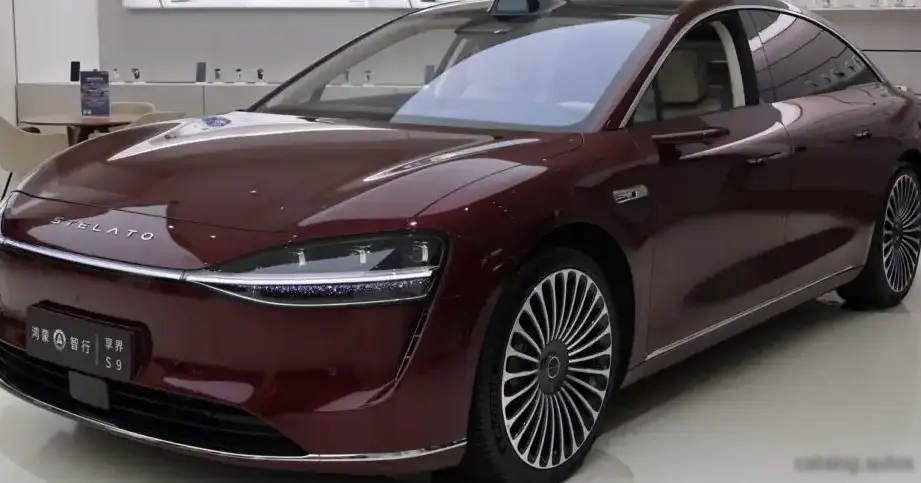
The Stelato S9 1.5T 53.4 kWh (309 Hp) Extended Range Hybrid is a plug-in hybrid electric vehicle (PHEV) sedan introduced in April 2025. Positioned as a technologically advanced offering within the Stelato lineup, the S9 represents the brand’s entry into the competitive extended-range EV market. It’s built on a dedicated EV platform designed to maximize interior space and efficiency, targeting consumers seeking a blend of electric driving with the reassurance of a gasoline-powered range extender. The S9 is a four-door, five-seat sedan, and is primarily aimed at the Chinese market, adhering to China VI b emission standards.
Technical Specifications
| Brand | Stelato |
| Model | S9 |
| Generation | S9 |
| Type (Engine) | 1.5T 53.4 kWh (309 Hp) Extended Range Hybrid |
| Start of production | April, 2025 |
| Powertrain Architecture | PHEV (Plug-in Hybrid Electric Vehicle) |
| Body type | Sedan |
| Seats | 5 |
| Doors | 4 |
| Fuel consumption (economy) – combined (WLTC) | 0.25-5.93 l/100 km (940.9 – 39.7 US mpg, 1129.9 – 47.6 UK mpg, 400 – 16.9 km/l) |
| Fuel Type | Petrol / electricity |
| Acceleration 0 – 100 km/h | 7.3 sec |
| Acceleration 0 – 62 mph | 7.3 sec |
| Acceleration 0 – 60 mph | 6.9 sec |
| Maximum speed | 202 km/h (125.52 mph) |
| Emission standard | China VI b |
| Weight-to-power ratio | 7.6 kg/Hp, 131.5 Hp/tonne |
| Weight-to-torque ratio | 7.3 kg/Nm, 136.2 Nm/tonne |
| Gross battery capacity | 53.4 kWh |
| Battery voltage | 400 V |
| Battery technology | Lithium iron phosphate (LiFePO4) |
| All-electric range (WLTC) | 290 km (180.2 mi) |
| Average Energy consumption (WLTC) | 18.4 kWh/100 km (29.61 kWh/100 mi, 114 MPGe, 5.4 km/kWh, 3.4 mi/kWh) |
| Electric motor power | 309 Hp |
| Electric motor Torque | 320 Nm (236.02 lb.-ft.) |
| Electric motor model/code | TZ210XYAP4 |
| Electric motor location | Rear axle, Transverse |
| Electric motor type | Synchronous |
| System power | 309 Hp |
| System torque | 320 Nm (236.02 lb.-ft.) |
| Power | 160 Hp |
| Power per litre | 106.8 Hp/l |
| Engine layout | Front, Transverse |
| Engine Model/Code | A156T2H |
| Engine displacement | 1498 cm3 (91.41 cu. in.) |
| Number of cylinders | 4 |
| Engine configuration | Inline |
| Number of valves per cylinder | 4 |
| Fuel injection system | Direct injection |
| Engine aspiration | Turbocharger, Intercooler |
| Valvetrain | DOHC |
| Kerb Weight | 2350 kg (5180.86 lbs.) |
| Max. weight | 2755 kg (6073.74 lbs.) |
| Max load | 405 kg (892.87 lbs.) |
| Trunk (boot) space – minimum | 375 l (13.24 cu. ft.) |
| Fuel tank capacity | 52 l (13.74 US gal | 11.44 UK gal) |
| Length | 5160 mm (203.15 in.) |
| Width | 2005 mm (78.94 in.) |
| Height | 1486 mm (58.5 in.) |
| Wheelbase | 3050 mm (120.08 in.) |
| Front track | 1706 mm (67.17 in.) |
| Rear (Back) track | 1738 mm (68.43 in.) |
| Drag coefficient (Cd) | 0.193 |
| Approach angle | 13° |
| Departure angle | 15° |
| Drivetrain Architecture | The Internal combustion engine (ICE) drives the generator only, with no mechanical connection to the drive. An electric motor drives the rear wheels. |
| Drive wheel | Rear wheel drive |
| Number of gears and type of gearbox | 1 gears, automatic transmission |
| Front suspension | Double wishbone, Transverse stabilizer, Air suspension |
| Rear suspension | Independent multi-link suspension, Air suspension, Transverse stabilizer |
| Front brakes | Ventilated discs |
| Rear brakes | Ventilated discs |
| Assisting systems | ABS (Anti-lock braking system) |
| Steering type | Steering rack and pinion |
| Power steering | Electric Steering |
| Tires size | 245/45 R20; 255/40 R21 |
| Wheel rims size | 20; 21 |
Powertrain & Engine Architecture
The Stelato S9 utilizes a sophisticated plug-in hybrid powertrain. The core of the system is a 1.5-liter turbocharged inline-four cylinder gasoline engine (code A156T2H) producing 160 horsepower. This engine doesn’t directly drive the wheels; instead, it functions as a generator to charge the 53.4 kWh lithium iron phosphate (LiFePO4) battery pack. The electric motor, a synchronous unit (TZ210XYAP4) located on the rear axle, delivers 309 horsepower and 320 Nm (236 lb-ft) of torque. The combined system output is also rated at 309 horsepower. The engine features direct fuel injection and a double overhead camshaft (DOHC) valvetrain. The single-speed automatic transmission is dedicated to the electric motor, optimizing efficiency and providing seamless acceleration. The battery pack operates at 400V.
Driving Characteristics
The S9’s driving experience is heavily influenced by its electric powertrain. In pure electric mode, the vehicle offers brisk acceleration and near-silent operation. The rear-wheel drive configuration contributes to a balanced feel, although the substantial weight (2350 kg / 5180.86 lbs) is noticeable. When the gasoline engine engages to act as a generator, it does so relatively seamlessly, though a slight change in engine note is perceptible. The single-speed transmission provides linear power delivery, but lacks the gear changes found in traditional automatic transmissions. Compared to potential variants with larger gasoline engines, the S9 prioritizes efficiency and refinement over outright performance. The 0-60 mph time of 6.9 seconds is respectable, but not particularly sporty.
Equipment & Trim Levels
Specific trim levels and standard equipment for the S9 are still emerging, but generally, the vehicle is well-equipped. Standard features are expected to include a large touchscreen infotainment system, advanced driver-assistance systems (ADAS) such as adaptive cruise control and lane-keeping assist, and premium interior materials. Interior upholstery is likely to be a combination of leatherette and fabric in base models, with full leather options available on higher trims. Optional extras may include a panoramic sunroof, upgraded audio system, and ventilated front seats. The S9 is designed to offer a comfortable and technologically advanced cabin experience.
Chassis & Braking
The S9 features a double wishbone suspension setup at the front and an independent multi-link suspension at the rear, both incorporating air suspension for improved ride comfort and adjustability. Transverse stabilizers are included on both axles to minimize body roll during cornering. Braking duties are handled by ventilated discs on all four wheels, coupled with an anti-lock braking system (ABS). The air suspension allows for ride height adjustment, enhancing both comfort and ground clearance. The steering system is a rack and pinion setup with electric power assistance.
Market Reception & Comparison
As a relatively new entrant to the market, the Stelato S9’s reception is still developing. Early reviews highlight its impressive electric range, comfortable ride, and advanced technology. However, the vehicle’s weight and the somewhat unusual powertrain configuration (engine as a generator only) have been points of discussion. Compared to other PHEV sedans, the S9’s fuel economy figures are competitive, and its all-electric range of 290 km (180.2 mi) is above average. Reliability data is currently limited, but the use of LiFePO4 battery technology suggests good long-term durability.
Legacy
The long-term legacy of the Stelato S9 1.5T 53.4 kWh will depend on its reliability and market acceptance. The use of a dedicated PHEV platform and a focus on electric driving range position it as a forward-thinking vehicle. The LiFePO4 battery technology is expected to contribute to a long service life. In the used car market, the S9 is likely to appeal to buyers seeking an efficient and technologically advanced sedan with a plug-in hybrid powertrain. Its unique powertrain configuration, where the gasoline engine solely functions as a generator, may become a defining characteristic of this model.
