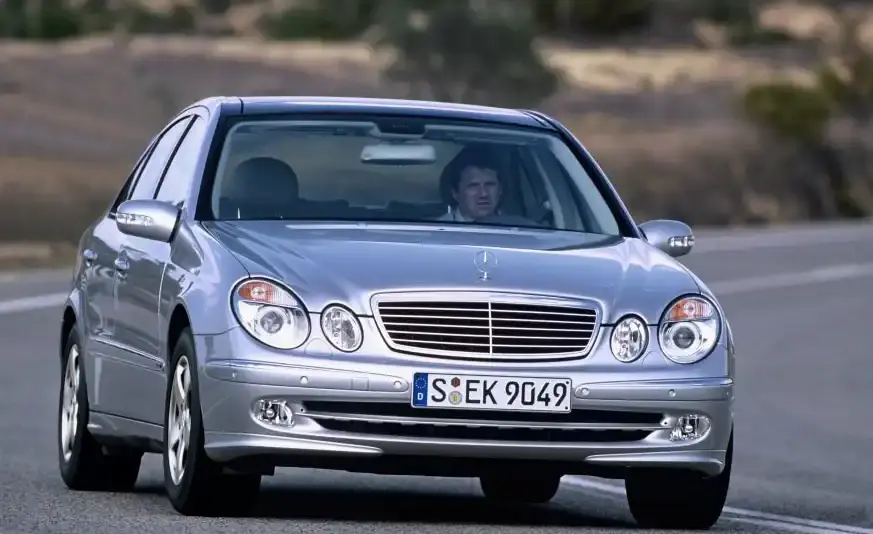
The Mercedes-Benz E 280 CDI, produced between 2005 and 2006, represented a compelling blend of performance and efficiency within the W211 E-Class range. Positioned as a mid-range offering, it catered to buyers seeking the refinement of a six-cylinder engine with the fuel economy benefits of a modern common-rail diesel. This variant was primarily aimed at the European market, where diesel engines held a significant market share, offering a sophisticated alternative to gasoline-powered E-Class models. The E 280 CDI slotted between the entry-level E 200 CDI and the more powerful E 320 CDI, providing a balance of power and running costs.
Technical Specifications
| Brand | Mercedes-Benz |
| Model | E-class |
| Generation | E-class (W211) |
| Type (Engine) | E 280 CDI V6 (190 Hp) |
| Start of production | 2005 |
| End of production | 2006 |
| Powertrain Architecture | Internal Combustion engine |
| Body type | Sedan |
| Seats | 5 |
| Doors | 4 |
| Fuel consumption (urban) | 9.5 l/100 km (24.8 US mpg) |
| Fuel consumption (extra urban) | 5.4 l/100 km (43.6 US mpg) |
| Fuel consumption (combined) | 6.9 l/100 km (34.1 US mpg) |
| Fuel Type | Diesel |
| Acceleration 0 – 100 km/h | 8.6 sec |
| Acceleration 0 – 62 mph | 8.6 sec |
| Acceleration 0 – 60 mph | 8.2 sec |
| Maximum speed | 241 km/h (149.75 mph) |
| Emission standard | Euro 4 |
| Weight-to-power ratio | 8.7 kg/Hp |
| Weight-to-torque ratio | 4.1 kg/Nm |
| Power | 190 Hp @ 4000 rpm |
| Torque | 400 Nm @ 1400 rpm (295.02 lb.-ft. @ 1400 rpm) |
| Engine layout | Front, Longitudinal |
| Engine Model/Code | OM 642.920 |
| Engine displacement | 2987 cm3 (182.28 cu. in.) |
| Number of cylinders | 6 |
| Engine configuration | V-engine |
| Cylinder Bore | 83 mm (3.27 in.) |
| Piston Stroke | 92 mm (3.62 in.) |
| Compression ratio | 18:1 |
| Number of valves per cylinder | 4 |
| Fuel injection system | Diesel Commonrail |
| Engine aspiration | Turbocharger, Intercooler |
| Engine oil capacity | 8.5 l (8.98 US qt | 7.48 UK qt) |
| Coolant | 13 l (13.74 US qt | 11.44 UK qt) |
| Kerb Weight | 1659 kg (3657.47 lbs.) |
| Max. weight | 2220 kg (4894.26 lbs.) |
| Max load | 561 kg (1236.79 lbs.) |
| Trunk (boot) space – minimum | 540 l (19.07 cu. ft.) |
| Fuel tank capacity | 65 l (17.17 US gal | 14.3 UK gal) |
| Permitted trailer load with brakes (12%) | 1900 kg (4188.78 lbs.) |
| Permitted trailer load without brakes | 750 kg (1653.47 lbs.) |
| Length | 4818 mm (189.69 in.) |
| Width | 1822 mm (71.73 in.) |
| Height | 1452 mm (57.17 in.) |
| Wheelbase | 2854 mm (112.36 in.) |
| Front track | 1577 mm (62.09 in.) |
| Rear (Back) track | 1570 mm (61.81 in.) |
| Drag coefficient (Cd) | 0.28 |
| Minimum turning circle (turning diameter) | 11.4 m (37.4 ft.) |
| Drivetrain Architecture | Rear wheel drive |
| Drive wheel | Rear wheel drive |
| Number of gears and type of gearbox | 6 gears, manual transmission |
| Front suspension | Double wishbone |
| Rear suspension | Independent multi-link spring suspension with stabilizer |
| Front brakes | Ventilated discs |
| Rear brakes | Disc |
| Assisting systems | ABS (Anti-lock braking system) |
| Steering type | Steering rack and pinion |
| Power steering | Hydraulic Steering |
| Tires size | 225/55 R16 |
| Wheel rims size | 16 |
Powertrain & Engine Architecture
The heart of the E 280 CDI is the OM 642.920, a 3.0-liter V6 diesel engine. This engine represented a significant advancement in Mercedes-Benz’s diesel technology, featuring common-rail direct injection and a variable geometry turbocharger. The common-rail system, operating at extremely high pressures, allowed for precise fuel metering and optimized combustion, resulting in improved efficiency and reduced emissions. The V6 configuration provided inherent smoothness compared to inline engines, a key characteristic valued in the luxury segment. The engine produced 190 horsepower at 4000 rpm and a substantial 400 Nm (295 lb-ft) of torque from as low as 1400 rpm. This broad torque curve was a defining feature, providing strong acceleration in everyday driving situations. The six-speed manual transmission was standard, offering precise shifts and allowing drivers to fully utilize the engine’s power. While an automatic transmission was available as an option, the manual was favored by enthusiasts for its responsiveness.
Driving Characteristics
The E 280 CDI with the manual transmission offered a surprisingly engaging driving experience. The abundant low-end torque meant that the engine rarely felt strained, even when fully loaded or tackling inclines. The six-speed gearbox was well-matched to the engine’s characteristics, with relatively short ratios for quick acceleration and a tall sixth gear for relaxed highway cruising. Compared to the higher-output E 320 CDI, the E 280 CDI felt less urgent in its acceleration, but it offered a more balanced and fuel-efficient driving experience. The manual transmission also provided a greater sense of control and driver involvement. The suspension, typical of Mercedes-Benz, prioritized comfort and refinement, absorbing bumps and imperfections in the road with ease.
Equipment & Trim Levels
The E 280 CDI typically came well-equipped, reflecting its position in the Mercedes-Benz lineup. Standard features included automatic climate control, power windows and mirrors, a multi-function steering wheel, and a high-quality audio system. Upholstery was typically a combination of cloth and leatherette, with full leather options available as an upgrade. Optional extras included a sunroof, navigation system, premium sound system, and parking sensors. The interior design was characterized by its understated elegance and high-quality materials, creating a comfortable and refined cabin environment.
Chassis & Braking
The W211 E-Class featured a robust chassis with a double wishbone front suspension and an independent multi-link rear suspension. This setup provided a good balance of ride comfort and handling precision. The E 280 CDI was equipped with ventilated disc brakes at the front and solid discs at the rear. Anti-lock braking system (ABS) was standard, enhancing safety and stability during hard braking. The steering was a hydraulic power-assisted rack and pinion system, providing precise and responsive steering feel.
Market Reception & Comparison
The E 280 CDI was generally well-received by automotive critics. It was praised for its fuel efficiency, smooth engine, and comfortable ride. However, some critics noted that the performance was not as exhilarating as that of the E 320 CDI or the gasoline-powered E 320. Compared to the E 200 CDI, the E 280 CDI offered a significant power upgrade, making it a more capable all-around vehicle. In terms of reliability, the OM 642 engine proved to be generally robust, although regular maintenance was essential to prevent issues with the fuel injection system and turbocharger.
Legacy
The Mercedes-Benz E 280 CDI (W211) remains a popular choice in the used car market, particularly for those seeking a comfortable, refined, and fuel-efficient luxury sedan. The OM 642 engine is known for its longevity, but potential buyers should be aware of the need for regular maintenance and potential issues with the diesel particulate filter (DPF) and glow plugs. The E 280 CDI represents a sweet spot in the W211 range, offering a good balance of performance, economy, and reliability, making it a compelling option for discerning buyers.